

Dark circles, puffiness, fine lines: what your under-eyes are telling you
Three different signals, often mistaken for one. What your under-eyes are telling you, and what actually helps.

Three different signals, often mistaken for one. Dark circles are usually shadow, from thin skin, tiredness or inherited pigment. Puffiness is fluid and mild inflammation, at its worst in the morning. Fine lines are structure giving way over the years. Because all three occupy the same small area, a single cream rarely settles them at once. The under-eye area is also the concern men name ahead of dryness, breakouts or oil.
The skin beneath the eye is the thinnest on the body, with few oil glands and little to hold it up, and it is in near-constant motion. That combination makes it the first place fatigue, dehydration and age become visible, and the reason it responds to a step of its own rather than whatever moisturiser is already on the shelf.
What Dark Circles Actually Are
Dermatologists sort under-eye darkness by cause: pigmented, from excess melanin; vascular, from the vessels showing through; structural, from the shadow of the tear trough; or some combination of the three1. In men the through-line is usually the skin itself. It is thin and faintly translucent, so the vessels beneath read as a bluish cast on the surface3. Short sleep and low hydration make those vessels more obvious, and for many there is an inherited pigment element on top.
- Pigmented Excess melanin in the skin itself, frequently inherited. Pigment sits deeper in the skin, so it is the slowest of the three to shift.
- Vascular Thin, translucent skin lets the blood vessels beneath read as a bluish shadow3. Hydration and improved circulation soften it fastest.
- Structural The tear trough casts a shadow, unrelated to colour. Light-reflecting formulas lift it on contact.
Why Do Men Get Puffy Under-Eyes?
Puffiness is fluid gathering and low-grade inflammation, which is why it peaks in the morning and eases as the day goes on. It rarely has a single cause. The under-eye is a multifactorial area, with skin, underlying structure and blood vessels all playing a part2. Salt, a late drink, poor sleep and a flat pillow all push it the wrong way. Ingredients that support the vessels and calm inflammation, marine bioactives and wild ginger among them, work on the cause rather than masking it.
The under-eye area does not need a routine of its own. It needs one dedicated step, used consistently.
Are Fine Lines Around the Eyes Preventable?
Up to a point. They come from collagen and moisture receding, hurried along by squinting, sun and dry air. Time is non-negotiable, but skin that is well hydrated and well supported creases far less than skin that is neither. Here more than anywhere, consistency tells: the eye area responds to a daily habit and shows neglect faster than the rest of the face.
Does Sleep Really Affect Dark Circles?
It does. In a controlled study, faces after a poor night were judged to have more swollen eyes, darker circles and paler, more tired-looking skin4. Everyday habits also track with how common and how pronounced under-eye pigment is to begin with5. So sleep, water and less salt genuinely move things, though none of them will rewrite thin skin or fixed pigment on their own.
What Actually Helps, and How Quickly?
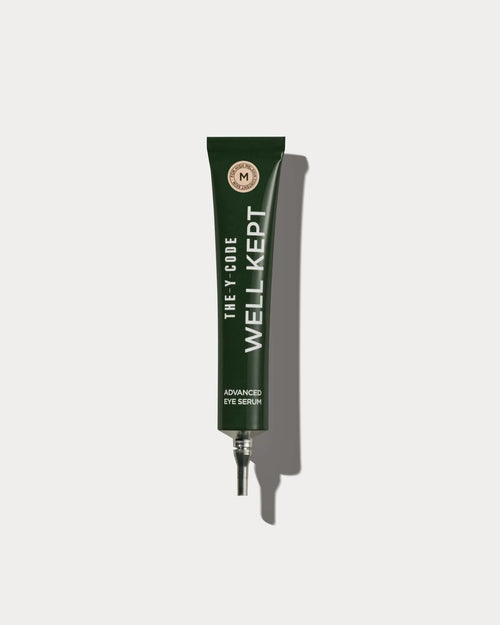
A dedicated eye serum works on three fronts at once: it hydrates fine skin, softens the look of shadow from the first use, and over the weeks its actives address the vessels and structure behind puffiness and lines. In the YCODE eye serum, light-reflecting minerals lift the shadow straight away while marine bioactives and wild ginger do the slower structural work. Hydration alone measurably reduces the look of under-eye shadow: in an independent 4-week consumer trial of the YCODE Hydrating Serum (panel of 50 men), 80 per cent agreed that dark shadows around the eyes had reduced. Expect brighter, less puffy eyes early on, with the deeper change building across the first month. One product, morning and night, is enough.
Do men need a separate eye product?
How quickly do eye serums work?
Is puffiness the same as dark circles?
Can lifestyle sort it without skincare?
- Sarkar R, et al. Periorbital Hyperpigmentation: A Comprehensive Review. Journal of Clinical and Aesthetic Dermatology, 2016. PubMed 26962392
- Vrcek I, et al. Infraorbital Dark Circles: A Review of the Pathogenesis, Evaluation and Treatment. Journal of Cutaneous and Aesthetic Surgery, 2016. PubMed 27398005
- Roh MR, et al. Infraorbital dark circles: definition, causes, and treatment options. Dermatologic Surgery, 2009. PubMed 19469797
- Holding BC, et al. The effect of sleep deprivation on objective and subjective measures of facial appearance. Journal of Sleep Research, 2019. PubMed 31006920
- Sheth PB, et al. Periorbital hyperpigmentation: a study of its prevalence, common causative factors and its association with personal habits and other disorders. Indian Journal of Dermatology, 2014. PMC3969674

I started YCODE because most skincare was never designed for men’s skin. What I write here is what the formulators taught me, and what the trials actually found.

Continue reading
VIEW ALL →
Stress and poor sleep have a way of becoming visible. The eyes look heavier....

Your skin can notice the change of season before you reach for a coat....

Three formulas focus on the major concerns men tend to see across the face...












































































