

How to manage oily skin and shine for men
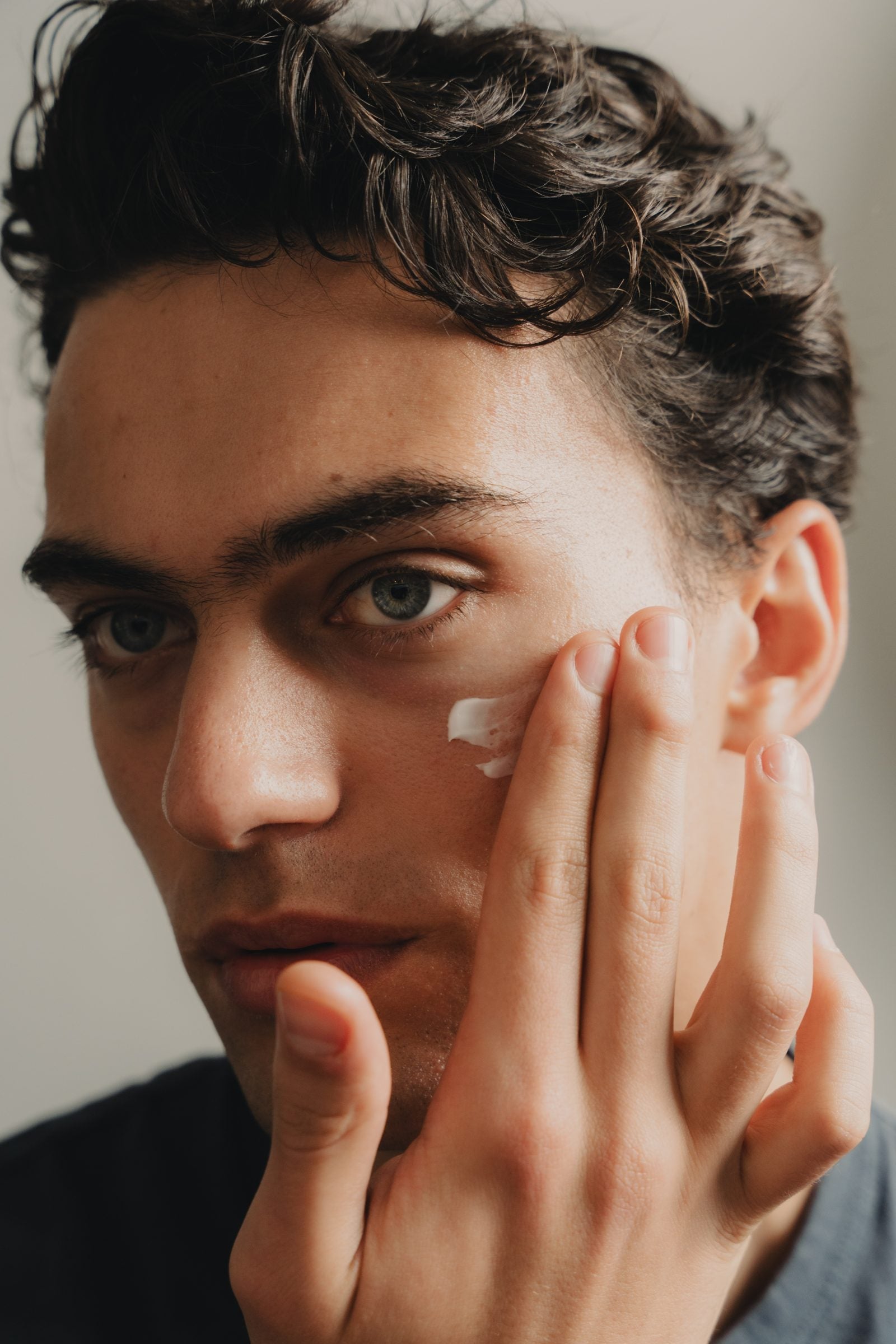
The short answer is that men's skin is oilier for a reason, and shine is controlled by working with that biology rather than against it. Male skin produces more sebum than female skin, and that output stays high for decades 3. You will not switch it off. What you can do is understand what drives it, stop the habits that make it worse, and use a moisturiser that balances oil to a matte finish rather than one that strips the skin and provokes more. This piece is about the why. If you want the step-by-step, that lives in our simple routine for oily skin.
YCODE Mattifying Moisturiser, independent consumer trial, 53 men, four weeks.
Why is men's skin oilier than women's?
Because of hormones, and the numbers are not subtle. In a controlled study of 300 people, sebum production in male skin was consistently higher than in female skin, and it stayed stable with age while women's declined over a lifetime 3. That is the crux of it. A man in his forties is often producing at close to the same rate he did at twenty five.
The driver is androgens, chiefly testosterone and its more potent relative dihydrotestosterone. Sebaceous glands are exquisitely sensitive to these hormones, and they even carry the enzyme, 5-alpha-reductase, that converts testosterone into the stronger DHT locally within the gland 2. More androgen signalling means larger, busier glands and more oil. This is not a flaw in your skin. It is your skin doing exactly what male physiology tells it to.
So when you look in the mirror at midday and see a shining T-zone, you are not failing at skincare. You are looking at biology that a face wash was never going to rewrite.
What actually controls how much oil your skin makes?
Sebum output is set mostly upstream, at the gland, by that hormonal signal 2. Oily skin, clinically called seborrhoea, is simply what happens when enlarged sebaceous glands produce sebum in excess, giving skin its shiny, greasy look 1. Diet, age, ethnicity and a hot, humid climate all nudge the dial, but the baseline is hormonal and largely fixed 1.
That matters for expectations. A topical product cannot lower your androgen levels, and it should not try to. What a good product can do is influence the surface, reduce the sebaceous glands' apparent activity at the skin, and change how oil sits and reflects light. The goal is control and balance, not eradication. Skin with zero oil is not the aim, and it is not achievable without prescription intervention.
There is also a point people miss. Sebum is not the enemy. It is part of the skin's water barrier, and its job is to keep moisture in 1. Strip it all away and the barrier suffers, which is precisely where the common oily-skin mistake begins.
Why does over-drying make oily skin worse?
This is the trap most men fall into. Shine feels like a cleanliness problem, so the instinct is to scrub harder, wash more often and reach for anything that leaves the face feeling tight and squeaky. Tight and squeaky feels like progress. It is not.
Sebum forms part of the barrier that limits water loss through the skin 1. When you repeatedly strip that layer with harsh foaming washes, high-strength alcohol toners or aggressive exfoliation, you compromise the barrier. Skin that is both oily and barrier-disrupted is a common and frustrating state, where a greasy surface sits over skin that actually feels tight and dehydrated underneath. You end up chasing oil all day and never getting ahead of it.
The fix is counterintuitive but consistent. Clean gently, do not over-wash, and put a well-formulated moisturiser back on afterwards. Hydrated, intact skin behaves better than skin you have scoured. The men who complain their skin is oiliest are very often the ones treating it most harshly.
What is the difference between mattifying and stripping?
They look similar for an hour and then diverge completely. Stripping removes oil and lipids aggressively, gives you a brief matte window, and tends to leave the barrier worse off, which is why the shine returns with interest by lunchtime. Mattifying manages how oil presents on the surface while leaving the skin's protective function intact.
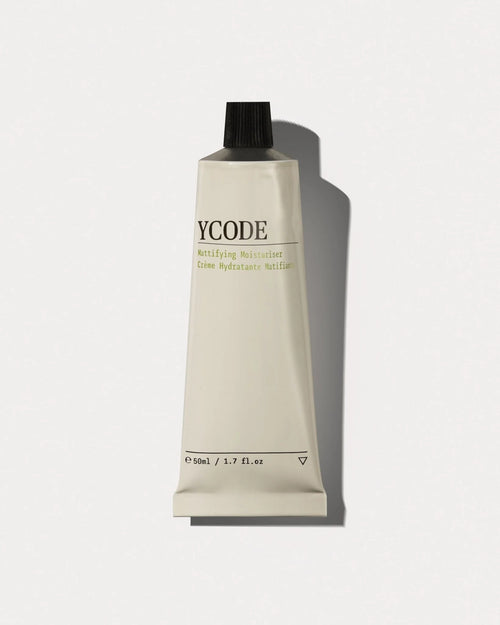
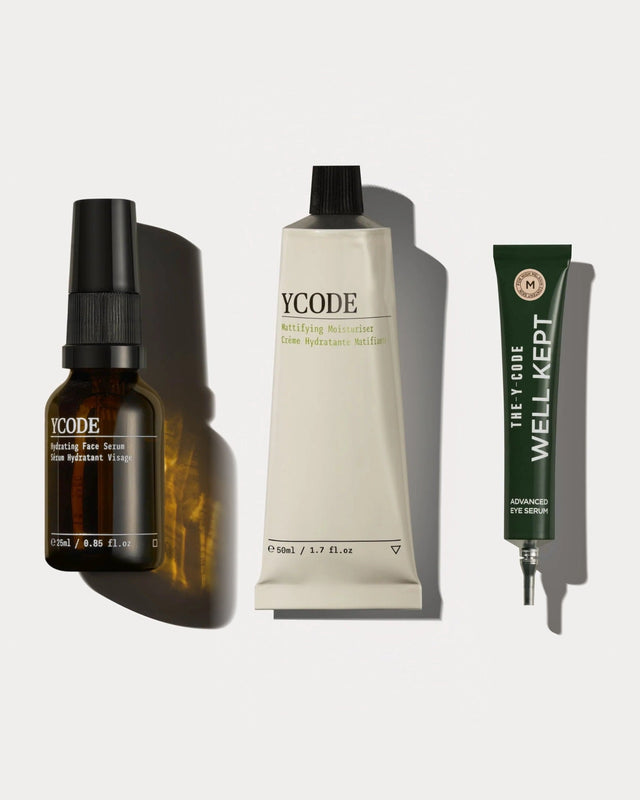
A mattifying moisturiser is not trying to bankrupt your skin of oil. It absorbs excess surface sebum, softens shine and holds hydration, so skin looks balanced rather than either greasy or parched. Our Mattifying Moisturiser is built to do exactly that, balancing oil to a matte finish while keeping the barrier supported. It is the difference between managing a resource and burning it, and over weeks the managed approach wins because it never triggers the rebound that stripping does.
The tell is how your skin feels thirty minutes after. Stripped skin feels tight. Mattified skin feels comfortable and looks less shiny. Aim for the second.
Stripping oil is the most common way to end up with more of it. Oily skin responds to regulation, not removal.
Which ingredients actually control shine?
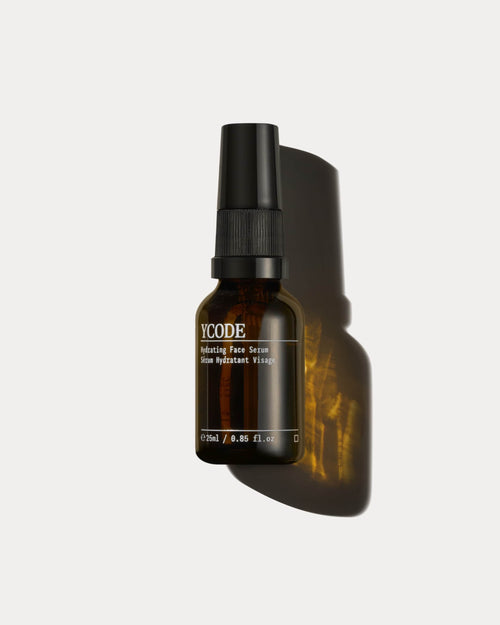
A small number have real evidence behind them, and niacinamide leads the list. In a double-blind, placebo-controlled trial, 2% topical niacinamide significantly reduced sebum excretion rate over four weeks 4. The effect is measurable rather than miraculous, which is the honest way to describe good skincare. It reduces oil at the surface, supports the barrier and helps skin look less shiny without the strip-and-rebound cycle. Niacinamide sits high on the ingredient list of our Hydrating Face Serum, so if shine is your main concern, that is the step in the routine carrying this particular evidence.
Beyond that, look for lightweight, non-occlusive hydration so you can moisturise without adding grease, and formulas designed to sit matte rather than dewy. Our Mattifying Moisturiser does the surface work with rice starch (Oryza sativa), a natural absorbent that soaks up excess sebum and softens shine, alongside lightweight hyaluronic acid for grease-free hydration and microalgae (Chlorella vulgaris) for barrier support. In an independent four-week consumer trial across 53 men, 74% said skin looked more balanced and less shiny, 72% said excess oil was controlled and 72% said skin felt mattified but not dry.
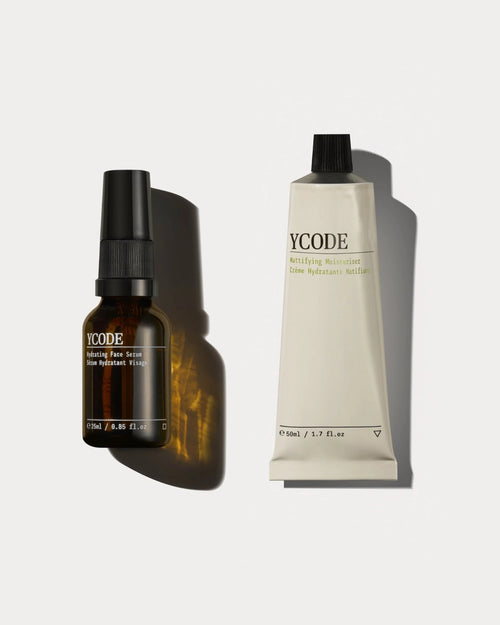
Used together, the two products work at different levels, which is why the pairing beats any single step. The face serum's niacinamide acts on how much oil the skin presents, and the moisturiser's rice starch absorbs what is already there and holds the matte finish.
If you are not sure where your skin sits or which products fit it, our two-minute skin quiz will point you to the right routine.
There is a part of this that has nothing to do with sebaceous glands. Catching your reflection at midday and seeing a shine you did not ask for is a small, nagging thing, and small nagging things stack up across a day. When your skin looks balanced and feels comfortable, you stop noticing it, and that is the point. You walk into the meeting, the introduction, the photograph, without a corner of your attention snagged on your own face. Looking well and feeling well are not separate things; one quietly feeds the other. Sort it out early rather than fighting it for years, and over time it is not only your skin that is in better shape.
The takeaway
Oily skin in men is hormonal, largely fixed at the gland, and not a hygiene failure 23. You cannot switch it off, and trying to strip it away only damages the barrier and provokes more 1. The winning approach is understanding: clean gently, keep the barrier intact, and use a moisturiser that mattifies and balances rather than one that strips. Control the shine, do not wage war on the oil.
Ready to manage shine properly? Try the Mattifying Moisturiser, built to balance oil to a matte finish, or take the two-minute skin quiz to find what fits your skin.
Why is my face still oily even though I wash it constantly?
Does moisturiser make oily skin worse?
Can I stop my skin producing so much oil?
Why is men's skin oilier than women's?
Is oily skin actually a bad thing?
- Sakuma TH, Maibach HI. Oily skin: an overview. Skin Pharmacol Physiol. 2012;25(5):227-235. PubMed
- Szöllősi AG, Oláh A, Bíró T, Tóth BI. Recent advances in the endocrinology of the sebaceous gland. Dermatoendocrinol. 2017;9(1):e1361576. PMC
- Luebberding S, Krueger N, Kerscher M. Skin physiology in men and women: in vivo evaluation of 300 people including TEWL, SC hydration, sebum content and skin surface pH. Int J Cosmet Sci. 2013;35(5):477-483. PubMed
- Draelos ZD, Matsubara A, Smiles K. The effect of 2% niacinamide on facial sebum production. J Cosmet Laser Ther. 2006;8(2):96-101. PubMed

I started YCODE because most skincare was never designed for men’s skin. What I write here is what the formulators taught me, and what the trials actually found.
Continue reading
VIEW ALL →
Your skin can notice the change of season before you reach for a coat....
Three formulas focus on the major concerns men tend to see across the face...
The Daily Essentials improves the face and neck. Advanced Eye Serum adds concentrated support...












































































