

What Makes Skin Look Healthy?
Healthy-looking skin is shaped by hydration, surface texture, oil, tone and the eye area. Here is how each changes the light across your face.
Quick answer
Healthy-looking skin reflects light softly and evenly. Hydration keeps the outer surface smoother, controlling excess oil prevents concentrated glare, an even tone reduces visible contrast and the area around the eyes influences whether the whole face looks rested. Good skincare cannot change every cause, but it can improve several of the conditions that determine how fresh your skin appears.
Key takeaways
- Hydration changes the outer surface of the skin and the way light moves through it.
- A natural, healthy-looking reflection and oily shine are different patterns of light.
- Completely matte skin can look dull because healthy skin still reflects light.
- Even tone strongly influences how healthy male facial skin appears.
- Dark circles, puffiness and dehydration lines can all make the eye area look tired, but skincare can improve their visible appearance in different ways.
Healthy-looking skin begins with the way it reflects light
Skin looks healthy when its texture, colour and reflection create an even visual impression. We see the result before we consciously identify the individual features behind it.
Light striking the face can reflect directly from the surface, scatter across its microscopic texture, be absorbed by pigments such as melanin and haemoglobin or pass into deeper layers before returning. A review in the Journal of Biomedical Optics describes human skin as an optically complex material rather than a simple coloured surface.
This explains why two faces with similar lines can look very different. Small variations in water, oil, surface texture and colour distribution change the way light returns to the eye. Together, those changes are read as smoothness, freshness, health, age or tiredness.
Research on male facial skin supports the importance of evenness. In a study using cheek images from 160 British men, 308 observers judged skin with more even distributions of melanin and haemoglobin as younger, healthier and more attractive. The effect did not depend on seeing the whole face. The skin itself carried enough information.
Hydration changes more than how skin feels
Hydration changes the optical properties of the outermost layer of the skin, which is why well-hydrated skin can look smoother as well as feel more comfortable.
The stratum corneum is the thin outer layer made from flattened skin cells held together by lipids. Water continually moves through it and escapes into the air, a process called transepidermal water loss. When the barrier retains less water, its cells become less flexible and its microscopic surface becomes less orderly.
A clinical study of skin moisturisation found that dehydration increased surface scattering, while increased hydration allowed more light to enter the skin and increased translucency. In plain English, a dry, rough outer layer interrupts the light at the surface. A better-hydrated one allows the face to look smoother and less opaque.
Hydration is not the same as oil. Skin can produce plenty of sebum and still be short of water. This distinction matters particularly for men because a study of 300 adults found male skin produced more sebum across every age group measured, while male skin hydration progressively declined from around the age of 40.

That is why simply stripping away oil can leave the face both shiny and uncomfortable. The oil is visible on top, while the shortage of water exists within the outer skin. Each needs to be addressed in a different way.
Healthy reflection, oily shine and matte skin are not the same thing
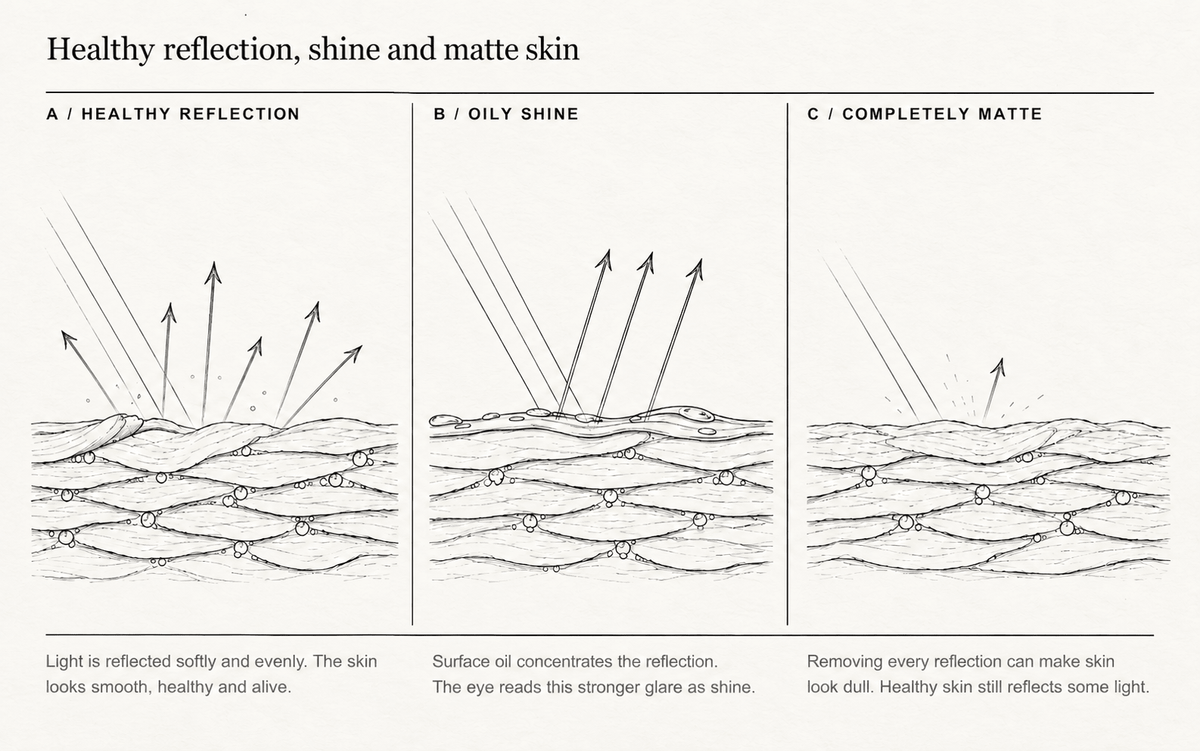
A natural, healthy-looking finish reflects light softly across the face. Oily shine creates stronger, more concentrated reflections from surface oil. Completely matte skin reflects very little light and can therefore look dull.
Researchers have tested this distinction. In two experiments involving 160 participants, they compared faces with soft, even reflection, concentrated oily shine and a matte finish. The softly reflective faces were rated more positively and appeared younger than the oily-looking or matte versions. Matte faces received the lowest ratings for healthy-looking reflection and several other positive impressions.
The study used female faces, so it should not be treated as a direct trial of male skin. It still demonstrates an important optical principle: removing all reflection is not the same as creating healthy-looking skin.
This is why an effective mattifying product should control concentrated shine without trying to erase every natural highlight. Cheekbones, the forehead and the bridge of the nose are three-dimensional surfaces. Some reflection helps the eye read their shape and gives the skin a living quality.

Surface texture also matters at a scale too small to see directly. A 2025 study found that microscopic texture on skin ridges influenced light diffusion and correlated strongly with ratings of softness and what the researchers called radiance. The reported correlation was 0.80 in magnitude for both qualities. The study involved Chinese women, so its population was limited, but it helps explain why skin can look smoother and fresher even when no single pore or line has dramatically changed.
Even tone affects how healthy a face appears
Even tone affects perceived health because patches of pigment and redness create contrast across the face. The eye is highly sensitive to these variations.
Skin colour comes partly from melanin and haemoglobin. Melanin contributes brown pigment, while haemoglobin contributes red tones from blood under the skin. Their amount matters, but their distribution matters too.
In the study of 160 British men, more even melanin distribution was more strongly associated with younger-looking skin. More even haemoglobin distribution was more strongly associated with health and attractiveness. This is useful because it separates “even tone” from the mistaken idea that healthy skin must be lighter or darker. The relevant quality is consistency across an individual's own skin.
Tone can be influenced by pigmentation, irritation, old blemishes and visible blood vessels. Skincare may help with some of these causes over time, but it cannot make every form of discolouration disappear. Persistent or changing patches should be assessed by a qualified medical professional rather than covered by increasingly complicated routines.
How the eye area can look fresher
The eye area changes the whole face because darkness, puffiness and fine dehydration lines create noticeable contrast around the feature people naturally look at first.
Dark circles can look softer when there is less visible contrast under the eye. Light-reflecting minerals can create an immediate optical effect, while targeted active ingredients can support further improvement through continued use.
Puffiness changes the contour under the eye and creates a darker edge below it. Reducing its visible appearance makes that contour look smoother. Hydration works differently again, helping fine dehydration lines look softer and allowing the thin skin around the eyes to reflect light more evenly.
Skincare can improve three of the signs that make the eye area look tired: visible dark circles, puffiness and fine dehydration lines. Bone structure and lost volume require different approaches and are outside the scope of this routine.


Which quality are you actually seeing?
The quickest way to understand your skin is to separate the visible sign from its likely cause.
| What you see | What may be happening | A simple check | What may help |
|---|---|---|---|
| Fine lines look stronger later in the day | The outer skin may be losing water | Compare the same area after washing and later in the day | Water-binding ingredients and support for the skin barrier |
| Bright glare through the forehead and nose | Surface sebum is concentrating reflected light | Blot once with clean tissue and see whether the glare reduces | Immediate oil absorption plus longer-term support for excess oil |
| Skin looks dull despite having little shine | The surface may be rough or completely mattified | Look in soft natural light rather than directly under a bathroom spotlight | Hydration and a finish that preserves some natural reflection |
| Visible darkness under the eyes | Colour and contrast are making the eye area look tired | Compare the area in soft natural light rather than directly under a spotlight | Light-reflecting minerals for an immediate optical effect and targeted actives through continued use |
| Puffiness under the eyes | Raised tissue is creating a darker edge below it | Look straight ahead in even light and compare the contour under each eye | Targeted actives that help reduce the appearance of under-eye bags |
| Fine lines under the eyes | The thin outer skin may be short of water | Notice whether the lines become more visible later in the day | Hydrating ingredients that help the surface look smoother |
| Patches of redness or uneven colour | Irritation, blemishes or visible vessels may be creating contrast | Notice whether the area also feels hot, sore or itchy | Gentle care and medical advice for persistent or symptomatic changes |
What skincare can realistically change
Skincare can improve hydration, surface smoothness, visible shine and some forms of uneven tone, but it cannot change every structural feature that affects appearance.
| Approach | What it can address | How quickly it can look different | Important limit |
|---|---|---|---|
| Humectants such as glycerin and hyaluronic acid | Water in the outer skin and the appearance of dehydration lines | Often from the first application | The effect depends on continued use and an effective barrier |
| Moisturising and barrier-supporting ingredients | Water retention, comfort and surface flexibility | Immediate comfort, with further improvement through regular use | They do not stop the skin producing oil |
| Absorbent powders such as rice starch | Oil already visible on the surface | From the first application | They manage existing shine rather than its underlying production |
| Niacinamide | Barrier support, uneven tone and excess oil | Builds through consistent use | It is not an instant mattifier |
| Light-reflecting minerals and targeted eye-area actives | The visible appearance of dark circles, puffiness and dehydration lines | Some optical effects can be immediate, while active support takes longer | They improve appearance rather than changing underlying facial structure |
| In-clinic procedures | Structural hollows, pronounced bags or persistent pigmentation, depending on the procedure | Varies by procedure | Requires individual assessment, cost and an appropriately qualified practitioner |
How YCODE applies the science
YCODE uses three focused formulas because hydration, surface oil and the eye area affect appearance in different ways. YCODE is a London-formulated men's skincare brand that combines marine microalgae research with selected actives in a two-minute daily routine.
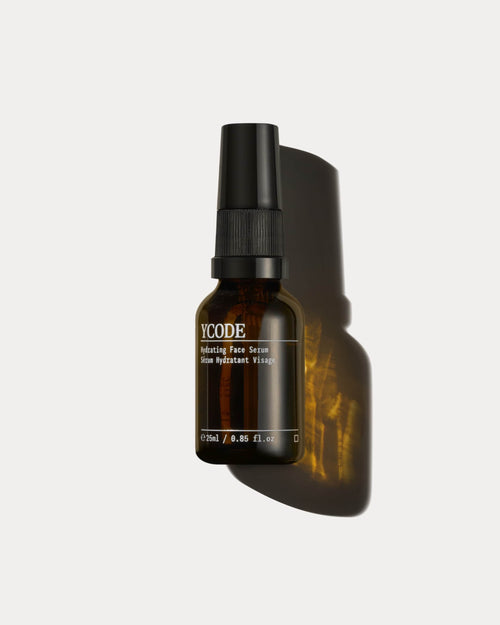
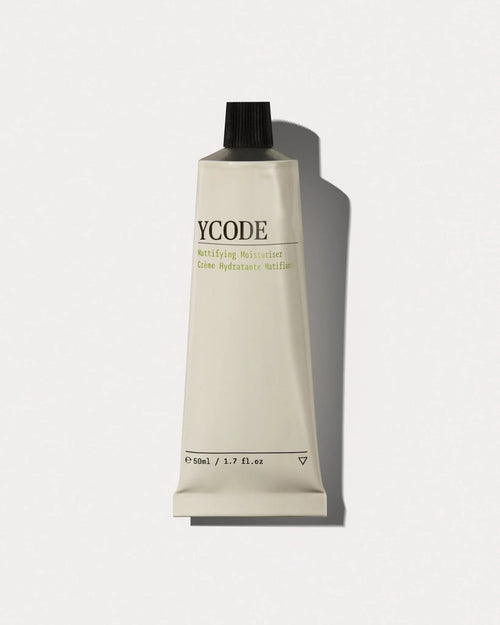
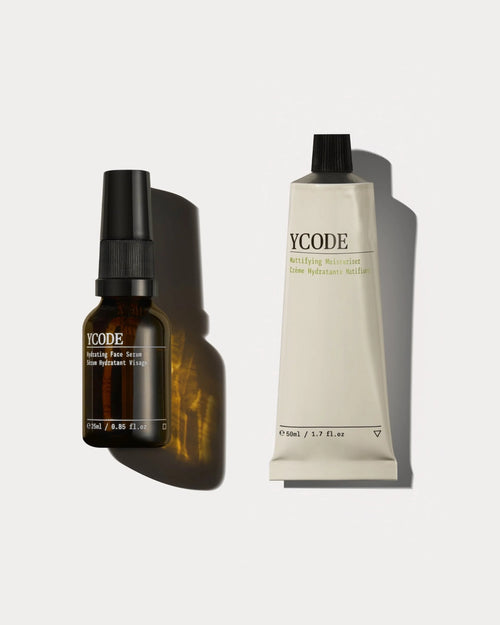
Hydrating Face Serum uses water-binding ingredients and selected actives to support hydration, tone, texture and the skin barrier. Mattifying Moisturiser helps retain that hydration while rice starch controls the surface shine you can see. The aim is an even, natural finish rather than a face with every reflection removed.
YCODE Advanced Eye Serum focuses on the thinner skin around the eyes. It combines light-reflecting minerals with marine algae, panthenol, beetroot extract, marine minerals and a supercritical CO₂ wild ginger extract.
The wild ginger evidence comes from an independent self-assessment of the ingredient extract carried out by Eurofins Dermscan. The trial included 111 volunteers with dark circles and/or puffiness, with a mean age of 42. At 15 days, 94% said they looked less tired, 90% reported visibly reduced dark circles and 89% reported reduced under-eye bags. Placebo showed no significant difference. These figures relate to the ingredient extract rather than the finished product, and the outcomes were self-assessed.
The practical point is simpler than the chemistry. No single product controls every quality that makes skin look healthy. Water, oil, surface texture, tone and the contour around the eyes all contribute to what you see.
Soft CTA: See the full trial data on The Evidence, or explore the Advanced Routine.
A straightforward routine for healthy-looking skin
The most useful routine addresses water, retention, shine and the eye area in the correct order.
- Apply Hydrating Face Serum to slightly damp skin across the face and neck.
- Follow with Mattifying Moisturiser to help retain hydration and control visible shine.
- Apply Advanced Eye Serum last, using a rice-grain amount across both eye areas.
- Use the routine morning and night. Consistency matters more than adding extra steps.
When to seek medical advice
Sudden swelling, pain, marked redness, changes to vision or a persistent one-sided change around an eye should be assessed by a medical professional. The same applies to any new or changing pigmented lesion on the face. Skincare is designed to support appearance and comfort, not diagnose or treat an underlying condition.
Frequently asked questions
Why does my skin look good in the morning but tired later?
Your skin gradually loses water while oil accumulates on the surface. Dehydration can make texture and fine lines more visible, while concentrated shine changes the way light reflects from the centre of the face. Tiredness may also become more noticeable around the eyes as puffiness and shadow interact with the lighting later in the day.
Does hydrated skin look younger?
Hydration can make the outer skin look smoother, more flexible and more translucent, which softens the appearance of fine dehydration lines. It does not remove established wrinkles or reverse structural ageing. The visible benefit comes from improving the condition and optical properties of the outer surface rather than changing your biological age.
Is shiny skin the same as healthy-looking skin?
No. Healthy-looking skin has a soft, even pattern of reflection. Oily shine is usually stronger and more concentrated, especially through the forehead, nose and central cheeks. Completely matte skin can also look dull. The aim is controlled reflection, not the removal of every natural highlight.
Why can oily skin still feel tight?
Oil and water are different. Sebum sits on the surface, while hydration describes water held within the outer skin. You can therefore produce plenty of oil while your skin barrier retains too little water. A useful routine hydrates the skin and manages excess surface oil rather than treating them as the same problem.
What makes men's skin different?
Research generally finds that male skin produces more sebum and has different patterns of hydration and pH. A study of 300 adults found male sebum production remained higher across all measured ages, while hydration declined progressively from around 40. These are group averages, so your own skin still matters more than a category.
Why does the eye area make my whole face look tired?
Dark circles create contrast at the centre of the face, while puffiness adds shadow and fine dehydration lines make the surface look less smooth. Because people naturally look at the eyes first, small improvements there can change how rested the whole face appears. Skincare can reduce their appearance, although it cannot alter every underlying structural cause.
Can skincare make my face look healthier?
Skincare can improve several visual cues associated with healthy-looking skin, including hydration, surface smoothness, visible shine and some uneven tone. It cannot change bone structure, replace lost volume or permanently remove deep hollows. A short, consistent routine is more useful than expecting one formula to alter every feature of the face.
Sources
- Lister T, Wright PA, Chappell PH. Optical properties of human skin. Journal of Biomedical Optics. 2012.
- Jiang ZX et al. Appearance benefits of skin moisturization. Skin Research and Technology. 2011.
- Luebberding S, Krueger N, Kerscher M. Skin physiology in men and women. International Journal of Cosmetic Science. 2013.
- Fink B et al. Colour homogeneity and visual perception of age, health and attractiveness of male facial skin. Journal of the European Academy of Dermatology and Venereology. 2012.
- Ikeda H et al. Facial radiance influences facial attractiveness and affective impressions of faces. International Journal of Cosmetic Science. 2021.
- Subvisible microscale texture study. Subvisible microscale texture is present on the crista cutis of the skin and interacts with incident light. International Journal of Cosmetic Science. 2025.
- Sarkar R et al. Periorbital Hyperpigmentation: A Comprehensive Review. Journal of Clinical and Aesthetic Dermatology. 2016.
- YCODE. The Evidence.
Related reading
- Why are eyes puffy in the morning?
- How much eye serum should you use?
- Why does eye serum sting?
- YCODE Advanced Eye Serum
- Find your Advanced Eye Serum formula

I started YCODE because most skincare was never designed for men’s skin. What I write here is what the formulators taught me, and what the trials actually found.
Continue reading
VIEW ALL →
Tiredness is not one line, shadow or colour. It is a pattern the eye...

One of the first things you notice about a product is its colour. Long...

When you stand beside the sea, it is usually the scale that gets your...


