

Skincare order: does serum go before or after moisturiser?
Serum first, moisturiser second. If you’re using the complete YCODE routine, Advanced Eye Serum is the final targeted step. Here’s why the order matters, without making skincare more complicated than it needs to be.

There are enough rules around skincare already. Most men do not need another one.
But if you use more than one product, knowing what goes where does matter. Not because there is one universal law that every skincare product must follow, but because different formulas are built to do different jobs.
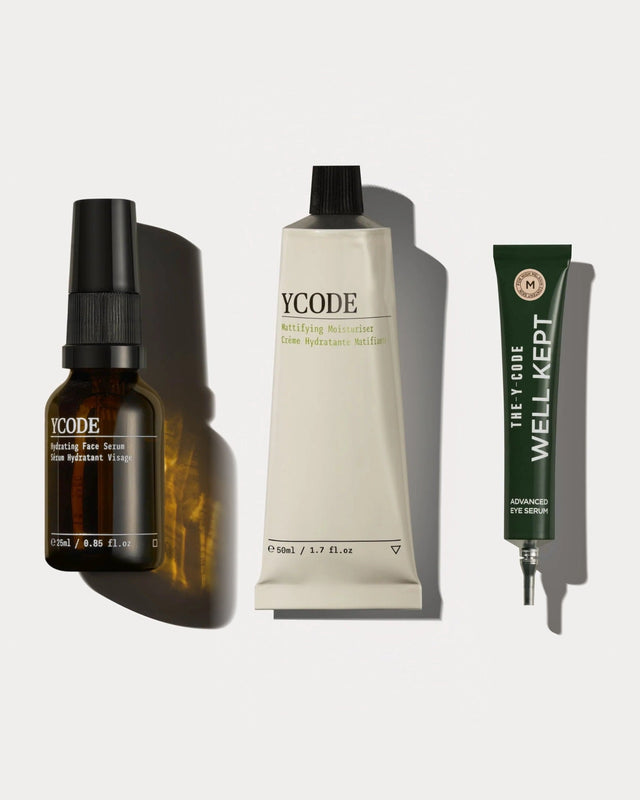
For the YCODE Advanced Routine, the order is simple:
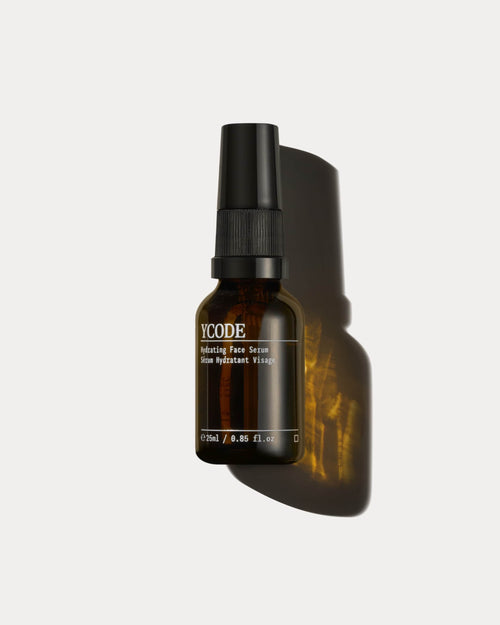
1. Hydrating Face Serum
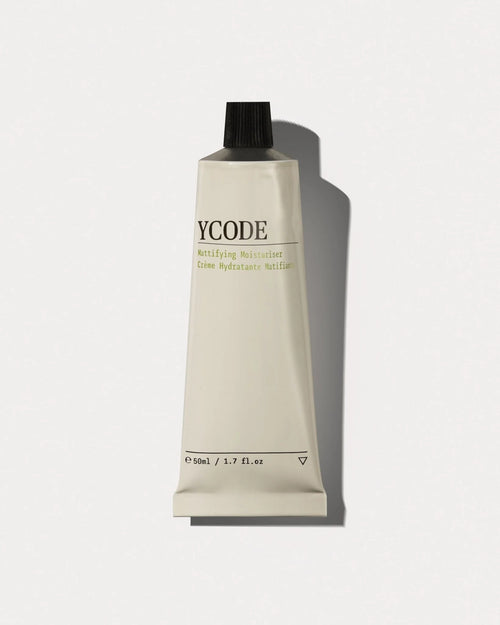
2. Mattifying Moisturiser
3. Advanced Eye Serum
Morning and night. About two minutes.
Why the face serum comes first
Men’s facial skin tends to be thicker than women’s, which is one of the biological differences we considered when developing YCODE.
The Hydrating Face Serum is a lightweight, water-based formula designed to deliver concentrated ingredients directly to clean skin. Many of the ingredients carried within a serum are much smaller than the structures that make up a moisturising emulsion, allowing the formula to work within the skin rather than primarily sitting at its surface.
Our Hydrating Face Serum contains niacinamide, hyaluronic acid, prebiotics, a biomimetic peptide and Chlorella vulgaris extract. Together, they support hydration, texture, tone and the skin barrier.
That is why the serum goes first. You want that lightweight formula in direct contact with clean skin before applying the richer layer that follows.
Give it around 30–60 seconds to settle, then apply your moisturiser.
Why the moisturiser comes next
The Mattifying Moisturiser is designed to do a different job.
Rather than trying to deliver exactly the same ingredients in a different texture, it works primarily at and around the skin barrier, helping retain hydration while improving the condition and appearance of the skin's surface.
It combines humectants with emollient ingredients, Chlorella vulgaris extract and peptides, while rice starch helps absorb excess surface oil to give skin a natural matte finish without making it feel dry.
So there is a logic to the sequence that goes beyond simply applying products from “thinnest to thickest”:
The serum works first. The moisturiser supports and protects what follows at the surface.
Then the Advanced Eye Serum is applied as the final targeted step around the eye area, addressing the appearance of dark circles, puffiness and fine lines.
So where does the Advanced Eye Serum go?
Last.
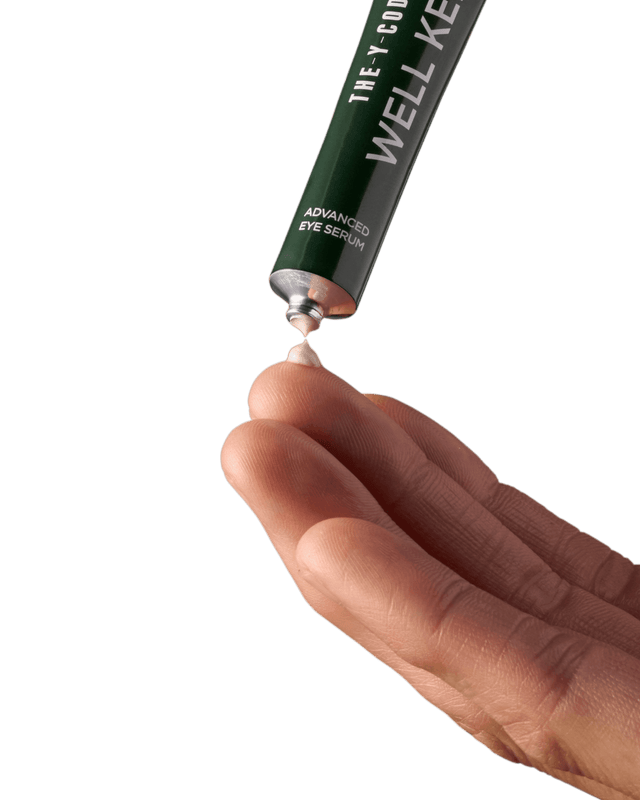
The Advanced Eye Serum is not simply another face serum in a smaller tube. It is a targeted formula developed specifically for the eye area and for concerns including dark circles, puffiness and fine lines.
Use a very small amount around the eyes after you have applied the Hydrating Face Serum and Mattifying Moisturiser.
That makes the complete sequence:
Cleanse → Hydrating Face Serum → Mattifying Moisturiser → Advanced Eye Serum
The Advanced Eye Serum is the final targeted step.
Do you need to wait between products?
Not for long.
Give the Hydrating Face Serum around 30–60 seconds to settle before applying the Mattifying Moisturiser. Then apply the Advanced Eye Serum once the rest of your routine has settled.
The aim is simply to avoid rubbing several wet formulas together at once.
If the previous product has absorbed and your skin no longer feels wet, you are ready for the next one.
Does the order really make a difference?
There is an important distinction here.
We have good formulation and skin-barrier reasons for applying a lightweight face serum before a moisturiser. But there is not a clinical trial proving that one universal skincare sequence is superior to every other possible sequence.
And skincare products are not interchangeable simply because they share a name.
“Serum”, for example, describes an enormous range of formulas. An eye serum can have a completely different purpose and formulation from a hydrating face serum.
That is why we would rather tell you how these particular products were designed to be used than give you a supposedly universal rule such as “always apply products from thinnest to thickest”.
The formula and its purpose matter more than a slogan.
What happens if you get the order wrong?
Nothing catastrophic.
Skincare should not be something you can fail at.
If you have occasionally put your moisturiser on before your face serum, or used your Advanced Eye Serum earlier in your routine, you have not wasted the products.
Just use the intended sequence going forward.
Consistency matters far more than perfection.
A man who follows a simple routine morning and night is likely to get considerably more from his skincare than someone with ten products who remembers to use them twice a week.
How this works with the Advanced Routine
The three products were designed to have distinct roles.
Hydrating Face Serum
The first step. Lightweight hydration and concentrated ingredients including niacinamide, hyaluronic acid, prebiotics, peptide and microalgae to support tone, texture and the skin barrier.
Mattifying Moisturiser
The second step. Supports hydration and the skin barrier while helping control excess surface shine and refine the appearance of skin.
Advanced Eye Serum
The final targeted step. Developed specifically for the eye area to address the appearance of dark circles, puffiness and fine lines.
Three products. Three jobs. One straightforward sequence.
What if I only use the Face Serum and Moisturiser?
The same principle applies.
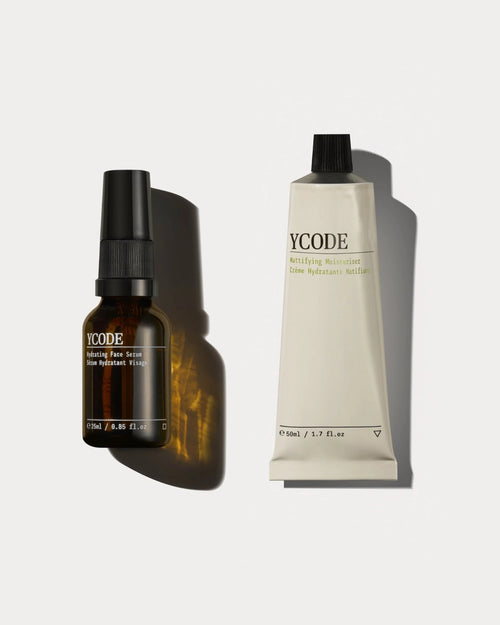
Hydrating Face Serum first. Mattifying Moisturiser second.
They were also independently assessed together as a two-product regime, used in that order morning and evening for four weeks.
90% said their skin felt deeply hydrated.
90% said their skin stayed moisturised all day.
88% said their moisture barrier felt stronger.
Independent consumer self-assessment, 50 men, four weeks, ADSL 2025-0162.
You do not need the Advanced Eye Serum for the other two products to work. Each product has its own job and can be used independently.
The Advanced Routine simply brings all three together for men who want a more complete approach.
Does serum go before or after moisturiser?
Where does Advanced Eye Serum go?
How long should I wait between serum and moisturiser?
Does the order change at night?
Hydrating Face Serum → Mattifying Moisturiser → Advanced Eye Serum.
What matters most?
Doing it.
There is useful science behind formulation, skin-barrier function and why products are designed to be applied in a particular way. But skincare stops being useful when the instructions become so complicated that nobody follows them.
Cleanse. Serum. Moisturise. Eyes.
Morning and night.
Then get on with your day.

I started YCODE because most skincare was never designed for men’s skin. What I write here is what the formulators taught me, and what the trials actually found.
Continue reading
VIEW ALL →
Your skin can notice the change of season before you reach for a coat....
Three formulas focus on the major concerns men tend to see across the face...
The Daily Essentials improves the face and neck. Advanced Eye Serum adds concentrated support...












































































