

The best ingredients for dark circles: caffeine, vitamin C and peptides

The best-evidenced ingredients for dark circles are caffeine, vitamin C and peptides, with niacinamide and retinal close behind. Caffeine constricts the blood vessels that give a bluish cast and helps drain fluid. Vitamin C targets the brown of pigment and adds brightness. Peptides work slowly on the collagen that props up thin under-eye skin. None of them is a cure for every case, because dark circles have three different causes and each one answers to a different active. That is the list everyone reaches for, and it is a sound starting point. It is also where most eye care stops. We went further, and this guide covers both the standard answer and the one we think is better.
Advanced Eye Serum, ingredient study, 111 people, 15 days. These are figures for the actives the serum is built on, not a consumer trial of the finished product.
That last point is the one most guides skip. Under-eye darkness is usually sorted into vascular, pigmented and structural types, and plenty of people carry a mix of all three.1 Vascular circles read blue or purple because blood vessels sit close to the surface under thin skin. Pigmented circles read brown because there is excess melanin in the area. Structural circles are shadow: hollows and contours that catch the light regardless of what colour the skin is. Match the ingredient to the cause and you give yourself a fair chance. Reach for the wrong one and you will wonder why nothing moved.
Here is what each ingredient actually does, and where it stops.
Does caffeine help dark circles?
Caffeine is the front runner for vascular circles and puffiness. Applied topically it acts as a vasoconstrictor, narrowing the small blood vessels near the surface, and it carries antioxidant and anti-inflammatory activity alongside that.2 When the blue-purple cast comes from pooling blood and dilated vessels, tightening those vessels can lift the shadow and take some of the morning puffiness with it.
The honest limit is duration. Caffeine works while it is on the skin and for a few hours after, so it flatters rather than rewrites. It does nothing for brown pigment, and it cannot fill a structural hollow. Think of it as the fast, visible layer of an eye routine, not the foundation.
Can vitamin C fade dark circles?
Vitamin C is the pick for the pigmented type. As an antioxidant and a tyrosinase inhibitor, it interrupts the enzyme step in melanin production, and a systematic review of topical vitamin C in melasma and photoageing found significant lightening of pigmented skin on objective measurement.3 For under-eye circles driven by melanin, that is the mechanism you want, and the brightening effect is a useful bonus on tired-looking skin generally.
Two caveats. The same review noted that patient self-assessment did not always match the instrument readings, so expect gradual rather than dramatic change. And vitamin C asks for patience and consistency over weeks. It is a slow brightener, not a switch.
Do peptides work on dark circles?
Peptides are the long game, and they matter most when thin skin is part of the problem. Signal peptides such as palmitoyl derivatives prompt fibroblasts to make more collagen and other matrix proteins, and a clinical evaluation of a palmitoyl-peptide formulation recorded measurable improvements in skin density and firmness on ageing skin.4 Denser, better-supported skin under the eye makes surface vessels less obvious and shadows less sharp.
The catch is time. Collagen change is measured over weeks and months, not days, so peptides reward the people who keep going. They will not neutralise brown pigment on their own, and they cannot rebuild the deep fat pads that create true structural hollows. What they can do is quietly improve the canvas everything else sits on.
What about niacinamide and retinal?
Two more actives earn a place. Niacinamide works on pigment from a different angle to vitamin C: rather than blocking melanin formation, it reduces the transfer of pigment-carrying melanosomes into skin cells, and a controlled trial found it significantly cut facial hyperpigmentation.5 It also supports the skin barrier, which suits the delicate under-eye area.
Retinal, a retinoid, thickens skin and encourages collagen over the long term, which helps the structural and vascular pictures. It is potent, so it belongs in low concentrations and careful use around the eye. Neither is a quick fix. Both build on the same principle as everything above: work with the cause, give it time.
Caffeine flatters, vitamin C fades, peptides rebuild. None of them fills a hollow. Matching the active to the cause is what separates a routine that works from one that just feels busy.
How YCODE approaches dark circles across the routine
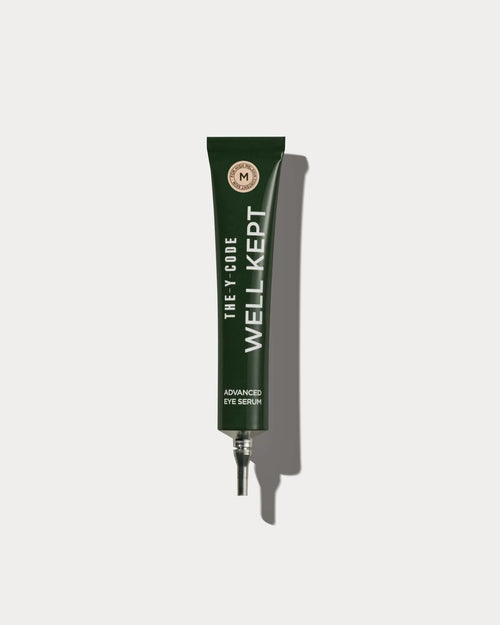
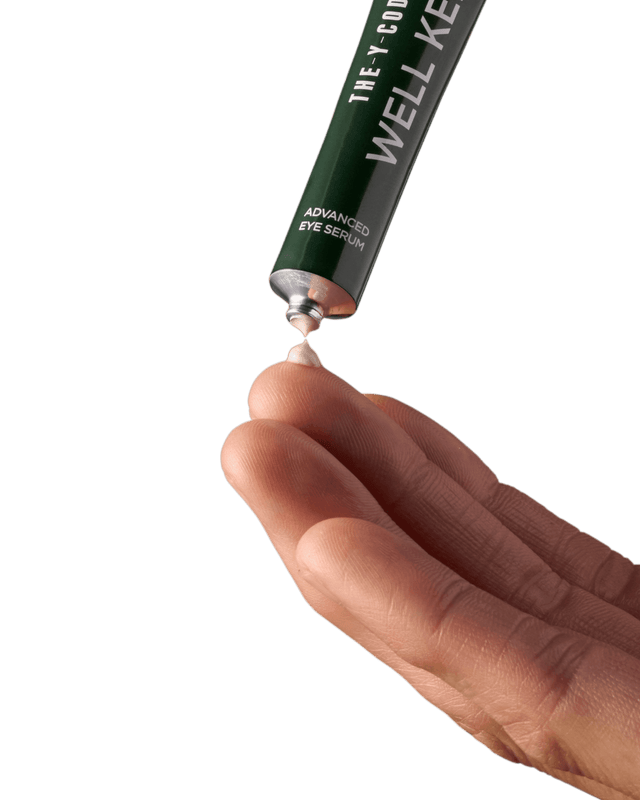
We built the range around these mechanisms rather than a single hero claim, and we made a deliberate choice at the under-eye. Instead of caffeine, the obvious pick, the Advanced Eye Serum uses CO₂-extracted wild ginger. Caffeine only tackles the vascular, blue-toned circles; wild ginger carries ingredient data on both the vascular cause and the brown pigment, so one active covers what caffeine and vitamin C do separately. That is why we chose it. Around it sit marine bioactives, mineral-rich algae and the melanin-adaptive minerals. The serum comes in three formulas, M, M+ and M-, each developed for the different requirements of a different skin tone, so it works with your skin rather than sitting on it. We do not use vitamin C at the eye; the wild ginger and marine antioxidants do the pigment and defence work in a gentler way for such thin skin.
In the 111-person, 15-day ingredient study behind these actives, 90% saw dark circles reduced and 73% saw instant brightening. Those are ingredient-study figures rather than a trial of the finished serum, and they describe a change in appearance, not a promise to erase every circle. If your darkness is mostly structural shadow, be honest with yourself about what a topical can and cannot reach.
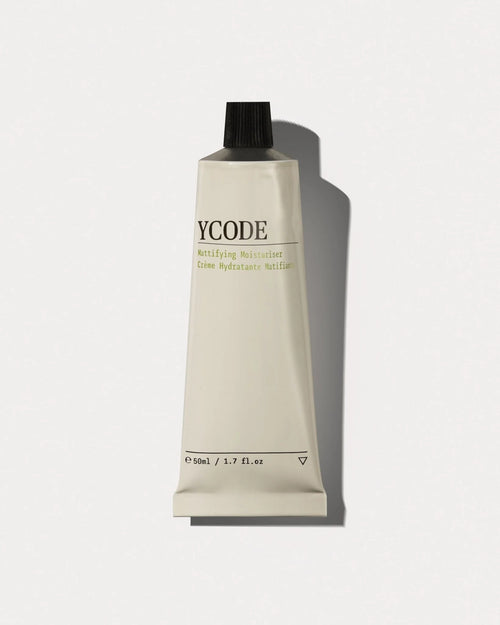
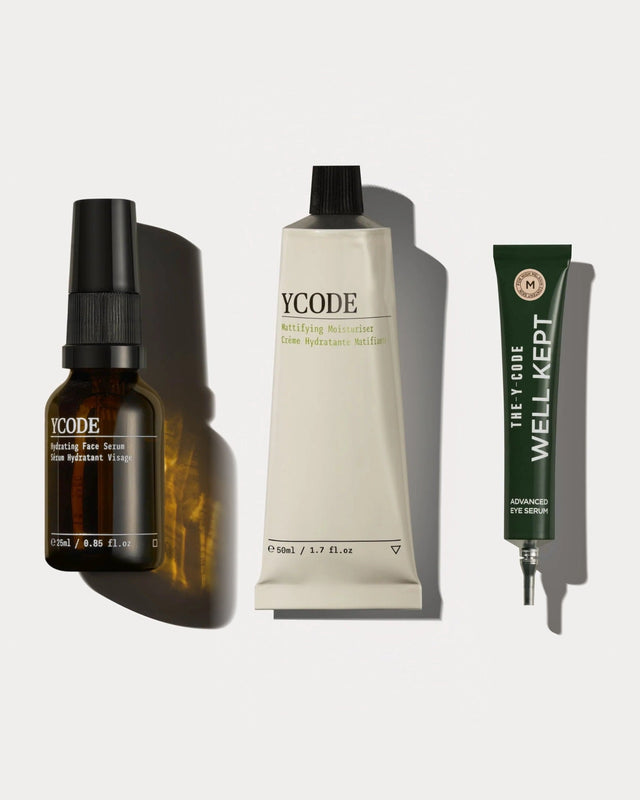
Peptides, the third ingredient above, sit elsewhere in the routine on purpose. The Hydrating Face Serum carries a soothing peptide alongside niacinamide for pigment, and in its consumer trial 80% of men said the dark shadows around their eyes had reduced. The Mattifying Moisturiser carries a collagen-supporting peptide, with 72% seeing fine lines and wrinkles reduced. This is the point of building each product with a different active set: the eye serum does the direct under-eye work, the serum and moisturiser strengthen the skin around it, and using them together reaches the vascular, pigmented and structural causes at once, which no single product can.
Not sure which type you are dealing with. Our two-minute quiz, find what works, walks you through it and points you to the right formula.
The short version
Caffeine for vascular circles and puffiness, fast but temporary. Vitamin C and niacinamide for brown pigment, slow and steady. Peptides and retinal for the structural support underneath, slowest of all. Most people need a combination, applied consistently, and a realistic view of which cause they are actually treating.
Ready to start. Shop the Advanced Eye Serum or take the quiz to match your under-eye type to the right routine.
Which ingredient is best for dark circles?
How long before eye-care ingredients show results?
Can any cream fix structural dark circles?
Is caffeine or vitamin C better for tired-looking eyes?
Does the Advanced Eye Serum come in different formulas?
- Huang YL, Chang SL, Ma L, Lee MC, Hu S. Clinical analysis and classification of dark eye circle. Int J Dermatol. 2014;53(2):164-170. PubMed
- Herman A, Herman AP. Caffeine's mechanisms of action and its cosmetic use. Skin Pharmacol Physiol. 2013;26(1):8-14. PubMed
- Correia G, Magina S. Efficacy of topical vitamin C in melasma and photoaging: A systematic review. J Cosmet Dermatol. 2023;22(7):1938-1945. PubMed
- Hahn HJ, Jung HJ, Schrammek-Drusios MC, et al. Instrumental evaluation of anti-aging effects of cosmetic formulations containing palmitoyl peptides, Silybum marianum seed oil, vitamin E and other functional ingredients on aged human skin. Exp Ther Med. 2016;12(2):1171-1176. PMC
- Hakozaki T, Minwalla L, Zhuang J, et al. The effect of niacinamide on reducing cutaneous pigmentation and suppression of melanosome transfer. Br J Dermatol. 2002;147(1):20-31. PubMed

I started YCODE because most skincare was never designed for men’s skin. What I write here is what the formulators taught me, and what the trials actually found.

Continue reading
VIEW ALL →
Your skin can notice the change of season before you reach for a coat....
Three formulas focus on the major concerns men tend to see across the face...
The Daily Essentials improves the face and neck. Advanced Eye Serum adds concentrated support...












































































