

Best Moisturiser for Dry Skin: A Man's Guide to Lasting Hydration

Dry skin is one of the most common concerns in men's skincare, and one of the most badly handled. A man notices tightness, flaking, or a rough patch along the jaw, reaches for the heaviest cream on the shelf, applies it once, and waits for something to change. It rarely does. The best moisturiser for dry skin is not the thickest one. It is the one that works with the skin's own biology, replacing what shaving, weather, and daily washing quietly strip out.
This guide sets out what actually causes dry skin in men, which ingredients have the evidence behind them, and why a two-step routine tends to deliver what a single product cannot.
Why does men's skin dry out differently?
Men's skin is biologically distinct. It is generally thicker, produces more sebum, and takes daily mechanical stress from shaving. That combination produces a specific and often misread problem: skin can look oily or normal at the surface while it loses moisture rapidly underneath.
Shaving disrupts the barrier with every pass. It removes not only hair but a fine layer of skin cells, weakening the structure that keeps water locked in. Add cold air, central heating, and frequent face washing, and the barrier breaks down faster than it can rebuild. The measure dermatologists use for this leak is transepidermal water loss, the water that evaporates straight out through a compromised barrier.1
The upshot is dryness that does not always look like dryness. Tightness after washing, rough patches that will not settle, and skin that turns reactive after a shave are all signs of a barrier under strain rather than a simple shortage of cream.
Which ingredients actually hydrate dry skin?
The best moisturiser for men with dry skin works on three fronts at once: it draws water into the skin, binds it there, and reinforces the barrier that stops it escaping. That humectant, emollient, and occlusive framework is the established basis of how moisturisers repair a dry, disrupted barrier.1 The evidence behind the individual actives is well documented.
- Niacinamide. One of the most thoroughly researched actives in dermatology. Laboratory and clinical work shows that topical niacinamide raises ceramide biosynthesis in the stratum corneum, the outermost layer of skin, and directly reduces transepidermal water loss in dry skin.2 Ceramides are the structural lipids that hold the barrier together, and low ceramide levels track closely with dry, compromised skin. What you notice? Less tightness after washing, and skin that stops feeling like it is pulling.
- Sodium hyaluronate. A refined, smaller-molecule form of hyaluronic acid that sits into the skin surface more readily than its larger counterpart. In a randomised, assessor-blinded study, a single application of a hyaluronic-acid moisturising fluid significantly raised skin hydration and cut transepidermal water loss, an effective humectant hydrating without weakening the barrier.3 What you notice? A plumper, more comfortable surface that holds through the day rather than fading by lunch.
- Saccharide isomerate and prebiotics. Plant-derived hydration that binds to skin proteins and mimics the skin's own natural moisturising factors, alongside prebiotics such as inulin and fructose that feed the beneficial bacteria at the surface without introducing live organisms. A healthy surface community is consistently linked to a more resilient barrier. What you notice? Fewer flare patches and better tolerance in cold weather.
- Collagen-supporting peptides. Actives such as palmitoyl tripeptide-5 take the longer view, supporting the structural matrix so improvements in moisture content, elasticity, and firmness compound over weeks. What you notice? Smoother texture and a firmer look that builds with consistent use.
Why does a two-step routine outperform one cream?
A single moisturiser, however well formulated, has a ceiling. It delivers and it seals in one motion. A serum applied first draws hydration deeper into the epidermis before the moisturiser lays a protective layer above it, and that layering tends to beat any standalone product. It is also how the three mechanisms above are best staged: humectant-led serum underneath, barrier-supporting moisturiser on top.1
The men who saw the biggest change were not using more product. They were using the right two, in the right order, every day.
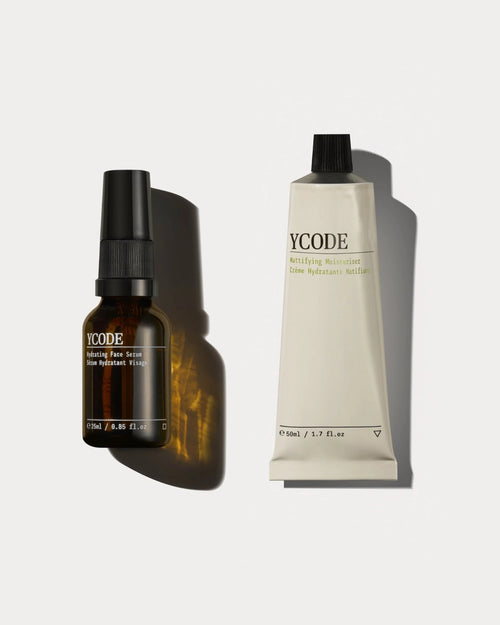
YCODE's Hydrating Face Serum and Mattifying Moisturiser were tested together in a consumer trial of 50 male participants aged 18 to 50, across normal, sensitive, and blemish-prone skin, with even distribution across Fitzpatrick skin tone classifications. Every evaluated claim passed the EU 655/2013 validation threshold at first use and at four weeks.
The results were clear. In the 4-week Mattifying Moisturiser trial (panel of 53 men), 87% said their skin appeared rehydrated, 81% that it absorbs easily without leaving a greasy film and 79% that the moisture barrier of their skin felt strengthened. Used as a two-step regime with the Hydrating Face Serum (panel of 50 men), 90% said their skin stayed moisturised all day. Zero adverse reactions were recorded across all skin types, including sensitive and blemish-prone skin. Participants repeatedly described the two as working better together than either did alone.
Men who had never held consistent results from other products noted the same thing: hydration that stayed stable across the full day, without heaviness. If you are unsure which pairing suits your skin, the two-minute skin quiz is the quickest way to find out.
What does the YCODE two-step dry skin routine look like?
Both products are available individually or as the Moisture Duo, designed as an AM and PM foundational system.
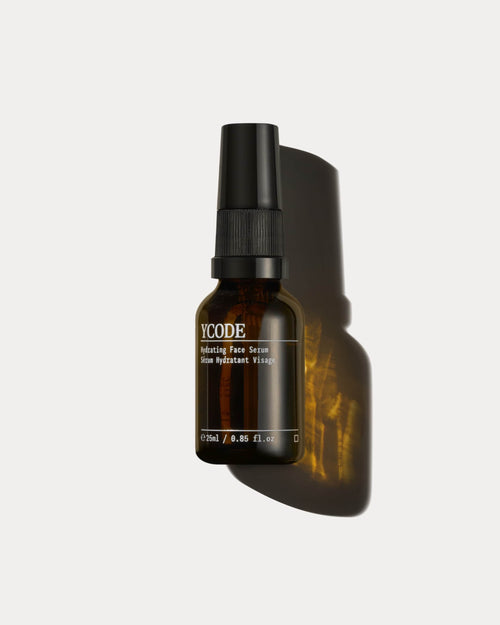
Hydrating Face Serum. Contains chlorella vulgaris extract, a microalgae chosen for its adaptive hydration, alongside niacinamide, sodium hyaluronate, saccharide isomerate, inulin, fructose, and a benzoyl dipeptide complex. Applied first, it primes the skin and delivers concentrated actives before the moisturiser seals them in.
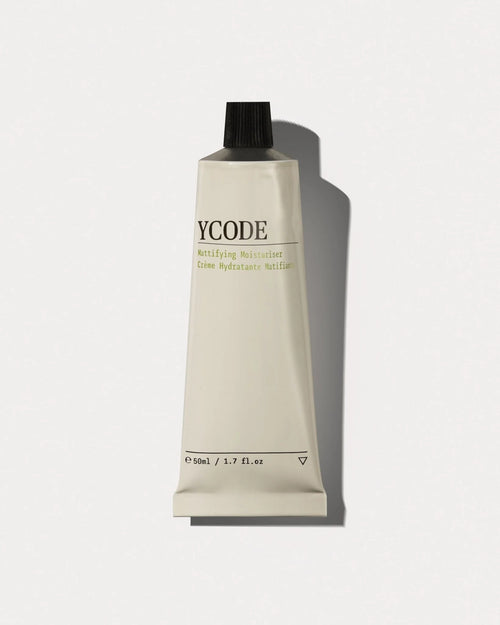
Mattifying Moisturiser. Contains chlorella vulgaris extract, palmitoyl tripeptide-5, niacinamide, sodium hyaluronate, prebiotics, and a rice starch mattifying complex. Applied second, it locks in the hydration from the serum, supports barrier strength over time, and controls surface oil without stripping moisture.
- Morning. Rinse with cool water. Apply one pump of serum to damp skin, pressing across face and neck, and let it absorb fully. Follow with a small amount of moisturiser, massaged in evenly. Results build from week one, with the clearest changes at the two to four week mark.
- Evening. Cleanse gently, avoiding hot water, which accelerates moisture loss. Repeat the serum and moisturiser. Night is when the barrier is most active in repair, so consistency here compounds what you see during the day.
FAQs: moisturiser for dry skin
What is the best moisturiser for dry skin in men?
The best moisturiser for dry skin in men addresses hydration, barrier strength, and surface control together. Look for formulas built around sodium hyaluronate, niacinamide, and barrier-supportive actives. For most men, pairing a hydrating serum with a moisturiser delivers stronger, longer-lasting results than a single product, a pattern supported by clinical consumer trials in male participants.
Should men with dry skin use a serum and a moisturiser?
Yes. A serum delivers concentrated hydration into the deeper layers, while a moisturiser seals it in and reinforces the barrier. Using both consistently outperforms a heavier cream used alone, which can sit on the surface without addressing the underlying moisture loss that drives dryness.
Can men with oily skin also have dry skin?
Yes, and it is one of the most common misconceptions in men's skincare. Skin can produce excess sebum at the surface while losing water beneath it, a state known as dehydrated skin. Niacinamide and barrier-focused hydration suit this pattern well, since they regulate oil behaviour without stripping.
How long does it take to see results from a dry skin moisturiser?
Surface comfort usually improves within the first few applications. Structural gains, including smoother texture, fewer dry patches, and a more resilient barrier, develop over two to four weeks of consistent daily use. YCODE consumer trial data showed continued improvement from week one through to week four, with hydration longevity and tone evenness the most consistent long-term wins.
Dry skin does not need the heaviest cream in the cabinet, it needs the right mechanisms in the right order. Start with the Mattifying Moisturiser and build a two-step routine that holds hydration across the day.
Disclaimer. This article is for informational purposes only and is not intended as medical advice. Individual results may vary with skin type, routine consistency, and product use. Consumer trial results were obtained from a 50-participant male panel under controlled conditions.
References
- Purnamawati S, Indrastuti N, Danarti R, Saefudin T. The role of moisturizers in addressing various kinds of dermatitis: a review. Clin Med Res. 2017;15(3-4):75-87. PMC5849435 (PMID: 29229630).
- Tanno O, Ota Y, Kitamura N, Katsube T, Inoue S. Nicotinamide increases biosynthesis of ceramides as well as other stratum corneum lipids to improve the epidermal permeability barrier. Br J Dermatol. 2000;143(3):524-531. PMID: 10971324.
- Milani M, Sparavigna A. The 24-hour skin hydration and barrier function effects of a hyaluronic 1%, glycerin 5%, and Centella asiatica stem cells extract moisturizing fluid: an intra-subject, randomized, assessor-blinded study. Clin Cosmet Investig Dermatol. 2017;10:311-315. PMID: 28860834 (PMC5560567).

I started YCODE because most skincare was never designed for men’s skin. What I write here is what the formulators taught me, and what the trials actually found.
Continue reading
VIEW ALL →
Stress and poor sleep have a way of becoming visible. The eyes look heavier....

Your skin can notice the change of season before you reach for a coat....
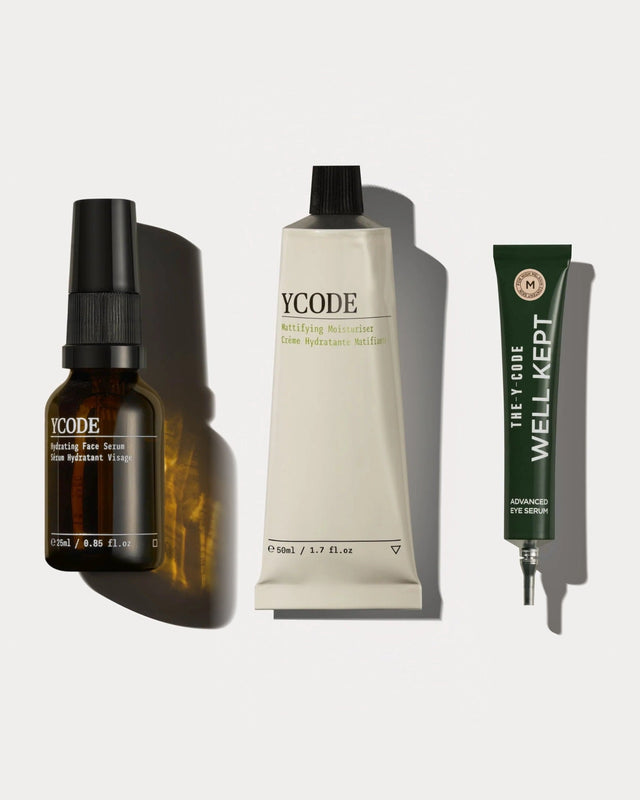
Three formulas focus on the major concerns men tend to see across the face...












































































