

Do You Need a Face Serum If You Already Use a Moisturiser?
A serum puts actives in. A moisturiser keeps them, and the water, where you put them. Here is when one is enough and when the second bottle earns its place.
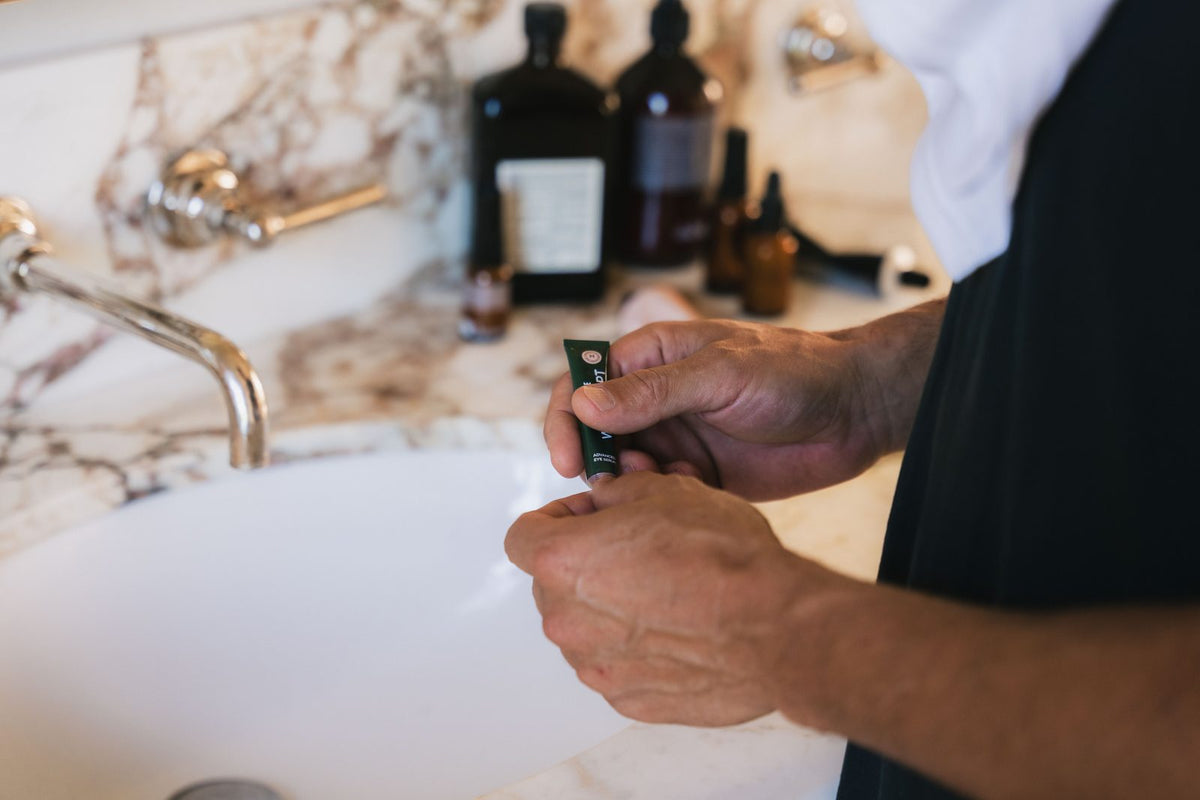
It is a fair question, and it deserves a straight answer rather than a sales one. You already own a moisturiser. It is a cream, it hydrates, you put it on and your face feels fine. Someone has now told you that you also need a serum, which is a smaller bottle of thinner liquid at a similar sort of price, and the obvious suspicion is that this is one product too many.
Sometimes it is. Often it is not. The difference comes down to what each one is physically able to do, and once you see that, the answer for your own face becomes easy to work out.
They are built to do different jobs
A moisturiser is an emulsion, water and oil held together, and its job is to improve and protect the surface. Dermatology describes its ingredients in three roles. Humectants such as glycerin and hyaluronic acid draw water into the upper layers. Occlusives sit on the surface and slow the escape of that water, the process known as transepidermal water loss. Emollients assimilate into the outer layer and improve how it feels and functions 1. Together they keep the barrier stocked and comfortable, and a good one also fortifies the skin's chemical and immunological defences rather than only its physical one 1.
A serum is a delivery vehicle. It is thinner because it carries far less oil and wax, which leaves room for a higher concentration of water-soluble actives and lets them spread and absorb quickly. That thinness is the point. A serum goes on first because there is nothing in the way, and the cream goes on afterwards to hold everything where you put it.
Why the order matters more than the count
Molecule size decides a lot of this. Studying hyaluronic acid of different molecular weights on human skin with Raman spectroscopy, researchers found the smaller fragments reaching further into the outer layers while the largest stayed at the surface, holding water there as a film 2. Both are useful, and they are useful at different depths, which is a neat illustration of why one product rarely does everything.
Humectants also need something above them. Drawing water upward into the epidermis works best when an occlusive layer is there to slow it leaving again 3. Serum then cream is not a ritual invented to sell you a second bottle. It is the sequence that lets each one finish the other's work.
A serum puts actives in. A moisturiser keeps them, and the water, where you put them. Neither replaces the other, and the order is the whole trick.
When one is genuinely enough
If your skin is comfortable all day, looks the way you would like it to at four in the afternoon, and you have no particular concern you are trying to shift, a well-made moisturiser on its own is a perfectly respectable routine. Dermatologists have been telling people to moisturise after cleansing for decades because it is the step that does the most for the least effort 4.
Start there if you are starting anywhere. One product, ten seconds, twice a day.
When a serum earns its place
Add one when there is something specific you want addressed, or when the moisturiser alone is leaving a gap.
Skin that feels tight within an hour of washing usually wants more water rather than more cream. That is what a hydrating serum is for.
Concerns that need an active at a meaningful concentration are the other case. Niacinamide is the clearest example: topical 2% niacinamide has been measured lowering sebum excretion rates after two and four weeks, and it is used across tone and barrier work as well 5. Actives like that belong in a light base where they can be delivered generously, which in practice means a serum.
And if you are over thirty and thinking about how your skin will look in ten years, layering is simply how you fit more useful chemistry into the same two minutes.
How ours are divided
We build each product with a deliberately different active set, so no product duplicates another and the routine compounds.
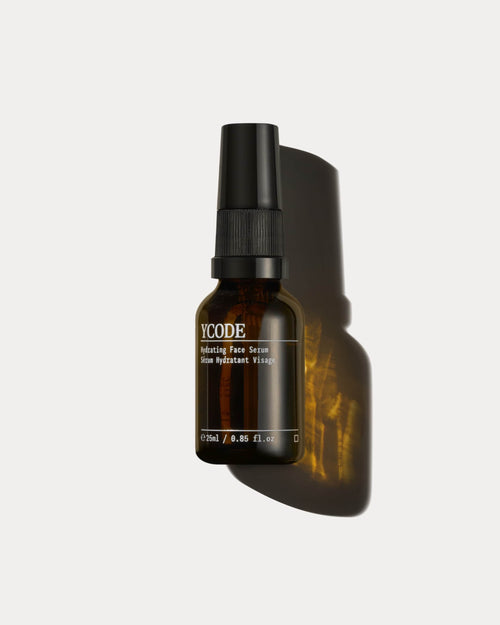
The Hydrating Face Serum carries niacinamide second on the ingredient list, hyaluronic acid, Chlorella vulgaris and a soothing peptide, in a light base that absorbs and leaves nothing behind.
YCODE Hydrating Face Serum, independent consumer trial, 50 men, four weeks.
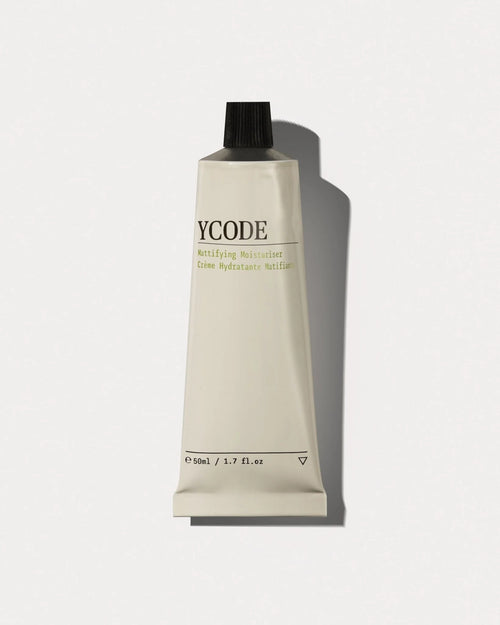
The Mattifying Moisturiser does the other half. It is a moisturiser first: deep hydration that holds all day, formulated for every skin type, with oil balanced and the look of pores refined. Barrier lipids from shea and coconut, glycerin and hyaluronic acid, Chlorella vulgaris and a collagen-supporting peptide, with rice starch giving it a matte finish. More on that in what mattifying actually means.
What the two together were measured doing
The pair was trialled as a regime, serum then cream, which is the only honest way to describe what layering gives you.
YCODE serum and moisturiser together, independent consumer trial, 50 men, four weeks.
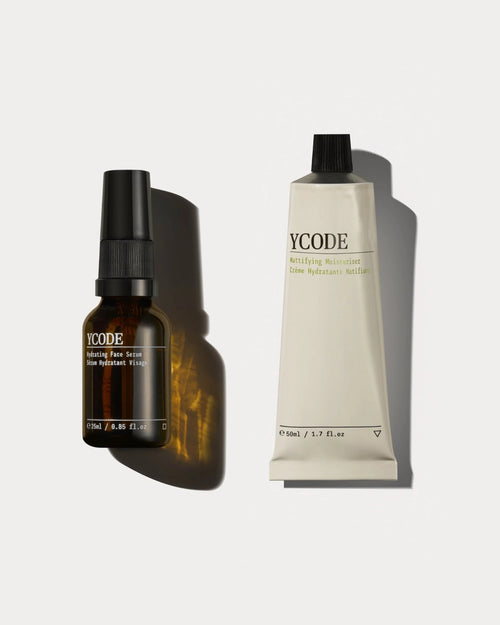
In the same trial, 84% said their skin looked less shiny and more balanced, and after the first use 88% said their skin instantly felt rehydrated using the serum followed by the cream. The two together are sold as Daily Essentials, which is the version of this most men end up on.
The practical answer
Serum first, on clean skin, five to ten seconds. Moisturiser second, over the top, another ten. Morning and night. That is under a minute in total and it is the whole of it.
If you would rather own one thing, own the moisturiser. If you want the routine to do more, the serum underneath is where the additional work happens. Either way, judge it over a fortnight, in daylight, on your own face.
Do I need a serum if I already use a moisturiser?
Which goes on first, serum or moisturiser?
Can a serum replace a moisturiser?
Is it worth using both if I only have two minutes in the morning?
- Rajkumar J, Chandan N, Lio P, Shi V. The Skin Barrier and Moisturization: Function, Disruption, and Mechanisms of Repair. Skin Pharmacology and Physiology, 2023. Source
- Essendoubi M, Gobinet C, et al. Human skin penetration of hyaluronic acid of different molecular weights as probed by Raman spectroscopy. Skin Research and Technology, 2016. Source
- Moisturizers: The Slippery Road. Indian Journal of Dermatology, 2016. Source
- American Academy of Dermatology. How to pick the right moisturizer for your skin. Source
- Draelos ZD, Matsubara A, Smiles K. The effect of 2% niacinamide on facial sebum production. Journal of Cosmetic and Laser Therapy, 2006. Source

I started YCODE because most skincare was never designed for men’s skin. What I write here is what the formulators taught me, and what the trials actually found.
Continue reading
VIEW ALL →
Your skin can notice the change of season before you reach for a coat....
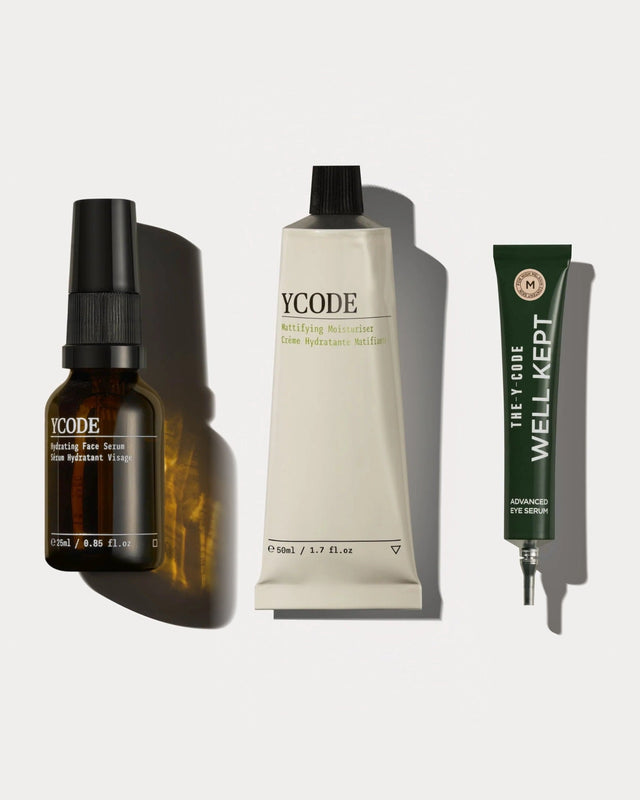
Three formulas focus on the major concerns men tend to see across the face...
The Daily Essentials improves the face and neck. Advanced Eye Serum adds concentrated support...












































































