

What Does Mattifying Moisturiser Actually Mean?
Mattifying describes a finish, not the job. Here is what the word actually covers, how a formula delivers it, and how to tell whether the one you own is working.
Mattifying is a word most men buy without ever being told what it means. It sits on the front of a tube, near some other words, and you work out from context that it has something to do with shine. That is roughly right, and it is also the smaller half of the answer. The word describes a finish. It does not describe the job. Knowing which is which changes what you look for, and it is worth two minutes.
What follows is the plain version. No claims about pores vanishing, no war on oil. Just what the word covers, how a formula delivers it, and how to tell whether the one you own is doing it.
The short answer
Matte is a description of how a surface handles light. A matte surface scatters light in many directions, so it reads flat and even. A glossy surface returns light in one direction, which is what your forehead is doing at two in the afternoon when someone holds up a phone.
So a mattifying moisturiser is a moisturiser formulated so that skin reads matte once it has absorbed, rather than damp or reflective. That is a finish claim, and a finish claim on its own says nothing about hydration. Hydration is a separate job, done by separate ingredients, and it is the job the product exists for. A mattifying moisturiser that leaves your skin tight has failed at the important part and succeeded at the cosmetic one.
Where the shine comes from
Shine is sebum, the oil your sebaceous glands produce. Output is governed largely by androgens acting at the gland, particularly dihydrotestosterone, which is why it rises through adolescence and why it differs so much between people 1. Comparative measurement across 300 people found male skin producing more sebum than female skin, and that is a structural difference rather than a habit 2.
It also moves through the day. Measuring facial skin continuously over 48 hours, researchers found sebum excretion following a daily rhythm with shorter cycles running inside it, alongside similar rhythms in water loss and surface pH 3. Your face is not producing oil at a flat rate from seven in the morning to seven at night. That is why shine has a schedule, and it is the subject of its own piece on why you are shiny by lunchtime.
How a mattifying formula is built
Think of it as two halves doing two different things.
Underneath sits the moisturiser proper. Humectants such as glycerin and hyaluronic acid draw water and hold it in the upper layers. Emollients and lipids settle into the surface and slow the rate at which that water evaporates away, which dermatology describes as transepidermal water loss. A review of barrier repair sets out the division simply: occlusives seal the surface, humectants draw water upward into the epidermis, emollients assimilate into it 4. Most of a good moisturiser is this.
On top sits the finish. Fine particles, rice starch and silica among the common ones, take up a little surface oil and scatter light rather than reflecting it. Starches have a long history in cosmetics for exactly this, valued for a soft, dry feel and for their absorbency, and they are increasingly used where talc once was 5. The particles are doing optical and absorbent work at the surface. They are not doing the hydration.
Matte is the finish. Hydration is the job. A moisturiser worth owning does the second and delivers the first on the way past.
What the word covers, and what it leaves to other ingredients
Mattifying describes how skin looks and feels for the hours after you apply it. It is a surface behaviour. What it does not describe is a change in how much oil the gland makes, because that is set well below where a cream reaches 1.
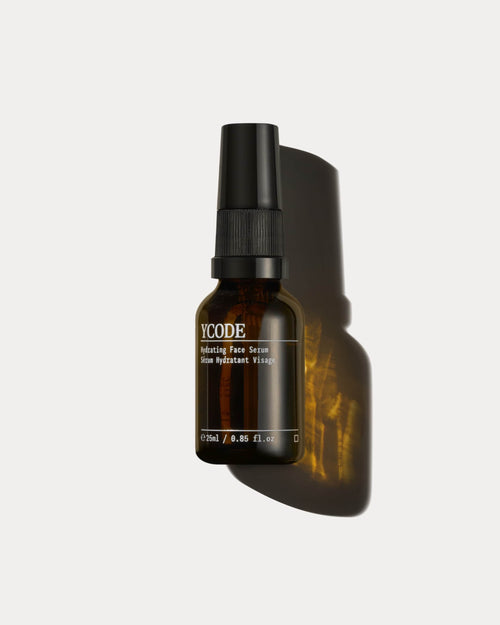
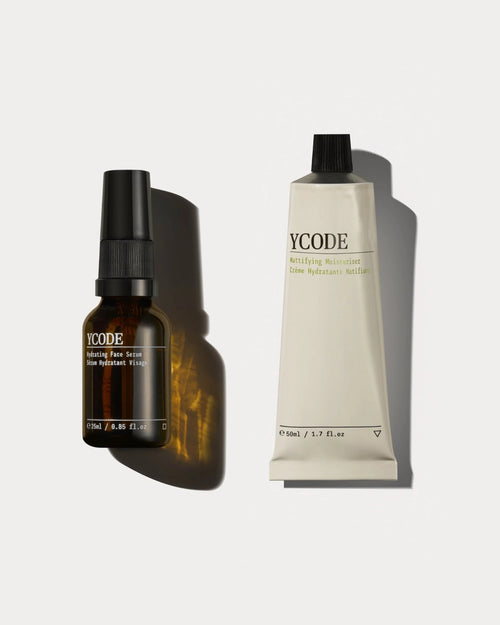
Ingredients that act on production are a separate category. Topical 2% niacinamide has been measured lowering sebum excretion rates after two and four weeks of use, which is a different mechanism working on a different clock 1. In our own range niacinamide sits in the Hydrating Face Serum rather than the cream, which is deliberate. The two products carry different active sets so each earns its place, and using them together is where the compounding happens.
How ours is built
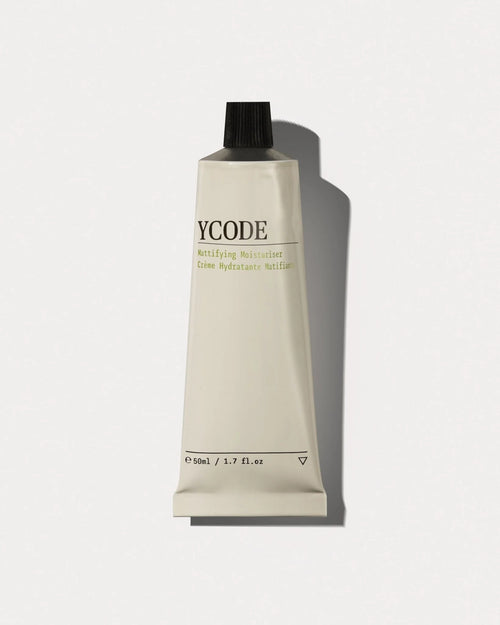
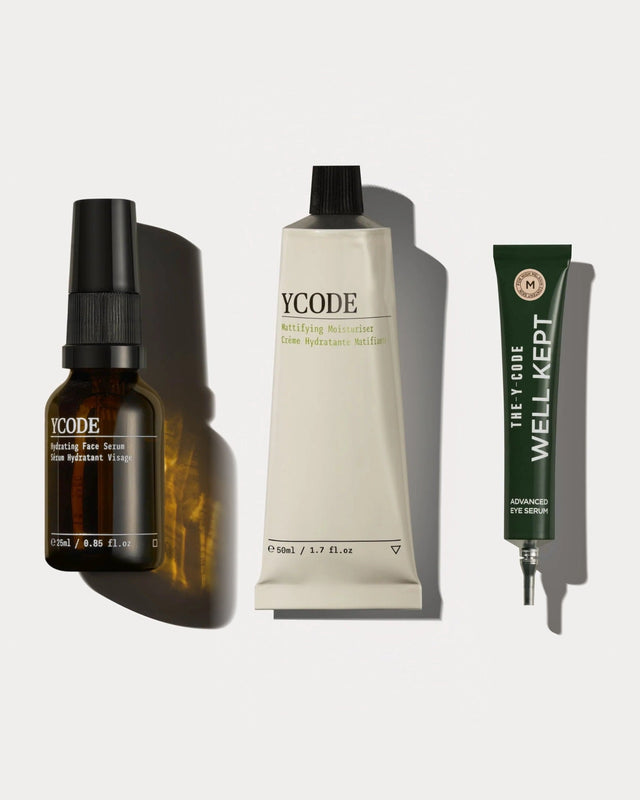
The Mattifying Moisturiser is a moisturiser first. Deep hydration that holds all day, formulated for every skin type, with oil balanced and the look of pores refined. The matte finish is one of the things it does, not the whole of what it is.
Underneath: glycerin and hyaluronic acid for water, barrier lipids from shea butter and coconut for the seal, Chlorella vulgaris for adaptive antioxidant and barrier support, and a collagen-supporting peptide. At the surface: rice starch, which is where the matte comes from. It is a light cream that absorbs in about ten seconds and then stays quiet.
YCODE Mattifying Moisturiser, independent consumer trial, 53 men, four weeks.
Three checks worth making on any of them
At ten minutes, it should have gone. Absorbed, comfortable, nothing sitting on top. A cream you can still feel after ten minutes will photograph as shine later.
At four hours, look at your forehead and nose in daylight rather than bathroom light. That is the honest test, and it is the window where a good matte finish earns its keep.
At any point in the day, your skin should feel comfortable rather than tight. Tightness means the hydration half is undersized, and skin that feels stripped tends to answer with more oil, not less 6.
That is the whole of it. Mattifying is a description of finish, sitting on top of a product whose real work is water, lipids and comfort over a full day. Worth knowing, and then worth forgetting about. If you would rather skip the reading altogether, the two-minute skin analysis asks a handful of questions and points you at the right starting product.
What does mattifying mean in skincare?
Is a mattifying moisturiser only for oily skin?
Does a mattifying moisturiser dry your skin out?
Can you use a mattifying moisturiser at night and in winter?
- Endly DC, Miller RA. Oily Skin: A Review of Treatment Options. Journal of Clinical and Aesthetic Dermatology, 2017. Source
- Luebberding S, Krueger N, Kerscher M. Skin physiology in men and women: in vivo evaluation of 300 people including TEWL, SC hydration, sebum content and skin surface pH. International Journal of Cosmetic Science, 2013. Source
- Le Fur I, Reinberg A, Lopez S, Morizot F, Mechkouri M, Tschachler E. Analysis of circadian and ultradian rhythms of skin surface properties of face and forearm of healthy women. Journal of Investigative Dermatology, 2001. Source
- Rajkumar J, Chandan N, Lio P, Shi V. The Skin Barrier and Moisturization: Function, Disruption, and Mechanisms of Repair. Skin Pharmacology and Physiology, 2023. Source
- Starch functionality in cosmetics and personal care products. Carbohydrate Polymers, 2025. Source
- Sakuma TH, Maibach HI. Oily skin: an overview. Skin Pharmacology and Physiology, 2012. Source
Is a mattifying moisturizer the same as a mattifying moisturiser?

I started YCODE because most skincare was never designed for men’s skin. What I write here is what the formulators taught me, and what the trials actually found.
Continue reading
VIEW ALL →
Your skin can notice the change of season before you reach for a coat....
Three formulas focus on the major concerns men tend to see across the face...
The Daily Essentials improves the face and neck. Advanced Eye Serum adds concentrated support...












































































