

Microalgae Skincare for Men | The Science Behind Marine Bioactives

Microalgae have been solving one problem for two and a half billion years: how to keep a living cell intact when its surroundings will not sit still. Sun, salt, drought, cold, the sudden loss of nutrients. The compounds these organisms evolved to survive all of that are the same compounds now appearing in men's skincare. Microalgae skincare for men is not a marketing coinage bolted onto a trend. It is a formulation built around marine biology, and the reason it behaves differently from the fixed-function actives most routines rely on is worth setting out properly.
A note on the evidence before we begin. Most of the marine research below comes from laboratory cell studies and animal models rather than large human trials. It is promising and mechanistically detailed, but it is preclinical, and we describe it as such throughout. The percentage figures above reflect YCODE's own reading of the biology male skin presents.
What are microalgae, and why does skin respond to them?
Microalgae are single-celled photosynthetic organisms that live in marine and freshwater environments. They predate land plants by more than a billion years, and that longevity comes down to adaptability. To hold out against tidal pressure, ultraviolet radiation, temperature swings and nutrient scarcity, they concentrated a dense set of protective molecules: antioxidants, polysaccharides, amino acids, peptides, chlorophyll, carotenoids and vitamins.3
These are working tools, assembled over geological time to shield a cell from damage. The same chemistry that let microalgae outlast almost everything else on the planet is what makes them useful on skin, where algal carbohydrates in particular have been studied for their antioxidant, anti-ageing and barrier-supporting effects.2
Which marine species does YCODE use?
YCODE formulates with three marine ingredients, each chosen for a specific job and placed where that part of the skin needs it. Chlorella vulgaris is a freshwater green microalgae. Fucus vesiculosus and Lithothamnion calcareum are marine macroalgae, larger seaweeds harvested from cold Atlantic coastlines. All three sit under the broad heading of marine bioactives.
- Chlorella's amino acids and polysaccharides support collagen and help hold water within the skin.3 What you notice? Skin that stays supple through the day rather than tightening by mid-afternoon.
- Chlorophyll carries documented soothing activity in laboratory models.3 What you notice? Less visible redness after shaving or a day outdoors.
- Fucus phlorotannins interrupt the NF-κB inflammatory pathway in stressed cells.4 What you notice? Calmer skin across the cheeks and around the eyes.
- Algal carbohydrates reinforce the barrier and slow moisture loss.2 What you notice? Fewer dry, flaking patches between washes.
Chlorella vulgaris
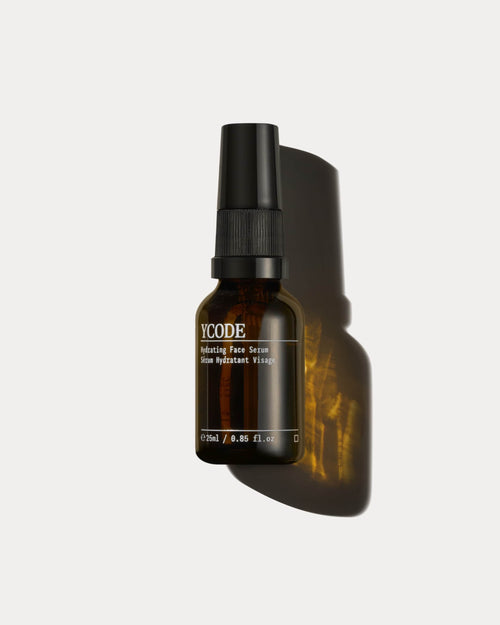
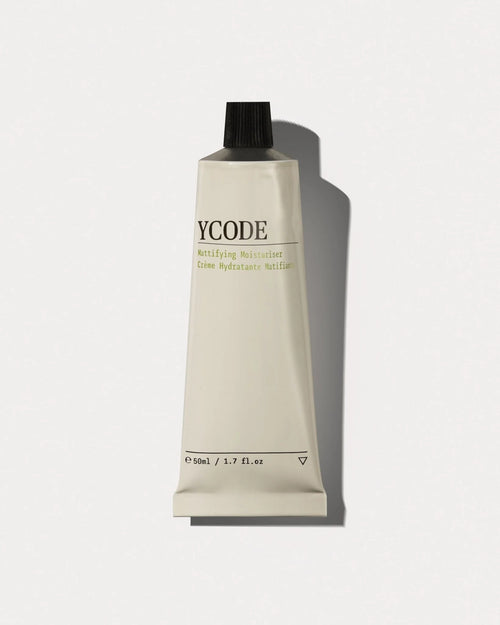
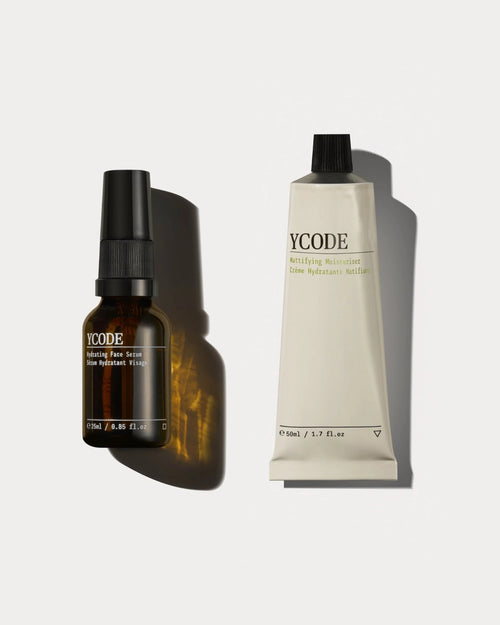
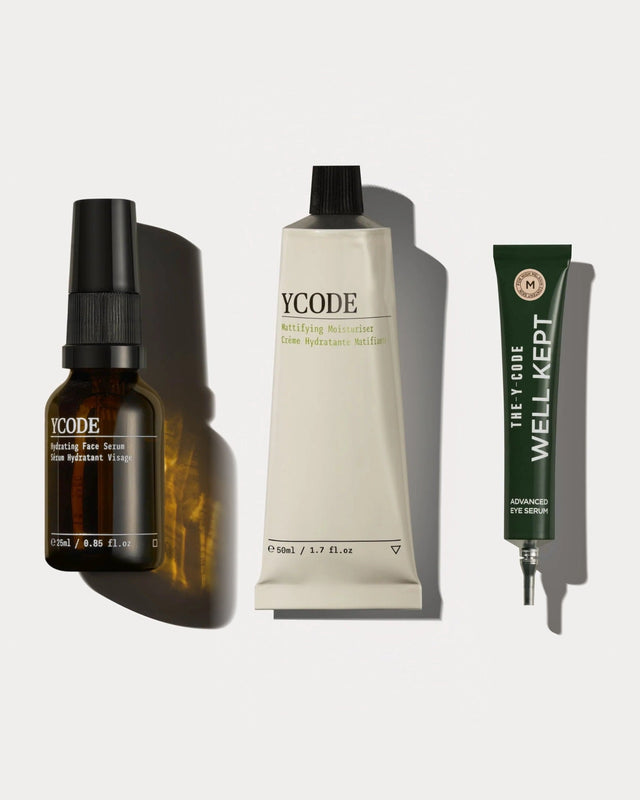
Chlorella vulgaris carries one of the densest nutrient profiles of any single-celled organism, and it is the most studied microalgae in cosmetic science. It is rich in proline, glycine and lysine, the amino acids that feed collagen synthesis, and laboratory work has recorded anti-collagenase and anti-elastase activity, meaning it may help slow the enzymatic breakdown of collagen and elastin already in the skin.3 That matters when collagen declines by roughly 1% a year after 30. Its chlorophyll content brings the soothing effect noted above, its carotenoids add antioxidant defence against ultraviolet stress, and its amino acids behave as natural moisturising factors that bind water at more than one depth. Chlorella vulgaris is a YCODE ingredient, working in the Hydrating Face Serum and the Mattifying Moisturiser alongside niacinamide, peptides and plant prebiotics.
Fucus vesiculosus
Fucus vesiculosus, better known as bladderwrack, is a brown macroalgae pulled from the cold North Atlantic, Baltic and Pacific. It is among the most researched marine species in cosmetic and pharmaceutical science, and it calms inflammation by two separate routes. Its phlorotannins block the NF-κB signalling pathway, cutting the production of nitric oxide and pro-inflammatory cytokines in stressed cells.4 Its fucoidan, a sulphated polysaccharide, has shown anti-inflammatory activity in vitro and in vivo through a different mechanism.5 The phlorotannins also scavenge radicals, nitric oxide radicals in particular, which complements Chlorella's carotenoid defence with a structurally distinct molecule. Fucus vesiculosus goes into the Advanced Eye Serum, placed in the product built for the most reactive skin on the face.
Lithothamnion calcareum
Lithothamnion calcareum is a red calcified algae from cold Atlantic waters. Across its lifecycle it draws calcium, magnesium and trace minerals straight from seawater, which makes it one of the most mineral-dense organisms used in cosmetic formulation. That mineral load helps replenish and strengthen skin at the surface, while the balance of calcium and magnesium supports barrier architecture and its polysaccharides form a light film that holds hydration in place. Around the eye, where oil glands are few and moisture loss shows first, that retention has a visible payoff. In the Advanced Eye Serum it works next to Fucus: one species calms and protects, the other remineralises and holds water.
How does osmoadaptation work on the skin?
Osmoadaptation is a biological process, and the word carries its own explanation. It joins osmosis, the movement of water across a cell membrane, to adaptation, the ability to change behaviour as conditions change. In their natural setting, microalgae meet constant shifts in salinity, temperature, light and nutrients. They do not run at one steady output. When ultraviolet exposure climbs, antioxidant production climbs. When water grows scarce, moisture-binding activity intensifies.3
That responsiveness survives extraction. Applied to skin, Chlorella vulgaris extracts read the local conditions and answer them. In humid weather the response is lighter. In dry or stressed conditions, hydration binding and barrier support step up. The formulation does not hand out the same dose regardless of what it lands on. It reads the room.
Most actives work at one speed. An osmoadaptive ingredient matches its output to what the skin in front of it actually needs.
Why do marine bioactives suit men's skin in particular?
Male skin is structurally its own thing. It runs roughly 25% thicker, produces about twice the sebum and sits at a lower pH than female skin, with a stronger inflammatory response and a barrier tested daily by shaving.1 Those traits set specific demands. Hydration has to reach through a thicker dermal layer. Anti-inflammatory support has to match a baseline that already leans reactive. Barrier repair has to account for regular disruption. Oil regulation has to balance the skin instead of stripping it.
The three marine species cover each demand. Chlorella's polysaccharides move below the surface and bind moisture. Its chlorophyll and the phlorotannins in Fucus calm inflammation through complementary routes.4 Lithothamnion's minerals firm up the barrier. The osmoadaptive mechanism keeps the whole thing self-regulating as conditions change. If you are not sure where your own skin sits, a short diagnostic that matches you to a starting product is a sensible first step.
Is microalgae really the ingredient of 2026?
Marine and algae-based actives have become one of the defining ingredient categories of the year. Industry reports point to precision algae and green biotech as the direction formulation is heading, and recent research has shown microalgae-derived compounds protecting skin cells from ultraviolet stress, supporting collagen networks and delivering calming effects that hold up against synthetic comparisons.3 The global microalgae cosmetics market is projected to pass $1.3 billion by 2030.
The larger suppliers are moving in the same direction. A March 2026 analysis from Future Market Insights called microalgae the next frontier in bioactive beauty ingredients, projecting the personal care microalgae market to grow from $68.5 million in 2025 to $117 million by 2035 and noting a shift from niche premium use into mainstream adoption. BASF, DSM and Roquette are all now investing in microalgae-derived actives. YCODE formulated with these ingredients before the market arrived at them, and the wider signals confirm the same brief the three-step system was built around: barrier-first care, shorter routines, ingredient transparency and anti-inflammatory formulation taken seriously.
This article is for information only and is not medical advice.
FAQ
What does Chlorella vulgaris do for skin?
What does Fucus vesiculosus do for skin?
What are marine bioactives in skincare?
Is microalgae good for men's skincare?
What is osmoadaptation in skincare?
If you want to put marine bioactives to work across cleanse, treat and protect, the Core Trio brings the full three-step system together, with Chlorella vulgaris running through the serum and moisturiser. Not sure where to start? Take the short diagnostic to find what suits your skin.
- Rahrovan S, Fanian F, Mehryan P, Humbert P, Firooz A. Male versus female skin: what dermatologists and cosmeticians should know. International Journal of Women's Dermatology. 2018;4(3):122-130. https://pmc.ncbi.nlm.nih.gov/articles/PMC6116811/
- Kim JH, Lee JE, Kim KH, Kang NJ. Beneficial effects of marine algae-derived carbohydrates for skin health. Marine Drugs. 2018;16(11):459. https://pmc.ncbi.nlm.nih.gov/articles/PMC6266229/
- Talero E, García-Mauriño S, Ávila-Román J, Rodríguez-Luna A, Alcaide A, Motilva V. Bioactive compounds isolated from microalgae in chronic inflammation and cancer. Marine Drugs. 2015;13(10):6152-6209. https://pmc.ncbi.nlm.nih.gov/articles/PMC4626684/
- Barbosa M, Valentão P, Andrade PB. Phlorotannins from Fucus vesiculosus: modulation of inflammatory response by blocking NF-κB signaling pathway. International Journal of Molecular Sciences. 2020;21(18):6897. https://pmc.ncbi.nlm.nih.gov/articles/PMC7554702/
- Wang L, Oliveira C, Li Q, et al. Fucoidan from Fucus vesiculosus inhibits inflammatory response, both in vitro and in vivo. Marine Drugs. 2023;21(5):302. https://pmc.ncbi.nlm.nih.gov/articles/PMC10221219/

I started YCODE because most skincare was never designed for men’s skin. What I write here is what the formulators taught me, and what the trials actually found.
Continue reading
VIEW ALL →
Stress and poor sleep have a way of becoming visible. The eyes look heavier....
Your skin can notice the change of season before you reach for a coat....
Three formulas focus on the major concerns men tend to see across the face...












































































