

Peptides in men’s skincare: The Essential Guide

Peptides turn up in the skincare conversation more than almost any other ingredient, usually tied to promises about collagen, firmness and fine lines. In men's skincare that talk rarely comes with an explanation. Male skin runs by its own logic, shaped by thickness, oil output, daily shaving and the slow structural drift of age, and an ingredient earns its place only when it answers those realities. Peptides are short chains of amino acids, the same building blocks that make up the structural proteins skin depends on. The interesting question is not whether they sound impressive on a label, but what they actually do once applied, and how modest or meaningful that effect really is.
What are peptides, and how do they work in skin?
Amino acids are the units that assemble into proteins, including collagen and elastin, the two proteins most responsible for firmness and elasticity. String a few amino acids together and you have a peptide. In topical skincare, certain peptides are thought to act as signalling ingredients rather than raw material. The idea is straightforward. A short peptide sequence can behave like a messenger, prompting the fibroblasts in the dermis to carry on producing collagen and other structural components.3 Applying a peptide does not deposit collagen onto the skin. It aims to nudge the cells that already make it.
That mechanism is worth picturing, because it explains both the appeal and the limits of peptides in men's skincare.
What do peptides do in a topical formula?
Depending on their structure, peptides are used in men's skincare to work on a few connected fronts. The evidence behind them is uneven, and honest reading matters more here than marketing does.
- They target the look of fine lines. Palmitoylated peptides, designed to pass more readily into the skin, have shown reductions in wrinkle depth and roughness in cosmetic trials over several weeks.2 The effect is gradual and best judged around high-movement areas such as the eyes and forehead. What you notice? Softer-looking creases in the crow's-feet zone after a couple of months of daily use.
- They support visible firmness. By signalling fibroblasts to keep producing structural proteins, some peptides are associated with modest gains in skin density and elasticity.1 This matters because dermal collagen declines steadily with age, a loss that is measurable rather than theoretical.4 What you notice? Skin that reads as a little more resilient rather than slack over time.
- They refine surface texture. With consistent use, peptides are linked to smoother, more even skin, particularly when they sit alongside proper hydration.3 They are cumulative ingredients, not overnight ones. What you notice? A more even surface that holds up better through a day of heat, sweat and shaving.
None of this is dramatic, and no honest account should pretend otherwise. Peptides do not become collagen when applied, and the size of the benefit depends heavily on the peptide, its concentration and the rest of the formula around it. Reviews of the field make clear that results vary and that the strongest claims tend to outrun the data.3
Those figures come from small cosmetic studies of full formulations rather than single ingredients, so they are best read as direction of travel, not a guarantee.
Peptide skincare or collagen supplements: what is the difference?
Peptides in skincare are often mentioned in the same breath as collagen supplements, but the two work differently. Oral collagen peptides are digested before absorption, so any benefit is systemic and indirect. Topical peptides are applied locally and designed to support cosmetic outcomes at the skin surface, where the mechanism depends on stability, barrier compatibility and steady use. Neither is magic. Topical peptides tend to perform best as one considered part of a formulation rather than as a standalone hero.
Why do peptides matter more for men's skin?
Men's skin is typically thicker, often more oil-prone, and regularly exposed to shaving and environmental stress. The common concerns follow from that. Uneven texture, visible fatigue, fine lines around high-movement areas, and dehydration sitting beneath surface oil. Peptides are relevant because they aim at texture refinement and long-term structural appearance, precisely the slow-moving problems where a quick cosmetic fix does little. Dermal collagen falls with age in both sexes,4 so an ingredient that supports the cells behind it has a logical role in a routine built for the long game. The value is cumulative, and it depends on pairing peptides with barrier-supportive hydration rather than expecting them to work alone.
Peptides are worth including, not worshipping. The evidence points to modest, gradual gains in the look of firmness and texture, which is exactly why they belong inside a considered routine rather than at the front of it.
Where do peptides appear in YCODE?
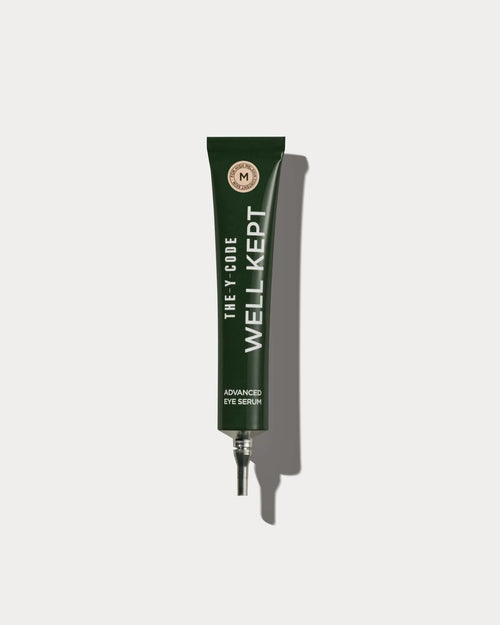
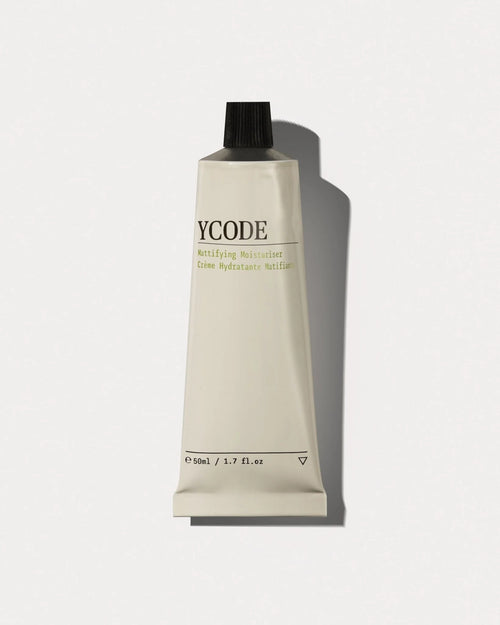
In our formulations peptides are used selectively, as functional additions within broader systems rather than as the headline. The Hydrating Face Serum for men contains a dipeptide alongside glycerin, niacinamide, sodium hyaluronate and microalgae extract, where the peptide supports overall skin quality while hydration and barrier stability stay foundational. The Mattifying Moisturiser for men contains palmitoyl tripeptide-5, the type most often studied for visible wrinkle and texture improvement, working alongside structured emollients and hydration-supporting ingredients to refine the surface over time. For the crow's-feet zone specifically, where peptide research is at its strongest, the Advanced Eye Serum for men is built to target that high-movement area, and the Core Trio brings the serum, moisturiser and eye treatment together as one structured routine.
Do peptides actually work?
In controlled cosmetic studies, some peptides show measurable benefit for wrinkle depth and surface roughness when used consistently over several weeks.2 The honest caveats are real. Performance depends on formulation integrity, and reviews of the topical-peptide literature stress that effects are modest and the evidence is mixed.3 Peptides are not the foundation of a routine. They enhance one that already prioritises hydration, barrier support and controlled ingredient design. Judged against that expectation, they are one of the more relevant functional ingredients available in topical men's skincare.
Peptides for men: common questions
How long do peptides take to work?
Peptides do not produce immediate change. Most cosmetic studies measure improvements across 8 to 12 weeks of consistent use, particularly in wrinkle appearance and surface texture. Early smoothness may show within a few weeks, but structural changes need daily application over time. Consistency matters more than concentration alone.
Can peptides fit into a simple men's routine?
Yes. Peptides are usually formulated into serums or moisturisers rather than used as standalone steps, so they layer easily into a routine that already covers hydration, barrier support and oil balance. They are not a replacement for sunscreen or moisturiser. They are a supportive ingredient within a broader structure.
Are skincare peptides suitable for all skin types?
Most cosmetic peptides are considered suitable for all skin types, including oily and combination skin, because they are used at low concentrations and are not exfoliating or strongly active in the way acids or retinoids can be. Tolerance is usually determined by the overall product, including fragrance and preservatives, more than by the peptide itself. Anyone with sensitive skin should introduce a new product gradually.
Do peptides have any downsides?
Topical peptides are generally well tolerated and are not linked to the irritation seen with stronger actives. Reported reactions are uncommon and usually relate to the full formulation rather than the peptide. The main honest limitation is expectation. The gains are modest and gradual, so peptides reward patience rather than delivering a visible overnight result.
If your main concern is the eye area and the fine lines that show first around it, the Advanced Eye Serum for men is the sharpest place to start, and the skin quiz will point you to the right combination for your skin.
References
1. Hahn HJ, Jung HJ, Schrammek-Drusios MC, Lee SN, Kim JH, Kwon SB, An IS, An S, Ahn KJ. Instrumental evaluation of anti-aging effects of cosmetic formulations containing palmitoyl peptides, Silybum marianum seed oil, vitamin E and other functional ingredients on aged human skin. Experimental and Therapeutic Medicine. 2016;12(2):1171–1176. PMID 27446338
2. Robinson LR, Fitzgerald NC, Doughty DG, Dawson NL, Berge CA, Bissett DL. Topical palmitoyl pentapeptide provides improvement in photoaged human facial skin. International Journal of Cosmetic Science. 2005;27(3):155–160. PMID 18492182
3. Gorouhi F, Maibach HI. Role of topical peptides in preventing or treating aged skin. International Journal of Cosmetic Science. 2009;31(5):327–345. PMID 19570099
4. Shuster S. Osteoporosis, like skin ageing, is caused by collagen loss which is reversible. Journal of the Royal Society of Medicine. 2020;113(4):158–160. PMC7160787

I started YCODE because most skincare was never designed for men’s skin. What I write here is what the formulators taught me, and what the trials actually found.

Continue reading
VIEW ALL →
Stress and poor sleep have a way of becoming visible. The eyes look heavier....

Your skin can notice the change of season before you reach for a coat....
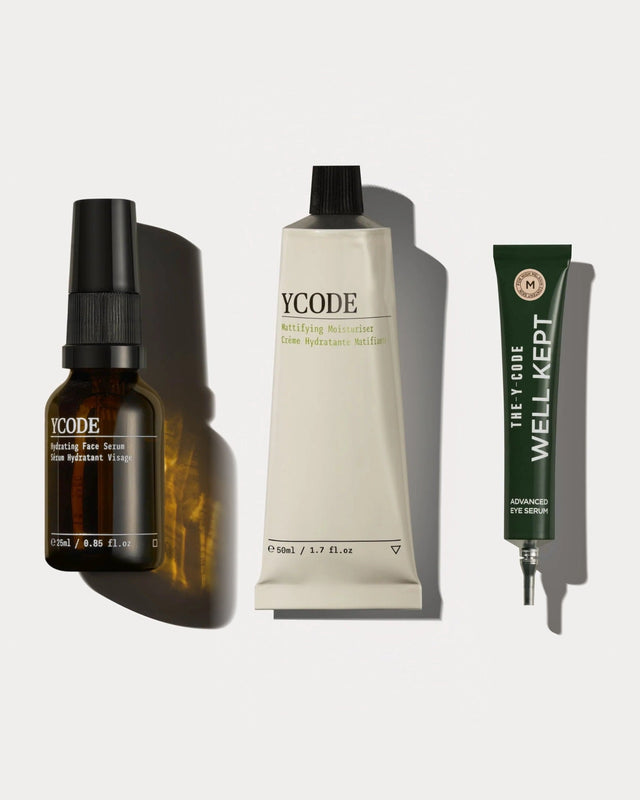
Three formulas focus on the major concerns men tend to see across the face...












































































