

Peptides in Skincare for Men: What They Actually Do
Peptides have become the most talked-about ingredient in men's skincare, and the least precisely explained. The word covers hundreds of different molecules that do entirely different jobs, so a product that says "with peptides" tells you almost nothing on its own. What matters is which peptide, at what level, and what it is documented to do. This article names the two peptides that appear in YCODE formulas, explains the published mechanism behind each, and is equally clear about the product that contains none.
The short answer. Peptides are short chains of amino acids that act as signals in the skin rather than as raw building material. In men's skincare the best-evidenced ones support the appearance of firmness and fine lines by prompting fibroblasts to keep producing collagen, and the effect is gradual, measured over weeks rather than days.
What Peptides Do in Skin
Amino acids assemble into proteins. Collagen and elastin are the two proteins that govern how firm and how elastic skin looks. A peptide is a short chain of those same amino acids, usually between two and about twenty units long. Because the chain is short, it can behave less like structural material and more like a message. Certain sequences are recognised by receptors or by signalling pathways in the skin, and that recognition is the entire basis of cosmetic peptide science.2
This is the point most marketing skips. Applying a peptide does not lay collagen onto the face. It aims to signal the cells that already make collagen to keep making it. That distinction sets a realistic ceiling on what any peptide can do, and it explains why the honest studies measure change over eight to twelve weeks rather than overnight.4
Which Peptides Are in YCODE, and Which Are Not
Two YCODE formulas contain a peptide. One does not. The full ingredient list for every product sits on its page, and the entries below are taken from those lists rather than from marketing shorthand.
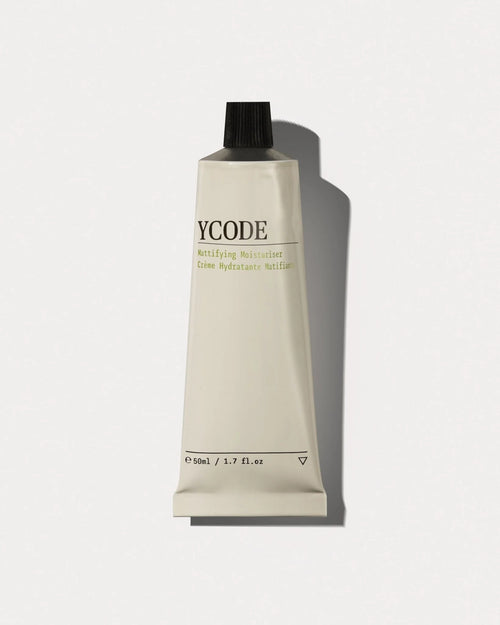
- Palmitoyl tripeptide-5, in the Mattifying Moisturiser. This peptide mimics a short sequence found in thrombospondin-1, a protein that activates TGF-β. TGF-β in turn prompts dermal fibroblasts to produce more type I and type III collagen, which is why this family is grouped with the signal peptides rather than the carriers. A peer-reviewed review of topical peptides reports that it also appears to slow collagen breakdown by interfering with MMP1 and MMP3, and that in an efficacy study of 60 volunteers over 84 days of twice-daily use it outperformed placebo and a palmitoyl pentapeptide control on wrinkle appearance and skin roughness.1 The palmitoyl chain is there for a practical reason. It makes an otherwise water-loving peptide lipophilic enough to travel past the very top of the skin.
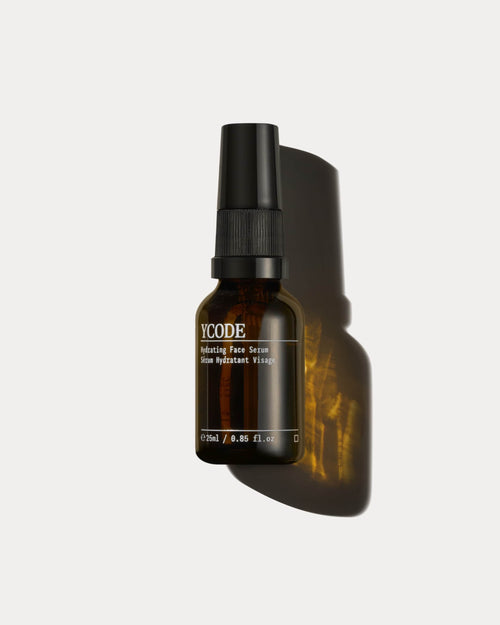
- Benzoyl dipeptide-18, in the Hydrating Face Serum. Its full INCI name is benzoyl dipeptide-18 D-phenylalanyl arginyl D-tryptophan dipropylamide mesylate, and it is a biomimetic peptide designed to act on the melanocortin-1 receptor. MC1R is the receptor through which the skin runs its own pigment and radiance response, normally in reply to alpha-melanocyte-stimulating hormone released by keratinocytes.5 In cosmetic use the intent is a more even, less grey-looking complexion rather than a change in skin colour. It is not a self-tan and it is not a substitute for sun protection.
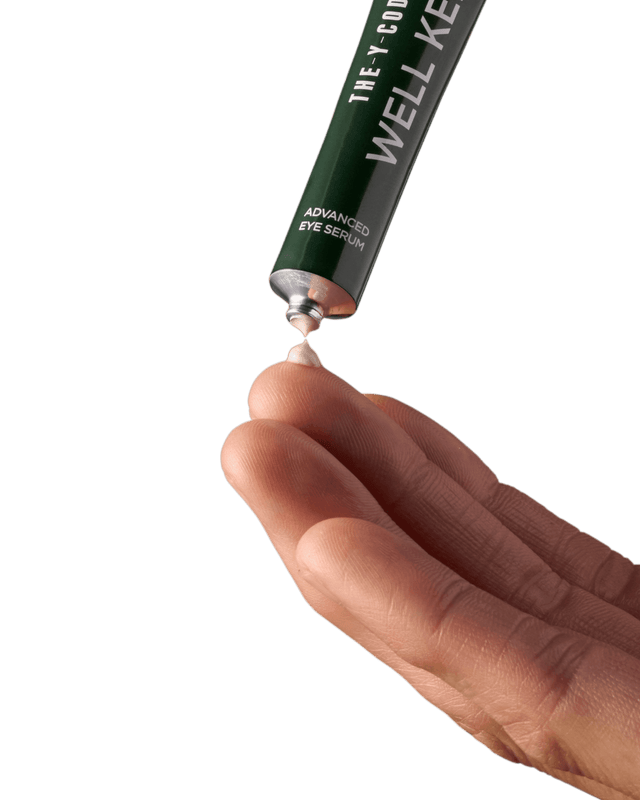
- The Advanced Eye Serum contains no peptide. Its ingredient list carries no peptide of any kind. It is built instead on fucus vesiculosus microalgae, CO2-extracted wild ginger and light-reflecting minerals, and its evidence comes from published ingredient studies rather than from peptide research. In a 111-person, 15-day study of those ingredients, 90% saw dark circles visibly reduced, 89% saw under-eye bags reduced, 86% saw fine lines and wrinkles smoothed and 73% reported instant brightening within 15 minutes. Any brand that tells you every product in its range contains peptides is either overstating the label or not reading it.
Why Peptides Matter More for Male Skin
Men's skin runs around 20 to 25% thicker and produces twice as much oil. It also has a different pH, a denser collagen structure, and takes the daily stress of shaving.3 Two consequences follow for peptides. The first is that a thicker, denser dermis means the visible signs of collagen loss arrive later but then progress in bolder lines, which is why men tend to notice creasing suddenly rather than gradually. The second is that an active has more tissue to travel through, so formulation matters as much as the peptide itself. A lipid-modified peptide in a well-built emulsion is doing something a raw peptide in a watery gel is not.
The practical read is that peptides suit the slow structural concerns rather than the fast surface ones. If skin is tight, flaking or shining by midday, hydration and barrier support will change more, faster. Peptides earn their place underneath that, over a longer horizon.
Peptides are a supporting ingredient with real, modest evidence behind them. Treat them as the long game inside a routine that already gets hydration and barrier right, and they repay the patience.
Copper Peptides, Matrixyl and the 2026 Peptide Boom
Three names dominate the current conversation, and they are not interchangeable. Copper tripeptide, usually written GHK-Cu, belongs to the carrier class. It works by binding and delivering trace copper, which skin enzymes involved in repair depend on, which is a different mechanism to the signal peptides entirely.1 Matrixyl is a trade name for palmitoyl pentapeptide-4, and Matrixyl 3000 for a combination of palmitoyl tripeptide-1 and a tetrapeptide. Palmitoyl pentapeptide-4 has the longest clinical record of the group, with a placebo-controlled double-blind study measuring reductions in fold depth, fold thickness and skin rigidity of 18%, 37% and 21% respectively after 28 days of twice-daily use.14
None of these is inherently superior. They answer different questions. A copper peptide is a repair-and-delivery argument, a palmitoylated signal peptide is a collagen-signalling argument, and an MC1R peptide is a tone-and-radiance argument. Judge a product by which question it is actually answering for your skin.
Peptides or Retinol: Which Should Men Use?
Retinol has the deeper clinical evidence for wrinkle change. Peptides have the better tolerance profile. Retinoids commonly cause an adjustment period of dryness, flaking and sensitivity, which is a particular problem for men who shave daily over the same skin. Peptides are generally well tolerated at cosmetic concentrations and are not exfoliating, so they do not compound razor irritation.2 For most men the sensible sequence is to get hydration, barrier and daily sun protection right, add peptides as the low-friction structural step, and consider a retinoid later only if the skin tolerates it.
How to Use Peptides in a Men's Routine
Peptides are formulated into serums and moisturisers rather than used as a separate step, so they layer into an existing routine without adding time. Apply the lighter texture first and the richer one over it, morning and night. Consistency is the variable that matters most, because every study that shows a result runs for weeks of daily use, not for occasional application. In a 4-week consumer trial of the Hydrating Face Serum on a panel of 50 men, 88% said their complexion appeared renewed and well rested, and in the trial of the Mattifying Moisturiser on a panel of 53 men, 72% said fine lines and wrinkles were reduced.
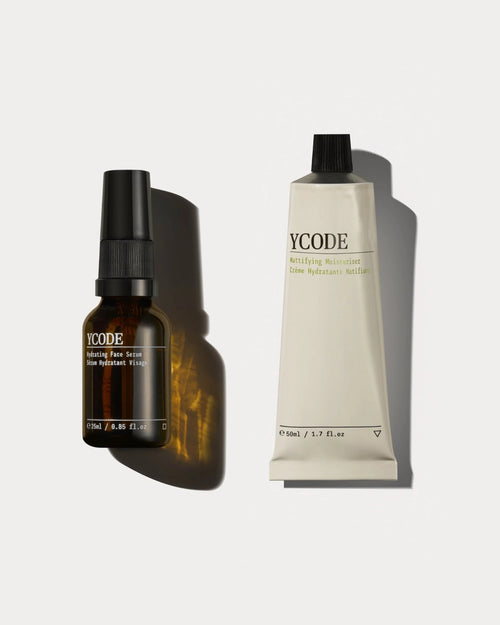
Peptides do not conflict with the ingredients most men already use. Hyaluronic acid, niacinamide and prebiotics sit alongside them comfortably. If you want the two peptide formulas working together, the Hydrating Face Serum and the Mattifying Moisturiser are the pair, and they are sold together as the Moisture Duo.
FAQs
What do peptides do for men's skin?
Which peptides does YCODE actually use?
How long do peptides take to work?
Are copper peptides better than other peptides for men?
Can peptides be used with retinol or niacinamide?
If you want the peptide side of the range in one step, start with the Mattifying Moisturiser. If you are not sure which formula your skin needs first, the quiz that matches skin to formula will point you to the right starting product.
This article is for educational purposes and is not medical advice. Cosmetic products support the appearance of the skin and are not intended to diagnose, treat or prevent any condition.
- Schagen SK. Topical peptide treatments with effective anti-aging results. Cosmetics, 2017;4(2):16. doi:10.3390/cosmetics4020016
- Gorouhi F, Maibach HI. Role of topical peptides in preventing or treating aged skin. International Journal of Cosmetic Science, 2009;31(5):327-345. PubMed 19570099
- Rahrovan S, Fanian F, Mehryan P, Humbert P, Firooz A. Male versus female skin: what dermatologists and cosmeticians should know. International Journal of Women's Dermatology, 2018;4(3):122-130. PMC6116811
- Robinson LR, Fitzgerald NC, Doughty DG, Dawson NL, Berge CA, Bissett DL. Topical palmitoyl pentapeptide provides improvement in photoaged human facial skin. International Journal of Cosmetic Science, 2005;27(3):155-160. PubMed 18492182
- Herraiz C, Martinez-Vicente I, Maresca V. The alpha-melanocyte-stimulating hormone/melanocortin-1 receptor interaction: a driver of pleiotropic effects beyond pigmentation. Pigment Cell & Melanoma Research, 2021;34(4):748-761. PubMed 33884776

I started YCODE because most skincare was never designed for men’s skin. What I write here is what the formulators taught me, and what the trials actually found.
Continue reading
VIEW ALL →
Your skin can notice the change of season before you reach for a coat....
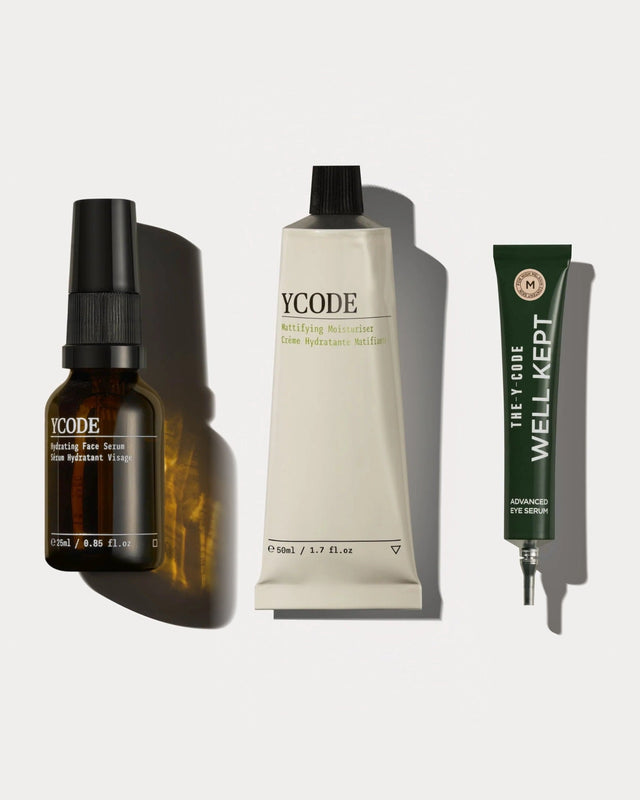
Three formulas focus on the major concerns men tend to see across the face...
The Daily Essentials improves the face and neck. Advanced Eye Serum adds concentrated support...












































































