

Skincare for Men Over 60 | Simple Routine for Healthier Skin

Skincare for men over 60 delivers some of the most visible results of any age group, yet it remains one of the most underserved corners of the grooming world. The biology of male skin shifts markedly after the sixth decade. The barrier weakens, collagen loss turns structural, sebum production falls away and the skin's own repair machinery slows in a way you can measure. None of that is a sentence. Each of those changes is something the right formulation can address directly. What makes this age so compelling is the response. Men over 60 consistently report the fastest, most obvious change of anyone who starts.
This guide sets out what is happening beneath the surface, which ingredients the science actually supports, and why starting now is precisely the right move rather than a lost cause. It also covers the concerns that dominate at this stage: the persistent dryness, the redness that will not settle, and the loss of tone that seems to arrive all at once.
What happens to male skin after 60?
Male skin carries real structural advantages for much of adult life. It is around a quarter thicker, it runs oilier, and it holds a denser collagen network than female skin2. That is why many men sail through their fifties showing fewer visible signs than their partners. The trade is simply deferred. When it arrives, it arrives quickly, and several changes converge at once.
- The barrier weakens. Beginning around 50, barrier function declines as the skin's lipid production and surface chemistry drift out of balance2. The defence that managed decades of weather and grime becomes less resilient. What you notice? Moisture escapes faster and small irritants land harder than they used to.
- Collagen loss turns structural. Both men and women shed roughly 1% of collagen a year from the age of 30, which is a cumulative loss near 30% by 601. What you notice? The skin thins, fine lines deepen and the scaffolding that held everything taut begins to soften.
- Hydration falls. Stratum corneum hydration climbs to a peak around 40 and then declines, most noticeably on the face and neck in men3. What you notice? Skin that was reliably oily turns tight and papery, and it is easy to blame the weather rather than the biology.
- Repair slows. The renewal cycle lengthens, so damage that once healed in days now lingers for weeks3. What you notice? Redness sits around longer and the skin looks tired for no obvious reason.
Which concerns dominate at this age?
Three complaints come up again and again, and all three trace back to the same underlying shifts. Persistent dryness is the barrier's falling lipid output letting moisture leave faster than the skin can hold it, which a basic cream masks for a few hours rather than mends. Redness and irritation follow a weakened barrier that lets everyday aggravation trigger a low, grinding inflammation, the process researchers call inflammaging3. Loss of tone and texture is thirty to forty years of collagen decline meeting a slower renewal cycle, so the surface coarsens and lines settle in around the eyes and brow.
The scepticism older men bring to skincare is earned. The problem was never their skin. It was a formula built for a different biology, sold on the promise that it would somehow work on theirs.
Why do most products fail after 60?
Most men over 60 have tried something at least once. A tub from the pharmacy, a cream a partner recommended. The experience underwhelmed, and the conclusion that skincare does not deliver felt reasonable. A standard moisturiser offers temporary surface hydration and little else. It was drawn up for a general audience, often lifted from a women's formula, and designed to sit on the skin rather than work inside it.
The thicker male dermis needs actives that travel further. A declining barrier needs ingredients that rebuild ceramide production rather than paper over it. Persistent redness needs genuinely calming compounds, and structural collagen loss needs peptides that signal repair. When a product addresses none of that, walking away is the rational response. Products designed around the specific changes in male skin after 60 read completely differently.
What is the best routine for men over 60?
This is the part that matters. A complicated routine will not survive contact with a real morning, so the system has to be fast, simple and repeatable. The good news is that the routine at 60 is the same as it is at 35. Three products, two minutes, morning and evening.
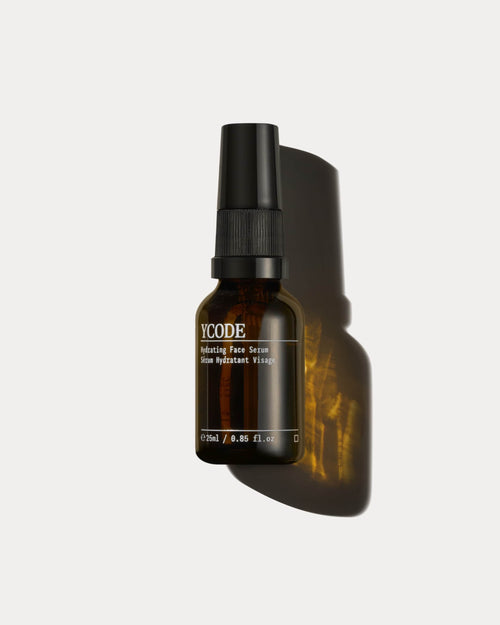
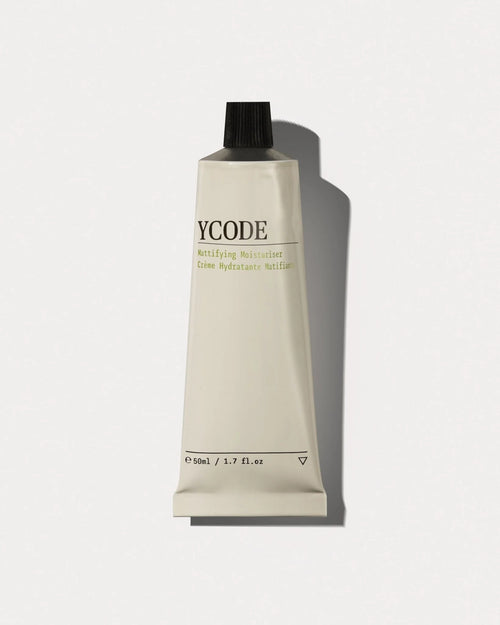
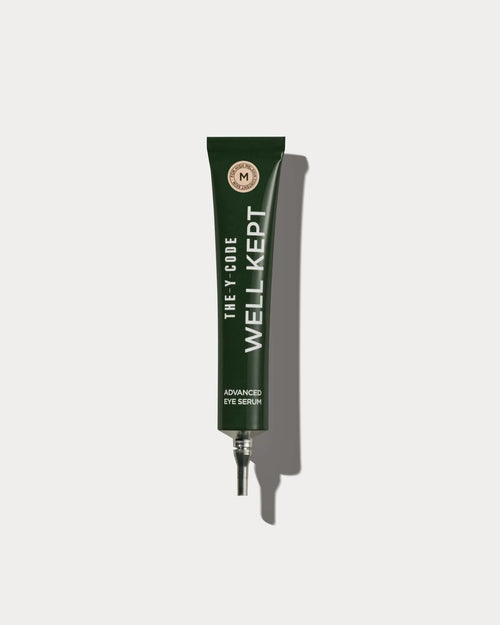
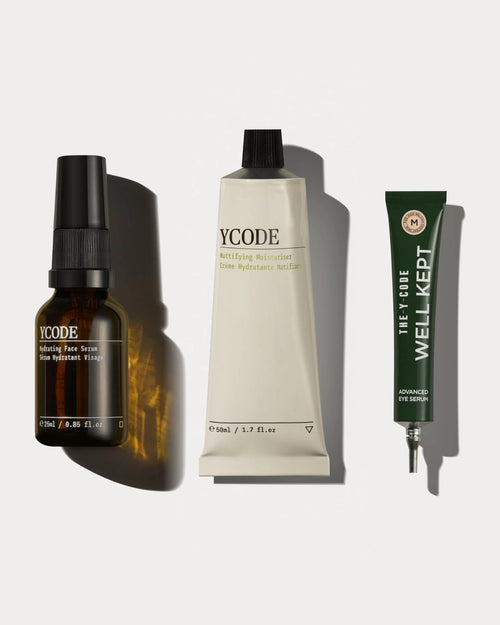
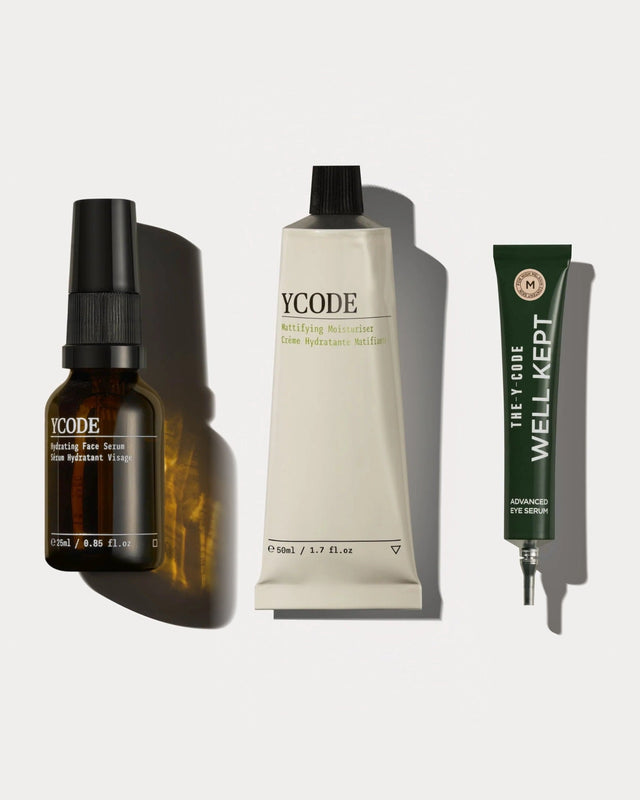
Step one is the Hydrating Face Serum, one or two pumps on damp skin, absorbed in seconds. Step two is the Mattifying Moisturiser, which seals in what the serum delivered and leaves a matte finish with no residue. Step three is the Advanced Eye Serum for dark circles, puffiness and fine lines in the most reactive part of the face. The Core Trio holds all three. Two minutes from start to finish, and the reasoning behind those two minutes is below.
Which ingredients does the science support?
Each change after 60 has a matching active with real evidence behind it. For barrier repair, niacinamide increases ceramide biosynthesis in the outer skin, rebuilding the lipid structure that thins with age, while it also steadies residual oil and calms inflammation4. For hydration, YCODE builds around microalgae, an ingredient it selects for its ability to read the skin's condition and adjust its response rather than deliver one fixed dose. For structure, peptides signal collagen synthesis, giving skin that has slowed the instruction it needs to keep rebuilding. For redness, YCODE pairs microalgae-derived soothing compounds with marine phlorotannins in the eye serum to settle the most reactive zone of the face. These marine and microalgae claims are YCODE's own.
Does skincare actually work at this age?
The reason results show up so fast is biological. When actives built for male skin meet a complexion that has gone decades untreated, the response is immediate because the baseline is bare. The skin is ready to react. It has simply been waiting for the right formulation. In a 4-week YCODE consumer trial of the two-step regime, the Hydrating Face Serum and Mattifying Moisturiser used together (panel of 50 men), 84% said their skin looked healthier and clearer and 88% that the moisture barrier of their skin felt stronger, with all evaluated claims validated under EU Regulation (EC) No 655/2013. Those figures are YCODE's own, drawn from its trial rather than the published literature. The pattern from older users tends to run the same way: scepticism, a visible shift within the first week, then the quiet recognition that whatever came before was working at a different level.
If you would rather be pointed to the right starting product than guess, the two-minute routine finder maps your skin and concerns to a specific set.
Common questions, answered
Is it worth starting a routine after 60?
What is the best skincare for men over 60?
Why does my skin look worse after 60?
Can older skin still improve?
The biology is ready and the products are built for it. If you want the whole routine in one box, the Core Trio pairs the serum, the Mattifying Moisturiser and the eye serum, or you can let the routine finder point you to the right starting set in two minutes.
- Shuster S. Osteoporosis, like skin ageing, is caused by collagen loss which is reversible. Journal of the Royal Society of Medicine. 2020;113(4):158-160. https://pmc.ncbi.nlm.nih.gov/articles/PMC7160787/
- Farage MA, Miller KW, Elsner P, Maibach HI. Characteristics of the Aging Skin. Advances in Wound Care. 2013;2(1):5-10. https://pubmed.ncbi.nlm.nih.gov/24527317/
- Wang Z, Man MQ, Li T, Elias PM, Mauro TM. Aging-associated alterations in epidermal function and their clinical significance. Aging (Albany NY). 2020;12(6):5551-5565. https://pubmed.ncbi.nlm.nih.gov/32217811/
- Tanno O, Ota Y, Kitamura N, Katsube T, Inoue S. Nicotinamide increases biosynthesis of ceramides as well as other stratum corneum lipids to improve the epidermal permeability barrier. British Journal of Dermatology. 2000;143(3):524-531. https://pubmed.ncbi.nlm.nih.gov/10971324/
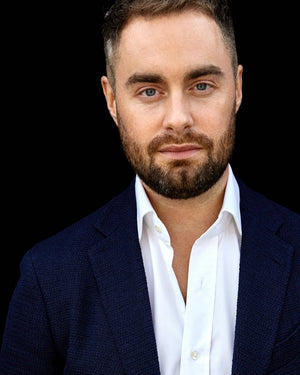
I started YCODE because most skincare was never designed for men’s skin. What I write here is what the formulators taught me, and what the trials actually found.
Continue reading
VIEW ALL →
Stress and poor sleep have a way of becoming visible. The eyes look heavier....
Your skin can notice the change of season before you reach for a coat....
Three formulas focus on the major concerns men tend to see across the face...












































































