

Skincare Routine for Men Over 40: What Your Skin Actually Needs Now

There is a moment most men notice, and it rarely arrives with a warning. The skin stops recovering the way it used to. A late night that once cleared overnight now takes two days to fade. Lines that used to appear and then vanish begin to hold their position. The area around the eyes carries tiredness regardless of how much sleep preceded it. Texture shifts. Bounce-back slows. None of this is imagination, and none of it is failure. It is a measurable biological turn, and it tends to land somewhere around 40.
After 40, male skin enters a phase where collagen loss, barrier depletion and slower cellular turnover compound at the same time. The products that served at 30 are not badly made. They are simply built for a different set of conditions. A skincare routine for men over 40 has to account for that turn, and it has to reach the layers where the change is actually taking place.
What actually changes in men's skin after 40?
Collagen declines at approximately 1% per year from the early thirties onward.1 By 40, a decade of quiet subtraction has become visible. The skin thins first where it was always thinnest: around the eyes, along the jaw, across the forehead. Firmness reduces. Lines settle deeper. This is the turning point that separates a routine built for maintenance from one built for active support, and it is worth understanding before you change a single product.
Cellular turnover slows too. In the twenties the skin renews itself in roughly 28 days. Over 40 that cycle stretches to 40 to 50 days.2 Dead cells sit on the surface longer, texture roughens, and anything you apply absorbs less efficiently because the surface it meets is denser with spent cells. Sebum production, meanwhile, begins to fall.3 For men who spent twenty years managing shine, this is an unfamiliar reversal. Skin that was reliably oily turns unpredictably dry, and the barrier now needs external support to replace a resource it once produced on its own.
The eye area registers all of this first. The skin around the eyes has fewer oil glands, less fat padding and thinner structure than anywhere else on the face. Collagen loss, slower recovery and reduced moisture converge in a small, highly visible zone, so dark circles, puffiness and fine lines that used to be occasional become the resting state. Recovery from environmental stress slows across the whole face as well. UV exposure, cold air, dry heating, travel and poor sleep each leave a longer impression than they did a decade earlier.4 The skin still repairs. It just needs more time, and more help, to do it.
Why does the routine that worked at 30 fall short now?
Most men who reach 40 are still running a routine built for younger biology. A cleanser and a moisturiser. Sometimes a face wash that strips oil and a cream that sits on the surface. That pairing suited 30-year-old skin, which had high oil, fast recovery and dense collagen. At 40 the conditions have moved, and the routine has not moved with them. The skin now needs active ingredients delivered below the surface, where repair, hydration binding and structural maintenance actually begin. A moisturiser seals the surface. Rebuilding the ceramide matrix, regulating a changing oil output and delivering peptides to the mid-epidermis calls for a serum.
A serum changes the equation because smaller molecules at higher concentrations can penetrate thicker male skin and reach the layers below. Applied before the moisturiser, it compounds everything that follows: the barrier receives the actives first, and the moisturiser locks them in. The eye area, meanwhile, needs its own formulation. Marine bioactives that calm inflammation, light-reflecting minerals that correct dark circles by optics, and barrier support calibrated for the thinnest skin on the face are distinct requirements, not a smaller version of a face cream.
Which shifts should a routine actually answer?
Each biological change points to a specific job. The list below is what a routine for men over 40 has to cover, and what you tend to see when it does.
- Collagen on a steady decline. From the early thirties the skin loses firmness structure at roughly 1% a year, and by 40 the cumulative loss shows.1 Peptides such as palmitoyl tripeptide-5 give daily structural support rather than a one-off fix.What you notice? Skin that looks less slack along the jaw and forehead over a full renewal cycle.
- Turnover slowing to 40 to 50 days. Dead cells linger and the surface roughens as renewal lengthens.2 Smaller, higher-concentration actives on damp skin reach past that denser surface.What you notice? Rougher texture smoothing and products that sink in rather than sit on top.
- Barrier and hydration dipping as sebum falls. The barrier loses a natural protective layer and holds less water.3 Niacinamide supports ceramide production and sodium hyaluronate binds water below the surface.What you notice? Less tightness and flaking, particularly after shaving or a cold commute.
- Recovery from stress taking longer. UV, cold, travel and poor sleep leave a longer mark once the skin's repair pace drops.4 Adaptive microalgae respond to changing conditions through the day.What you notice? Fewer days where your face plainly reads the week you have had.
What does the three-step system look like in practice?
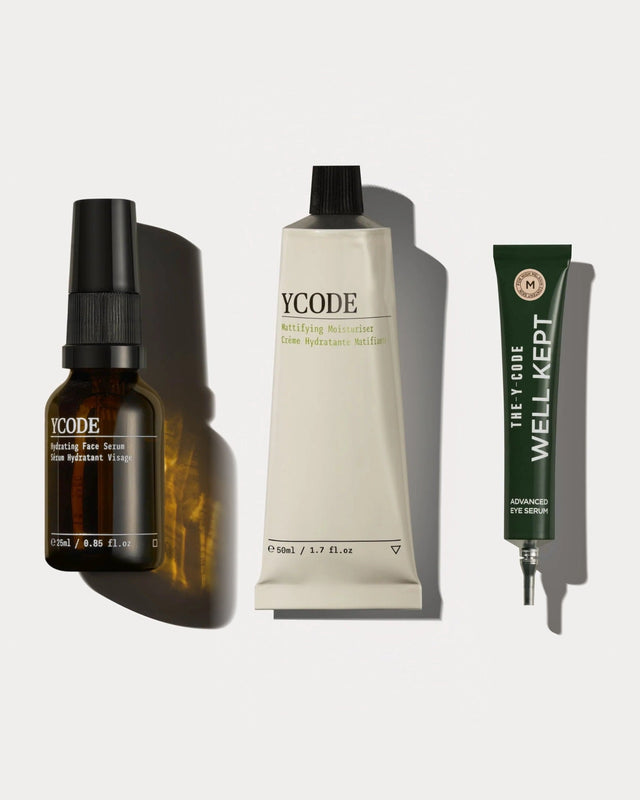
A routine for men over 40 needs three things: active delivery beneath the surface, barrier protection at the surface, and targeted treatment for the eye area. The Core Trio sets this out as three products and about two minutes, applied in an order where each step compounds the one before it.
Step one, a hydrating face serum. Skin over 40 has a slower turnover cycle and a thinner barrier, so actives need to arrive in smaller molecules at higher concentrations to reach the layers where repair happens. One to two pumps on damp skin, carrying niacinamide, sodium hyaluronate, chlorella vulgaris extract, saccharide isomerate and prebiotics into the barrier before anything else sits on top.
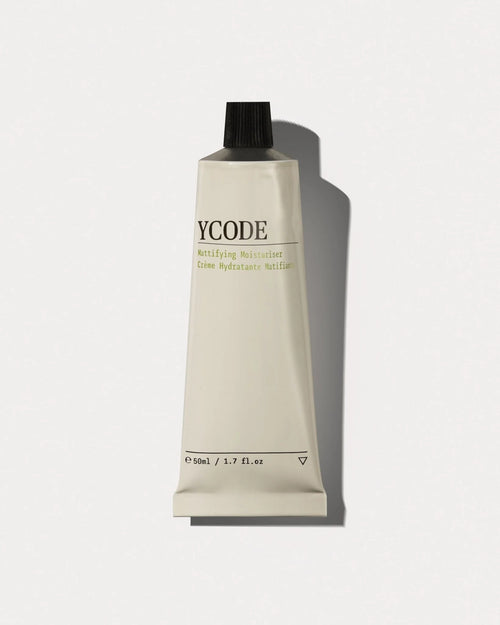
Step two, a mattifying moisturiser. As sebum falls after 40, the skin loses a protective layer it used to maintain on its own. The moisturiser is not only hydration here. It is barrier reinforcement, oil regulation with rice starch, and cumulative structural support from palmitoyl tripeptide-5, delivered daily across the full day.
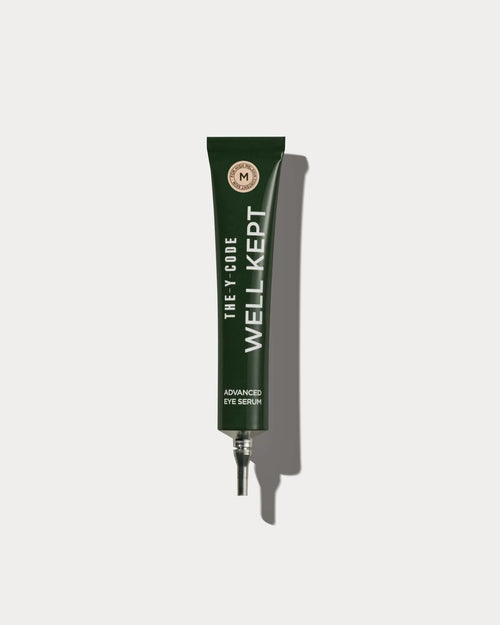
Step three, the Advanced Eye Serum. The skin around the eyes is thinner, has fewer oil glands and loses collagen faster than anywhere else, which is why it shows change first. Marine bioactives calm inflammation within minutes, a light-reflecting mineral complex corrects dark circles through optics rather than coverage, and three melanin-adaptive formulas match tone precisely. Every product is under 100ml, so the full system is carry-on sized by design.
One cycle will show you what the products can do. Thirty will show you what your skin is capable of.
If you are unsure where your skin actually sits, a short diagnostic beats guesswork. Applied once, the routine delivers a visible difference. Applied daily across a full renewal cycle, it delivers structural change.
FAQ
What is the best skincare routine for men over 40?
Three steps. A hydrating serum to deliver actives below the surface, a moisturiser to seal and protect, and a targeted eye treatment for the area that shows change first. Applied in sequence, each step compounds the next, and the whole routine takes under two minutes.
What actually happens to men's skin after 40?
Collagen declines at roughly 1% per year from the early thirties.1 Cellular turnover slows from about 28 days to 40 to 50 days,2 sebum production drops, and the barrier holds less water.3 Recovery from environmental stress also takes longer.4 These shifts are measurable and well documented.
Which ingredients should men over 40 look for?
Niacinamide for barrier repair and oil regulation, sodium hyaluronate for sub-surface hydration, peptides for cumulative collagen support, adaptive microalgae for hydration that adjusts to changing conditions, and marine bioactives for the eye area. They perform best as a system, applied in sequence, daily.
How long before a new routine shows results?
Hydration improves from the first application. Texture and tone tend to improve within two weeks. Structural recovery, including visible softening of fine lines, needs one full renewal cycle, which runs 40 to 50 days over 40.2 Stay consistent through at least one complete cycle before you judge it.
Build the routine your skin now needs.
Start with the Core Trio for the full three-step system, or take the two-minute skin quiz to see where your skin sits first.
This article is for informational purposes only and is not intended as medical advice.
References
- Shuster S. Osteoporosis, like skin ageing, is caused by collagen loss which is reversible. Journal of the Royal Society of Medicine. 2020;113(4):158-160. https://pmc.ncbi.nlm.nih.gov/articles/PMC7160787/
- Farage MA, Miller KW, Elsner P, Maibach HI. Characteristics of the aging skin. Advances in Wound Care. 2013;2(1):5-10. https://pubmed.ncbi.nlm.nih.gov/24527317/
- Wang Z, Man MQ, Li T, Elias PM, Mauro TM. Aging-associated alterations in epidermal function and their clinical significance. Aging (Albany NY). 2020;12(6):5551-5565. https://pubmed.ncbi.nlm.nih.gov/32217811/
- Rittie L, Fisher GJ. Natural and sun-induced aging of human skin. Cold Spring Harbor Perspectives in Medicine. 2015;5(1):a015370. https://pubmed.ncbi.nlm.nih.gov/25561721/
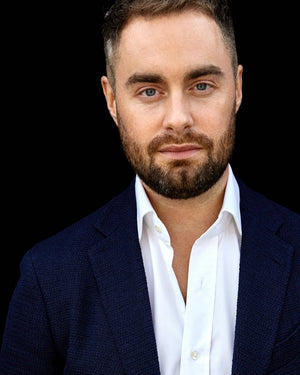
I started YCODE because most skincare was never designed for men’s skin. What I write here is what the formulators taught me, and what the trials actually found.

Continue reading
VIEW ALL →
Stress and poor sleep have a way of becoming visible. The eyes look heavier....

Your skin can notice the change of season before you reach for a coat....
Three formulas focus on the major concerns men tend to see across the face...