

Why You Are Shiny by Lunchtime, Even Though You Moisturised
Shine that arrives on a schedule is telling you about your own biology, not about your moisturiser. Here is the timing behind it, and what actually helps.

You wash, you moisturise, you leave the house looking like a man who has his act together. Four hours later you catch yourself in the lift doors and your forehead is doing something reflective. It is one of the most common complaints men have about skincare, and the usual conclusion, that the moisturiser did it, is almost always wrong.
The timing is the clue. Shine that arrives on a schedule is telling you about your own biology rather than about the product. Once you understand the schedule, the fix becomes obvious and fairly undramatic.
Your skin has a clock
Sebum is not produced at a flat rate. Researchers measuring facial skin continuously over 48 hours found sebum excretion following a circadian rhythm, with shorter cycles of around eight hours running inside it, alongside rhythms in water loss through the skin and in surface pH 1. Your face at eleven in the morning is not the same surface it was at seven.
Add the baseline. Sebaceous gland activity is governed largely by androgens, dihydrotestosterone in particular, which set how big and how productive the glands are in the first place 2. In vivo measurement across 300 people found male skin producing more sebum than female skin, and continuing to produce at that level for decades while female output falls away 3.
So the shine is on time because it is your own oil, arriving on its own rhythm, on a face that produces more of it than most. That is worth knowing simply because it removes the sense that you are doing something wrong.
What is actually happening between nine and one
Four things stack up over the morning.
Sebum accumulates. Nothing removes it between your morning wash and the end of the day, so it builds on the surface, pooling first where the glands are densest across the forehead, nose and chin.
Heat and movement speed it up. A commute, a warm office, a meeting room with the door shut. Warm skin releases oil more readily than cool skin, which is why the same face behaves differently in February and July.
Your hands help it along. Leaning on a hand, pushing hair back, the small unconscious face-touching that fills a working morning. Dermatologists specifically flag this, because it spreads oil around rather than removing it 4.
And any product that has not fully absorbed is still sitting there, adding its own reflectivity to whatever your skin is doing.
Shine that arrives at the same time every day is not a product failure. It is a schedule, and schedules can be worked with.
The loop that makes it worse
The instinctive response is to attack. Wash harder, wash more often, use something that squeaks, skip the moisturiser because moisturiser feels like adding to the problem.
This is the one genuine mistake in the whole sequence. Sebum is part of the skin barrier, and stripping it repeatedly disrupts that barrier, which leaves skin greasy on the surface and uncomfortable underneath 5. The American Academy of Dermatology's guidance is to cleanse gently up to twice a day, avoid scrubbing, and moisturise afterwards, on the basis that harsh products irritate skin and can drive oil production up 4.
Skipping moisturiser does not reduce the oil either. It reduces the water, which is a different thing entirely, and it tends to leave you shiny and tight at the same time.
What genuinely helps
Cleanse gently, morning and evening, and let that be the whole of your washing 4.
Use a moisturiser that hydrates properly and finishes matte. The finish comes from fine absorbent particles at the surface, rice starch among the most useful of them, while humectants and lipids do the hydration underneath. If you want the mechanism in full, we have written about what mattifying moisturiser actually means.
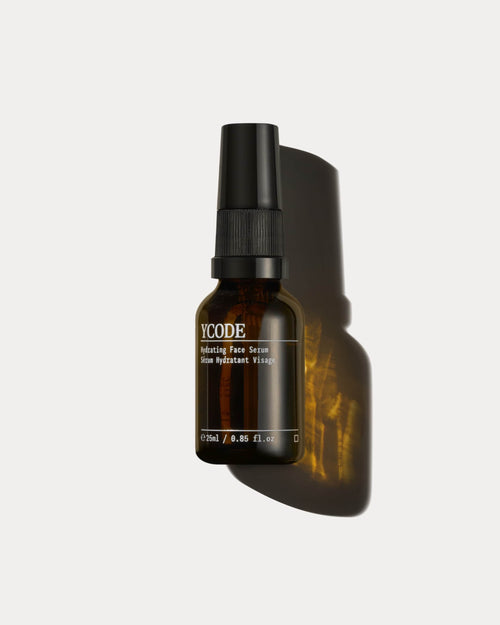
Consider niacinamide. Topical 2% niacinamide has been measured lowering sebum excretion rates after two and four weeks of use, which is one of the few well-documented ways of acting on production rather than on the surface 62. It sits second on the ingredient list of our Hydrating Face Serum.
Keep blotting papers in a drawer. The AAD recommends pressing rather than rubbing, so you lift the oil instead of moving it around 4. Ten seconds before a meeting does more for how you look than an extra wash at lunchtime.
What we built for this
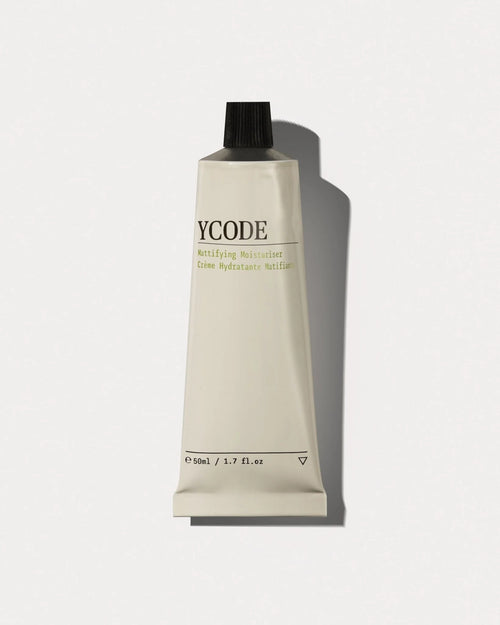
The Mattifying Moisturiser exists because of the four o'clock problem, though it is a moisturiser first. Deep hydration that holds all day, formulated for every skin type, with oil balanced and the look of pores refined. Barrier lipids, glycerin and hyaluronic acid do the hydration, Chlorella vulgaris does adaptive antioxidant and barrier support, and rice starch handles the finish.
YCODE Mattifying Moisturiser, independent consumer trial, 53 men, four weeks.
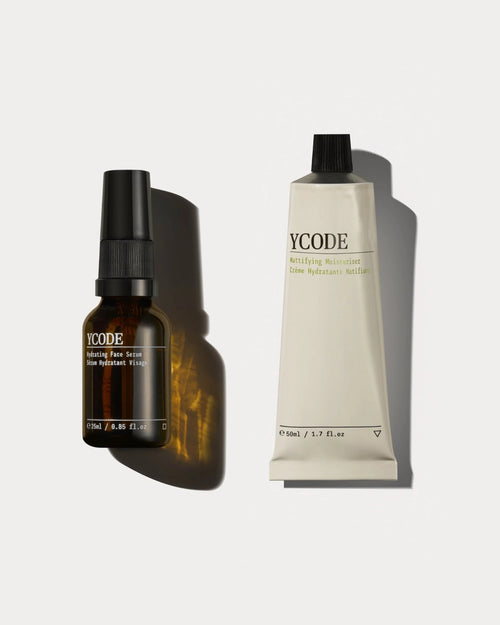
Used with the face serum underneath it, the pair was trialled together as a regime.
YCODE serum and moisturiser together, independent consumer trial, 50 men, four weeks.
A realistic expectation
You will still produce oil. That part is set at the gland, and no cream reaches it 2. What changes is how the surface reads at the hours that matter, and how your skin feels while it gets there.
Judge it over a fortnight rather than a morning, and judge it in daylight at four in the afternoon rather than in a bathroom mirror at eight. Most men find the difference is less about eliminating shine and more about no longer thinking about it, which was always the point.
If you want the full routine rather than the explanation, our guide to managing oily skin and shine covers the order and the habits.
Why does my face get shiny a few hours after moisturising?
Should I stop using moisturiser if I get shiny?
Does washing my face at lunchtime help?
How long before a mattifying moisturiser makes a visible difference?
- Le Fur I, Reinberg A, Lopez S, Morizot F, Mechkouri M, Tschachler E. Analysis of circadian and ultradian rhythms of skin surface properties of face and forearm of healthy women. Journal of Investigative Dermatology, 2001. Source
- Endly DC, Miller RA. Oily Skin: A Review of Treatment Options. Journal of Clinical and Aesthetic Dermatology, 2017. Source
- Luebberding S, Krueger N, Kerscher M. Skin physiology in men and women: in vivo evaluation of 300 people including TEWL, SC hydration, sebum content and skin surface pH. International Journal of Cosmetic Science, 2013. Source
- American Academy of Dermatology. How to control oily skin. Source
- Sakuma TH, Maibach HI. Oily skin: an overview. Skin Pharmacology and Physiology, 2012. Source
- Draelos ZD, Matsubara A, Smiles K. The effect of 2% niacinamide on facial sebum production. Journal of Cosmetic and Laser Therapy, 2006. Source

I started YCODE because most skincare was never designed for men’s skin. What I write here is what the formulators taught me, and what the trials actually found.
Continue reading
VIEW ALL →
Your skin can notice the change of season before you reach for a coat....
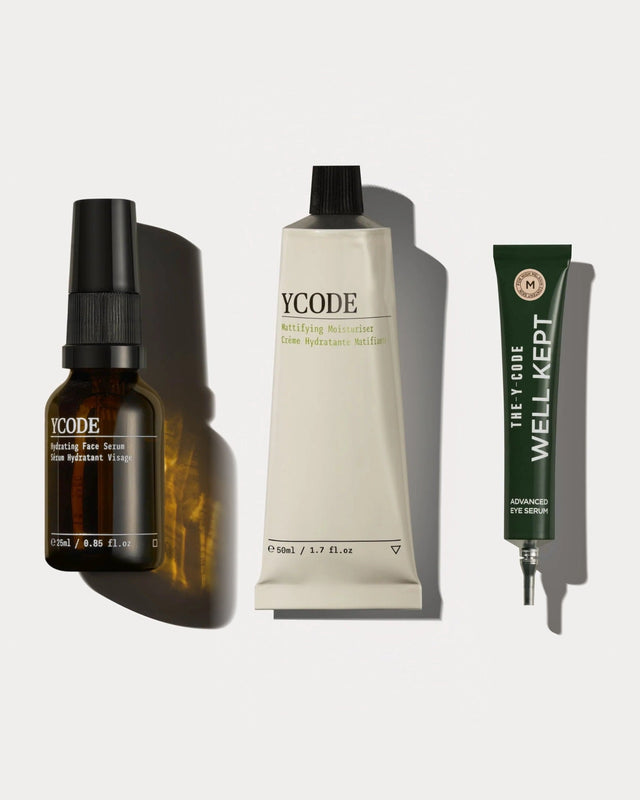
Three formulas focus on the major concerns men tend to see across the face...
The Daily Essentials improves the face and neck. Advanced Eye Serum adds concentrated support...












































































