

Eye Serum for Darker Skin: Why Depth of Tone Changes What Works
The under-eye is the thinnest skin on your body, and what shows through it changes with depth of tone. Why most eye serums solve a problem you may not have, and what to look for instead.

The skin under your eye is the thinnest on your body, and it has almost no fat beneath it. Everything sitting underneath shows through: blood vessels, muscle, bone, and pigment. That is true for everyone. What changes with depth of tone is which of those things you are actually seeing, and that single fact decides whether an eye product will do anything for you.
Most eye serums are built around one answer. They assume the darkness is vascular, they constrict the blood vessels, and on the right skin that works reasonably well for a few hours. On deeper tones it often does very little, and the reason is not the product being weak. It is the product solving a problem you do not have.
Four causes, and which one is likely yours
Under-eye darkness is classified into four types: pigmented, which reads brown; vascular, which reads blue or purple through the thin skin; structural, which is hollowing and contour catching the light; and mixed.1 Most people have a mixture, but the balance shifts with tone.
In deeper skin the pigmented component usually carries more weight. That is not a value judgment about the skin, it is a straightforward consequence of how melanin behaves in an area this thin. There is nothing above it to soften what it does optically.
The classification also has a genetic dimension that is rarely mentioned on a product page. Periorbital hyperpigmentation is considered to have a genetic basis, and the review literature describes families showing the same pattern across generations, with the darkening becoming more pronounced with age.1 Dermal melanocytosis, such as nevus of Ota or Hori, can also present around the eye as slate-grey or blue-black pigmentation.1
If your circles arrived in your teens and never left, and everyone in your family has them, you are probably looking at something constitutional. That is useful information. It changes what success looks like.
Why the same pigment reads differently
Here is the part that explains the rest of this article.
Skin tone is not about how many pigment cells you have. It is about how the pigment is made, packaged and distributed. When researchers examined this under the microscope, they found melanosomes, the packets that carry pigment, are largest in darker skin and are dispersed individually through the surrounding skin cells. In lighter skin they are smaller and grouped into membrane-bound clusters, and Asian skin shows a mixture of both.2
Individually dispersed pigment absorbs light more evenly across an area. Clustered pigment scatters it differently. In a region of skin as thin as the lower eyelid, that difference is the difference between a brown cast and a blue one, and between an active that helps and an active that misses.
Depth matters as much as amount
The second thing to understand is where the pigment is sitting.
Pigment held in the epidermis reads tan to dark brown and can take months to years to resolve on its own. Pigment that has dropped into the dermis reads blue-grey, and may either be permanent or fade over a very long period without treatment.3 No topical reaches dermal pigment quickly, and any product implying otherwise is overselling itself.
This is why we are careful about what we promise around the eye. A well-built serum can make the area look more even and less tired, and it can genuinely reduce the appearance of dark circles. It is not a bleaching agent and it is not a substitute for a dermatologist if something has changed suddenly or sits on one side only.
Depth of tone does not make the under-eye harder to treat. It makes it a different problem, and the industry has mostly kept solving the other one.
Why gentle is not the soft option here
On deeper skin, irritation has a cost that does not exist in the same way on lighter skin.
Melanocytes in deeper tones tend to be larger and more active, with higher tyrosinase activity and dendrites that pass more pigment into surrounding cells.4 Inflammatory mediators released by any injury, including the low-grade kind caused by an active that is slightly too strong, activate tyrosinase directly and increase both melanin production and its transfer.3 Post-inflammatory hyperpigmentation follows, and it is markedly more common in skin of colour.3
The clinical literature is blunt about the consequences. A systematic review covering 1,356 people with Fitzpatrick types III to VI found topical retinoids the most effective topical option, then warned that retinoid dermatitis may worsen the pigmentation being treated, and recommended lower starting concentrations with slow escalation. Repeated laser treatment induced new pigmentation in 11% to 17% of cases, more often in darker skin types.5
Now apply that to the thinnest skin on your body, where actives penetrate faster and irritation shows sooner. Restraint is not a lesser choice around the eye. It is the correct one.
The same logic applies to rubbing. Allergic and atopic dermatitis contribute to periorbital darkening partly through the rubbing and scratching they cause.1 If you have hay fever, treating the hay fever may do more for your under-eye than any serum will.
Light, and why it is a year-round problem
Sun exposure deepens under-eye pigmentation, and it is not only ultraviolet that does it. Visible light also induces pigment darkening in Fitzpatrick types IV and V, though ultraviolet is far more efficient at it per unit of energy delivered.6 The practical version: daily sun protection does more for pigmented circles over a year than any active applied at night, and it matters in January as well as July.
What we changed, and why there are three formulas
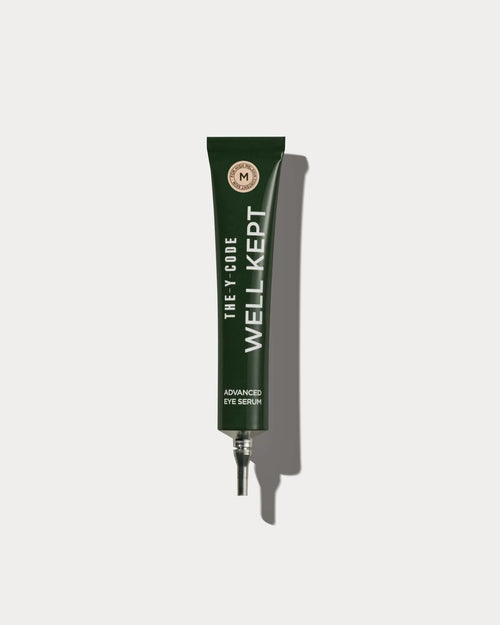
Our Advanced Eye Serum is made in three formulas. Formula M was developed for the majority of skin tones, M- for very light skin, and M+ for deeper tones, with more hydration and a finish that stays true rather than going ashy or flat.
The optical part is worth being precise about. Every mineral particle in a formula interacts with light that the skin underneath is already scattering, and skin scatters light differently at different depths of tone. A single mineral loading built on one tone will read chalky on another. The three formulas exist because that is a formulation variable, not a shade chart. Nothing is being covered and nothing is being corrected.
The actives are the same in all three. The lead one is a supercritical CO₂ extract of wild ginger, chosen over caffeine because caffeine only reaches the vascular cause, while the wild ginger extract carries published data on both the vascular cause and the pigmented one. Alongside it sit marine actives, mineral-rich red algae, vitamin E and panthenol. The formula is fragrance-free, and it contains no vitamin C, because the eye area is a poor place for an active that turns unstable and irritating.
Published ingredient studies of the supercritical CO₂ wild ginger extract the serum is built on. Eurofins Dermscan, 111 volunteers, mean age 42, measured at 15 minutes and 15 days. These are ingredient-study figures, not a consumer trial of the finished serum.
For the wider argument behind all of this, read what melanin adaptive skincare actually means. If you want the practical shopping version instead, we wrote a buying guide for men of colour. And if you would rather answer a few questions than read any of it, the two-minute skin analysis will point you at the right formula.
Do eye serums work on darker skin?
Why are my dark circles brown rather than blue?
Can dark circles on darker skin be permanent?
Should I use retinol under my eyes?
- Sarkar R, Ranjan R, Garg S, Garg VK, Sonthalia S, Bansal S. Periorbital Hyperpigmentation: A Comprehensive Review. Journal of Clinical and Aesthetic Dermatology. 2016;9(1):49-55. Source
- Thong HY, Jee SH, Sun CC, Boissy RE. The patterns of melanosome distribution in keratinocytes of human skin as one determining factor of skin colour. British Journal of Dermatology. 2003;149(3):498-505. Source
- Davis EC, Callender VD. Postinflammatory Hyperpigmentation: A Review of the Epidemiology, Clinical Features, and Treatment Options in Skin of Color. Journal of Clinical and Aesthetic Dermatology. 2010;3(7):20-31. Source
- Markiewicz E, Karaman-Jurukovska N, Mammone T, Idowu OC. Post-Inflammatory Hyperpigmentation in Dark Skin: Molecular Mechanism and Skincare Implications. Clinical, Cosmetic and Investigational Dermatology. 2022;15:2555-2565. Source
- Mar K, Khalid B, Maazi M, Ahmed R, Wang OJE, Khosravi-Hafshejani T. Treatment of Post-Inflammatory Hyperpigmentation in Skin of Colour: A Systematic Review. Journal of Cutaneous Medicine and Surgery. 2024;28(5). Source
- Ramasubramaniam R, Roy A, Sharma B, Nagalakshmi S. Are there mechanistic differences between ultraviolet and visible radiation induced skin pigmentation? Photochemical and Photobiological Sciences. 2011;10(12):1887-1893. Source

I started YCODE because most skincare was never designed for men’s skin. What I write here is what the formulators taught me, and what the trials actually found.

Continue reading
VIEW ALL →
Stress and poor sleep have a way of becoming visible. The eyes look heavier....

Your skin can notice the change of season before you reach for a coat....
Three formulas focus on the major concerns men tend to see across the face...












































































