

Under Eye Serum for Men of Colour: What to Look For, and What to Ignore
A buying guide for men of colour, written to be useful rather than flattering. What goes wrong with under-eye products on deeper tones, what to look for on a label, and how to judge whether something is actually working.

If you have ever bought an under-eye product, put it on, and seen a faint grey film sitting on your skin, you already understand the problem this article is about. The ingredient list was probably fine. The formula was calibrated on somebody else.
This is a buying guide for men of colour, written to be useful rather than flattering. It covers what actually goes wrong with under-eye products on deeper tones, what to look for on a label, what to ignore, and how to judge whether something is working. There is a section on what we make at the end, clearly marked, so you can skip it if you want the rest.
Start with the cause, not the product
Darkness under the eye is not one condition. Dermatology sorts it into four groups: pigmented, which reads brown; vascular, which reads blue or purple through thin skin; structural, which is contour and hollowing catching the light; and mixed, which is most people.1
That classification matters more for you than it does for most buyers, because the pigmented component is more likely to be significant in deeper tones, and because periorbital hyperpigmentation is considered to have a genetic basis. The same review notes families in which the pattern runs across generations, with the darkening increasing with age.1
Which is worth saying plainly. If you have had circles since you were nineteen, and your father has them too, that is not a sleep debt you can repay. It is constitutional. A product can make the area look less tired and more even. It cannot rewrite your genetics, and anything claiming otherwise is selling you something.
The practical test is simple. Press gently on the darkest part and stretch the skin lightly. If the colour largely stays, you are looking at pigment. If it fades noticeably, there is a vascular component. If the darkness deepens when you tilt your head under a downlight, some of it is structural. Most men find they have two of the three.
The four things that go wrong on deeper tones
One: the cast. Most under-eye products with any optical component are built around a single mineral loading. On deeper skin that reads grey, chalky or flat. It is the most common complaint and the easiest to test, because you can see it in daylight within ten seconds of application.
Two: irritation that leaves a mark. This is the important one. Melanocytes in deeper tones are larger and more active, with higher tyrosinase activity, and inflammatory signals drive both pigment production and its transfer into surrounding skin cells.2 The result is post-inflammatory hyperpigmentation, which is markedly more common in skin of colour and can take months to years to fade on its own.3 A product that stings a little is not a minor annoyance under your eye. It can leave you worse off than before you started.
Three: actives chosen for a different risk profile. A systematic review of 1,356 people with Fitzpatrick types III to VI found topical retinoids the most effective topical option for post-inflammatory pigmentation, and in the same breath warned that retinoid dermatitis may worsen the pigmentation it was meant to treat. It recommended lower starting concentrations and slow escalation.4 Strong is not the same as suitable.
Four: the wrong mechanism entirely. Caffeine is the most common under-eye active in men's skincare. It constricts blood vessels, which addresses the vascular cause and does nothing at all for brown pigment. If your circles are largely pigmented, a caffeine product will disappoint you and you will conclude eye products do not work.
A product that stings a little is not a minor annoyance under your eye. On skin that answers inflammation with pigment, it can leave you worse off than when you started.
What to look for on the label
Fragrance-free, not unscented. Unscented often means a masking fragrance. Fragrance is among the more common causes of low-grade contact irritation, and low-grade irritation is where pigment problems begin.
An active that works on pigment, not only on vessels. Ingredients with evidence against the pigmented cause include niacinamide, azelaic acid and tyrosinase-targeting extracts. Anti-inflammatory actives that also suppress melanogenesis are the sensible category to look for in deeper tones, precisely because they work on both halves of the problem at once.2
A stated position on tone. Not a diverse campaign. An actual formulation answer: does the brand offer more than one calibration, and can it explain why. If tone appears only in the photography, it was a marketing decision.
Simplicity. Ten actives in one under-eye product is ten chances to react. The thin skin around the eye is not where you experiment.
What to ignore
Ignore anything promising to change the colour of your skin rather than to reduce dark circles. That vocabulary came from an industry that treated deeper tones as something to correct, and it is a reliable signal that a brand has not thought about you at all.
Ignore before-and-after images shot under different lighting. Under-eye photography is trivially easy to manipulate with a downlight.
Ignore panel results that do not tell you who was in the panel. If the study population is undeclared, the number means less than it looks like it means.
Something specific to men
There is one thing worth flagging that sits outside the eye area but affects the same skin. Pseudofolliculitis barbae, or razor bumps, affects an estimated 45% to 80% of men of African ancestry, and once the bumps heal, post-inflammatory hyperpigmentation and scarring can follow.5 If shaving is leaving marks along your jaw, the same reactivity is at work as under your eye. Reducing irritation is the same project in both places, which is a reason to treat gentleness as a strategy rather than a compromise.
What we make, and why it is built this way
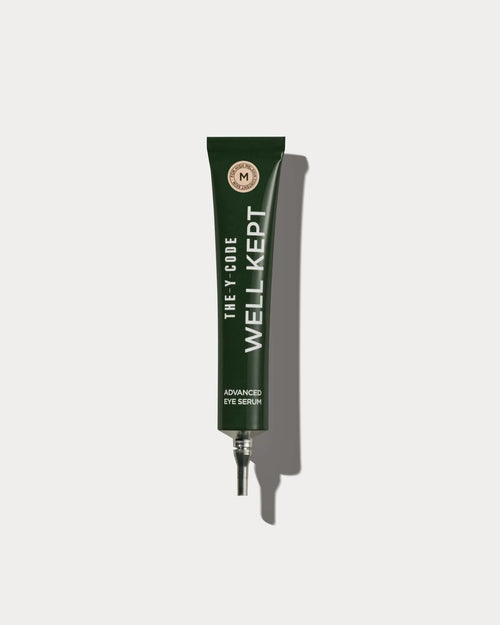
Our Advanced Eye Serum comes in three formulas rather than one. Formula M was developed for the majority of skin tones, M- for very light skin, and M+ for deeper tones, with more hydration and a finish that stays true rather than going ashy. They are formulas, not shades, and there is no coverage in the make-up sense. The mineral system responds to the tone it is applied to, so the area reads as a more rested version of your own skin.
The lead active is a supercritical CO₂ extract of wild ginger rather than caffeine. That was a deliberate choice, made for the reason in the fourth point above: caffeine only reaches the vascular cause, while the wild ginger extract carries published data on both the vascular cause and the pigmented one. The formula is fragrance-free and contains no vitamin C, which we left out because the eye area is not the place for an active that turns unstable and irritating.
Published ingredient studies of the supercritical CO₂ wild ginger extract the serum is built on. Eurofins Dermscan, 111 volunteers, mean age 42, measured at 15 minutes and 15 days. These are ingredient-study figures, not a consumer trial of the finished serum.
Two honest caveats. Those figures describe the active at test concentration, not our finished product, and we say so every time. And they describe a change in appearance. If your darkness is largely structural hollowing, no topical will fill it, and we would rather tell you that than take the sale.
How to judge whether it is working
Give it a fortnight before you decide anything, and judge it in daylight rather than bathroom light. What you are looking for is the area reading more even and less tired, not a dramatic before and after. If you see any stinging, itching or redness that lasts more than a few minutes, stop, because on your skin that is not a sign it is working.
If you want the full reasoning behind the three formulas, read what melanin adaptive skincare actually means. For a plain comparison of the actives, our guide to the best ingredients for dark circles covers what each one does and where it stops. There is more on the under-eye area itself in why depth of tone changes what works there. And if you are building a routine rather than buying one product, the starter kit is the simpler place to begin.
What is the best under eye serum for men of colour?
Why do eye products leave a grey cast on darker skin?
Are my dark circles from lack of sleep?
Can an eye serum make pigmentation worse?
- Sarkar R, Ranjan R, Garg S, Garg VK, Sonthalia S, Bansal S. Periorbital Hyperpigmentation: A Comprehensive Review. Journal of Clinical and Aesthetic Dermatology. 2016;9(1):49-55. Source
- Markiewicz E, Karaman-Jurukovska N, Mammone T, Idowu OC. Post-Inflammatory Hyperpigmentation in Dark Skin: Molecular Mechanism and Skincare Implications. Clinical, Cosmetic and Investigational Dermatology. 2022;15:2555-2565. Source
- Davis EC, Callender VD. Postinflammatory Hyperpigmentation: A Review of the Epidemiology, Clinical Features, and Treatment Options in Skin of Color. Journal of Clinical and Aesthetic Dermatology. 2010;3(7):20-31. Source
- Mar K, Khalid B, Maazi M, Ahmed R, Wang OJE, Khosravi-Hafshejani T. Treatment of Post-Inflammatory Hyperpigmentation in Skin of Colour: A Systematic Review. Journal of Cutaneous Medicine and Surgery. 2024;28(5). Source
- Numan H, Gomez J, Oakley A. Pseudofolliculitis barbae. DermNet, 2022. Source

I started YCODE because most skincare was never designed for men’s skin. What I write here is what the formulators taught me, and what the trials actually found.

Continue reading
VIEW ALL →
Stress and poor sleep have a way of becoming visible. The eyes look heavier....

Your skin can notice the change of season before you reach for a coat....
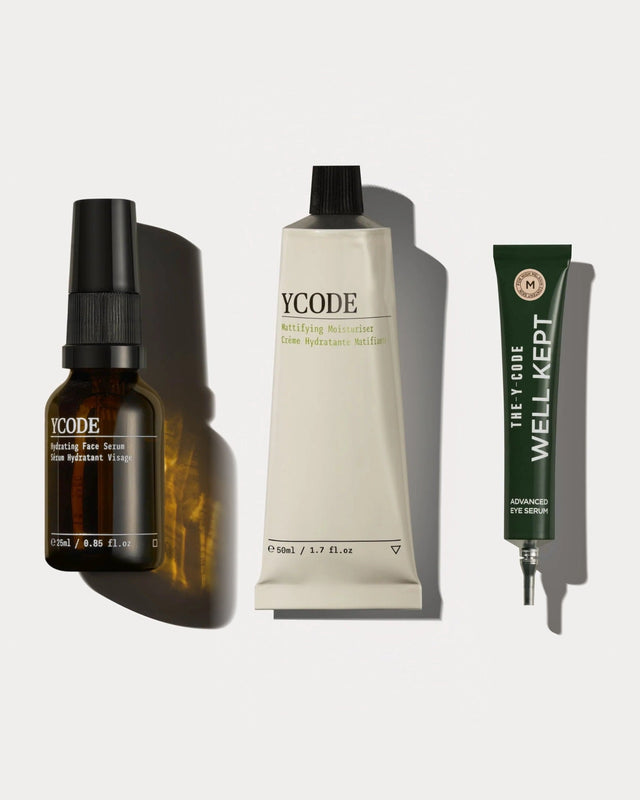
Three formulas focus on the major concerns men tend to see across the face...