

Melanin Adaptive Skincare: What It Means and Why Skin Tone Changes the Formula
We coined the phrase, so here is the honest definition. Melanin adaptive skincare is formulated around how a skin tone behaves, not around matching what colour it is, and the difference decides what a product does when it meets your skin.

Melanin adaptive is a phrase we coined, which means we owe you a definition rather than a slogan. Melanin adaptive skincare is skincare formulated around how a skin tone behaves, rather than around what colour it is. Those are two different questions, and the second one has been asked far more often than the first.
The distinction matters because melanin is not a coat of paint. It is an active biological system, and it changes how skin answers friction, inflammation, actives and light. A formula that ignores that is not neutral. It is built around one set of responses and then sold to everybody.
What melanin actually does, beyond colour
Start with the part most people have backwards. Skin tone is not a question of having more or fewer pigment cells. Melanocytes are present in broadly similar numbers across tones. What differs is what those cells produce, and how the pigment is packaged and distributed once it has been handed on to the surrounding skin cells.
When researchers examined this directly, they found that melanosomes, the small packets that carry pigment, are largest in darker skin and are dispersed individually through the keratinocytes. In lighter skin they are smaller and grouped into membrane-bound clusters, with Asian skin showing a mixture of both patterns.1 That is a structural difference rather than a shade difference, and it is one reason the same stimulus produces a different visible result on different skin.
The second difference is reactivity. Melanocytes in deeper tones tend to be larger and more active, with higher tyrosinase activity and dendrites that transfer more pigment into surrounding cells.2 Under ordinary conditions that is protective. After an insult, it is the mechanism behind a mark that will not shift.
The consequence almost nobody formulates for
That reactivity has a name in dermatology, and it is the single most important fact in this whole subject. Post-inflammatory hyperpigmentation is the dark mark left behind after skin has been inflamed, and it is both more common and more stubborn in deeper tones.
The numbers are stark. In a review of the epidemiology, pigmentary disorders other than vitiligo were the third most common skin complaint among African-American patients at 9%, against 1.7% in Caucasian patients, and dyschromia is one of the leading reasons people with Fitzpatrick types IV to VI see a dermatologist at all.3 Epidermal marks can take months to years to fade without treatment. Pigment that has dropped into the dermis may resolve over a very long period, or not at all.3
The mechanism is not mysterious. Inflammatory mediators released during any skin injury, including leukotrienes, prostaglandins, interleukins and TNF-alpha, activate tyrosinase and drive both melanin production and its transfer into keratinocytes.3 Inflame the skin and you have started a pigment process, whatever caused the inflammation.
So irritation is not a minor inconvenience in deeper tones. It is the first step in something that can outlast its cause by a year.
Why a good active can still be the wrong active
This is where formulation stops being a matter of picking impressive ingredients.
A systematic review of treatments for post-inflammatory hyperpigmentation in skin of colour looked at 48 studies covering 1,356 people with Fitzpatrick types III to VI. Topical retinoids were the best performing topical option, producing partial improvement in 64% of patients. The same review warned about retinoid dermatitis, which may worsen the very pigmentation it was prescribed to treat, and recommended starting at lower concentrations and building slowly. Repeated laser treatment induced new pigmentation in 11% to 17% of cases, more often in darker skin types, and chemical peels carried a higher rate of adverse effects.4
Read that carefully and the lesson is not that retinoids are bad. It is that the same active, at the same strength, carries a different risk profile depending on whose skin it lands on. On skin that answers inflammation with pigment, an active that irritates slightly is not a slight problem. The formulation question is therefore not only what an ingredient does. It is what happens when it goes slightly wrong.
Tone is not a marketing question about who appears in the photographs. It is a formulation question about what a product does when it meets skin that answers inflammation with pigment.
The third variable is light
There is a purely physical part to this as well, and it is the one the industry has handled worst.
Anything that sits partly on the surface of the skin, which includes every mineral particle in every formula that contains one, has to interact with light already being scattered by the skin underneath. A single mineral loading calibrated on one tone will read grey, chalky or flat on another. That is the white cast problem, and it has been treated as a cosmetic inconvenience when it is really a formulation failure. An under-eye product can have a faultless ingredient list and still be the wrong product, because you can see it.
What melanin adaptive means in practice
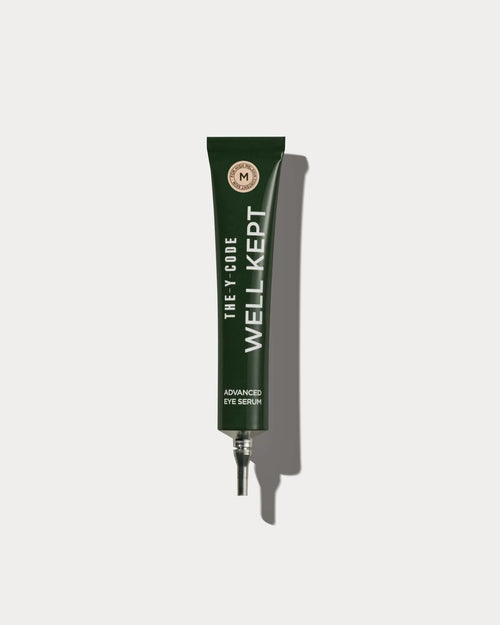
Our Advanced Eye Serum comes in three formulas. Formula M was developed for the majority of skin tones. Formula M- was developed for very light skin, where calming redness matters more. Formula M+ was developed for deeper tones, with more hydration and a finish that stays true rather than going ashy or flat.
They are formulas, not shades. The mineral system is chosen so that it responds to the tone it is applied to, letting the under-eye read as a more rested version of your own skin rather than a colour laid over the top of it. There is no coverage in the make-up sense. Nothing is being concealed, and nothing is being corrected.
The actives underneath are the same across the three. The lead one is a supercritical CO₂ extract of wild ginger, chosen over caffeine for a specific reason. Caffeine only addresses the vascular cause of dark circles. The wild ginger extract carries published data on both the vascular cause and the pigmented one, which is the cause that matters most in deeper tones. Around it sit marine actives, mineral-rich algae, vitamin E and panthenol. The whole formula is fragrance-free, because fragrance is one of the more common causes of the low-grade irritation that starts the pigment process in the first place.
Published ingredient studies of the supercritical CO₂ wild ginger extract the serum is built on. Eurofins Dermscan, 111 volunteers, mean age 42, measured at 15 minutes and 15 days. These are ingredient-study figures, not a consumer trial of the finished serum.
What melanin adaptive is not
It is not a shade range. Three dots of colour on a chart is exactly the thing we are arguing against, and it is why we do not show swatches. It is not concealer, tint or coverage either. Those are cosmetics, and there is nothing wrong with cosmetics, but they work by sitting on top of skin rather than by doing anything to it.
It is not a promise to change the colour of your skin. We do not use the vocabulary of shade correction anywhere near this product, because that language came from an industry that treated deeper tones as a problem to be solved. The outcome we describe is dark circles reduced, tone more even, and looking less tired than you did.
And it is not a claim that one product covers everyone. It is the opposite claim. One formula for every tone is the assumption we are objecting to.
Where this goes next
The eye area is where tone shows first, which is why the three-formula system starts there. Periorbital hyperpigmentation, the clinical name for darkness around the eye, is multifactorial and is considered to have a genetic basis, with families showing the same pattern across generations and the darkening increasing with age.5 It is often constitutional rather than earned, which is worth knowing before you blame yourself for it. But the underlying principle applies across a whole routine: keep the irritation threshold low, choose actives that work without provoking, avoid fragrance, and never assume the optical result on one tone will hold on another. That thinking runs through every product we make.
If you want the reasoning applied to the under-eye specifically, read why depth of tone changes what works under the eye. For the wider argument about why the industry sorts skin by type and stops there, read skin tone, not just skin type. And if you are shopping rather than reading, we wrote a buying guide for men of colour.
What does melanin adaptive skincare mean?
Is melanin adaptive the same as a shade range?
Why does irritation matter more in deeper skin tones?
Which formula should I use?
- Thong HY, Jee SH, Sun CC, Boissy RE. The patterns of melanosome distribution in keratinocytes of human skin as one determining factor of skin colour. British Journal of Dermatology. 2003;149(3):498-505. Source
- Markiewicz E, Karaman-Jurukovska N, Mammone T, Idowu OC. Post-Inflammatory Hyperpigmentation in Dark Skin: Molecular Mechanism and Skincare Implications. Clinical, Cosmetic and Investigational Dermatology. 2022;15:2555-2565. Source
- Davis EC, Callender VD. Postinflammatory Hyperpigmentation: A Review of the Epidemiology, Clinical Features, and Treatment Options in Skin of Color. Journal of Clinical and Aesthetic Dermatology. 2010;3(7):20-31. Source
- Mar K, Khalid B, Maazi M, Ahmed R, Wang OJE, Khosravi-Hafshejani T. Treatment of Post-Inflammatory Hyperpigmentation in Skin of Colour: A Systematic Review. Journal of Cutaneous Medicine and Surgery. 2024;28(5). Source
- Sarkar R, Ranjan R, Garg S, Garg VK, Sonthalia S, Bansal S. Periorbital Hyperpigmentation: A Comprehensive Review. Journal of Clinical and Aesthetic Dermatology. 2016;9(1):49-55. Source

I started YCODE because most skincare was never designed for men’s skin. What I write here is what the formulators taught me, and what the trials actually found.

Continue reading
VIEW ALL →
Stress and poor sleep have a way of becoming visible. The eyes look heavier....

Your skin can notice the change of season before you reach for a coat....
Three formulas focus on the major concerns men tend to see across the face...












































































