

How long does eye serum take to work? A realistic timeline for men
A good eye serum works on two clocks: an immediate optical lift you see the first morning, and a slower change over about a fortnight. Which one to judge when, and the under-eye darkness no serum can shift.

There is a short answer and an honest one, and they are not quite the same. The short answer is that a good eye serum starts to do something in minutes and keeps doing more over a fortnight. The honest one is that those are two different effects on two different clocks, and knowing which is which is the difference between a fair test and a disappointed one.
So it is worth taking the two apart, because most men judge an eye serum on the wrong clock and either give up too early or expect the wrong thing too soon.
The honest answer: two different clocks
An eye product does two jobs. One is optical and it is close to immediate: light-reflecting minerals sit on the skin and change how the under-eye reads in a mirror, so the area looks less shadowed straight away. The other is biological and it is slow: actives that work on the causes of under-eye darkness, on the look of the skin and on the tissue's comfort, which build up with repeated use over days and weeks.
The first clock is why you can see a difference the first morning. The second clock is why you keep using the thing on the fourteenth. Both are real, and they are worth judging separately.
What you see the first morning
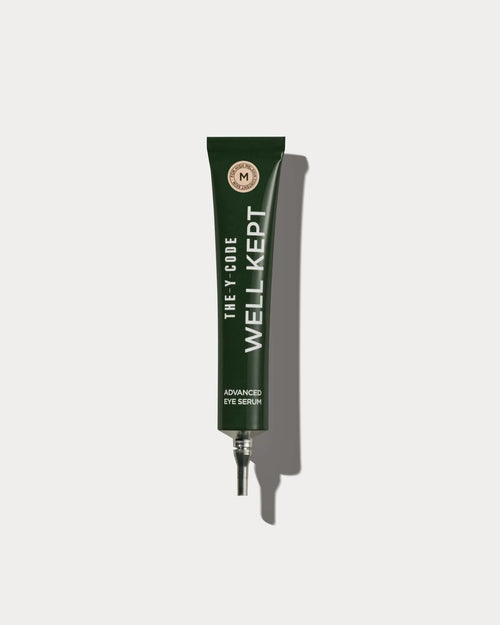
The immediate change is mostly light. Our Advanced Eye Serum comes in three formulas, M, M+ and M-, built around the different requirements of different skin tones under our Melanin Adaptive Technology. The minerals in each are chosen to reflect light in a way that suits that tone, so the under-eye reads as a more rested version of your own skin rather than a layer of colour sitting on top. That is a genuine effect and it happens the moment it is on.
It shows up in how the ingredient it is built on was tested. At fifteen minutes, 86% of volunteers said they looked less tired, 73% that their dark circles were reduced, and 79% that the eye contour looked improved. Fast, and worth having on a morning you did not sleep. What it is not is the actives having finished their work, because at fifteen minutes they have barely started.
What changes over about two weeks
The slower clock is where the real argument for a daily habit sits. The serum is built around a supercritical CO2 extract of wild ginger, chosen because its published data addresses both the pigment and the vascular causes of under-eye darkness rather than only one of them, alongside marine actives that work on the same area. None of that is instant, because skin does not change instantly. The epidermis renews itself over a matter of weeks, not days, with the turnover time measured at roughly six to seven weeks in adults,1 and a change in how pigment and microcirculation present at the surface follows that slower rhythm.
By fifteen days, the same figures had moved on from where they sat at fifteen minutes.
Figures from published ingredient studies of the supercritical CO2 wild ginger extract the serum is built on. Eurofins Dermscan self-assessment, 111 volunteers (37 men and 74 women), mean age 42, measured at 15 minutes and 15 days. Under-eye bags were rated reduced by 89% at 15 days. These are ingredient-study results, not a YCODE consumer trial.
The pattern is the useful part. Every figure rose between the first quarter of an hour and the fifteenth day, which is exactly what a two-clocks product should do: a quick optical lift on day one, then a steadier improvement as the actives are given time to work.
Judge day one on how you look, and judge the fortnight on how the skin behaves. Hold the two to the same standard and you will always be unfair to one of them.
The darkness a serum will not shift
It is worth being straight about the ceiling, because it saves you a month of wondering. Under-eye darkness is not one thing. Reviews of the area describe several causes at once: pigment in the skin, blood vessels showing through thin tissue, and structural shadow from the way fat and bone sit and from the tear-trough hollow that deepens with age.2
The pigment and the vascular part are what respond to a topical, on the slower clock above. The structural part, the hollow that casts its own shadow, is not something a serum reverses on any timeline, and a brand that promises otherwise is selling you a story. Knowing which kind you are mostly looking at tells you what a fair result even looks like. If yours is mostly pigment, give it the fortnight. If it is mostly a deep hollow, a serum will soften how the area reads without filling it.
Why "tired" is the first thing to change
The figure that moves first and highest is the one about looking tired, and that is not an accident. Looking tired is a real, measurable signal that other people read off your face. When researchers photographed people after normal sleep and again after being kept awake, independent observers reliably rated the tired faces as having more swollen eyes, more shadowed under-eyes and a generally more fatigued look.3 It is the composite the eye area produces, and it is the thing the optical clock touches on day one and the slow clock keeps improving. Which is why "I look less tired" tends to be the first honest thing a man notices, before he could tell you exactly what changed.
How to give it a fair test
The fastest way to get a slow result is to be consistent about the fast habit. A rice-grain dose, once a day, applied cool on the orbital bone rather than rubbed into the lid, is a two-minute thing rather than a project, and the technique matters more than the amount. We set the method out in how much eye serum to use and where to apply it. Do that for a fortnight before you decide, because a fortnight is roughly where the second clock starts to show. If the under-eye is your main concern and you want to understand what is actually doing the work, our guide to the ingredients that work on dark circles is the next thing to read.
Give it a fortnight, in other words, and someone may say something to you. They will not be able to tell you what changed, which is rather the point.
How long before I see anything from an eye serum?
How long until dark circles actually fade?
Why can I see a difference straight away but not a bigger one yet?
What if I have used it every day for a month and seen little?
- Iizuka H. Epidermal turnover time. Journal of Dermatological Science. 1994;8(3):215-217. Source
- Sarkar R, Ranjan R, Garg S, Garg VK, Sonthalia S, Bansal S. Periorbital Hyperpigmentation: A Comprehensive Review. Journal of Clinical and Aesthetic Dermatology. 2016;9(1):49-55. Source
- Sundelin T, Lekander M, Kecklund G, Van Someren EJW, Olsson A, Axelsson J. Cues of Fatigue: Effects of Sleep Deprivation on Facial Appearance. Sleep. 2013;36(9):1355-1360. Source

I started YCODE because most skincare was never designed for men’s skin. What I write here is what the formulators taught me, and what the trials actually found.

Continue reading
VIEW ALL →
Stress and poor sleep have a way of becoming visible. The eyes look heavier....

Your skin can notice the change of season before you reach for a coat....
Three formulas focus on the major concerns men tend to see across the face...