

Why your skin feels tight after washing: dehydrated, not dry
That pull across your cheekbones after you dry your face is not the feeling of clean. It is a measurable state of your skin, it points at water rather than oil, and it takes about twenty seconds to fix.

You rinse, you pat dry, and within a minute the skin across your cheekbones feels a size too small. It is not painful. It is just there, a faint pull when you raise your eyebrows, and it has usually faded by the time you have found a shirt. Most men read that as clean. It is closer to the opposite.
Tightness after washing is information. It tells you something specific happened to the outer layer of your skin, it tells you which of two very different problems you have, and it points at a fix that takes about twenty seconds.
What tightness actually is
For a long time the sensation was treated as subjective, the sort of thing you either notice or you do not. In 2023 a group at Stanford, working with researchers at L'Oreal, modelled it properly and published the mechanism 1.
Cleansers remove lipids from the stratum corneum, the outermost layer of dead, flattened cells that does most of the barrier work. When that layer loses lipids and water it contracts. The contraction sends mechanical strain down into the tissue below, where mechanoreceptors sit, and those nerves fire. Your brain reads the firing as tightness. Moisturisers do the reverse: they raise the water content of the same layer, it swells, and the pull releases.
The researchers built a model of this and tested it against large consumer panels, roughly two thousand people rating moisturisers and further panels rating cleansers. The computed nerve activity tracked what people said they felt for up to twelve hours after application 1. So the feeling is not in your head. It is a measurable mechanical state of your skin, reported accurately by your own nervous system.
Dehydrated and dry are not the same problem
This is the distinction that fixes most cases, and almost nobody makes it clearly.
Dry skin is short of oil. The lipid content of the barrier is low, which is largely genetic, worsens with age and cold, and tends to show as flaking, roughness and a dull, papery look. It is a skin type. You have it or you do not.
Dehydrated skin is short of water. Most of the water in the stratum corneum sits inside the corneocytes, bound to natural moisturising factor, a mixture of free amino acids, pyrrolidone carboxylic acid, urea and lactic acid that holds water in place 5. Strip that, or lose it faster than you replace it, and the layer contracts. That is a state, not a type, and it is temporary.
Which is why oily men get tight faces. Dehydration has nothing to do with how much oil you produce. You can be shiny by lunchtime and dehydrated at eight in the morning, and if you treat that tightness as dryness and put something heavy and greasy over the top, you will fix nothing and add shine you did not want.
What the wash actually did
Two things, both of them recoverable.
The first is lipid disruption. Anionic surfactants, sodium lauryl sulphate being the standard example, bind to the lipids between the corneocytes, increase their mobility and reduce the integrity of the bilayers that hold water in 4. That is the same review that describes how moisturisers repair it, which tells you the two are halves of one process.
The second is pH. Healthy skin sits acidic, on average below pH 5 across large populations 3. That acidity is not decorative. It governs the enzymes that build barrier lipids and keeps the resident flora in the right balance. Washing raises it, and here is the part worth knowing: surface pH rises after a single wash, or after rinsing with water alone, and recovery to the physiological level can take several hours 2.
Tight skin after washing is not the feeling of clean. It is the feeling of a surface that has lost water and has not been given any back.
Why this catches men out in particular
Not biology so much as habit. The face gets washed in the shower, with whatever is in the shower, at whatever temperature the shower is set to. Shaving comes on top of that, which is a second mechanical pass over the same barrier. And then, in most cases, nothing goes on afterwards.
The American Academy of Dermatology's own guidance is unglamorous and worth following: lukewarm water, a gentle non-abrasive cleanser without alcohol, applied with your fingertips rather than a flannel, no scrubbing, twice a day and after sweating, pat dry rather than rub, and moisturise afterwards 6. Nothing in that list is difficult. Most men break four of the seven before breakfast.
The twenty-second fix
Put the water back, then stop it leaving.
Hydration goes on first, while the skin is still slightly damp, because a light water-phase product spreads and absorbs when there is nothing in the way. Humectants draw water into the outer layer; occlusives and emollients then slow its escape and help the barrier rebuild its own lipids 4. One draws in, the other holds. Reverse the order and you put the lid on before you have filled anything.
Judged over a fortnight, that is usually the whole answer.
What we make for it
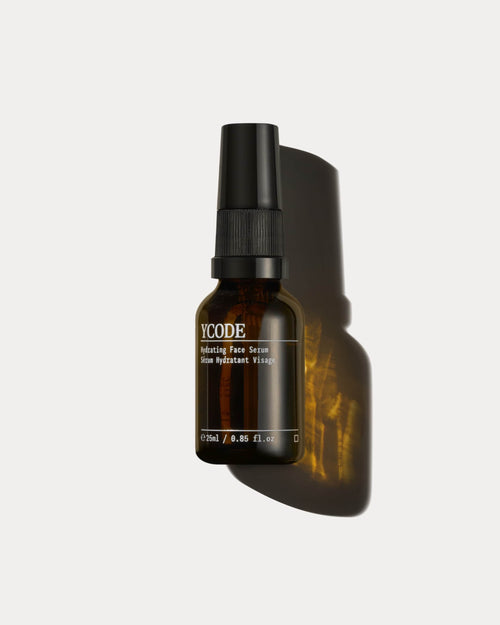
The Hydrating Face Serum is the water step. It is deliberately light so it can go on damp skin and be gone in seconds.
YCODE Hydrating Face Serum, independent consumer trial, ADSL 2025-0056, 50 men, after first use.
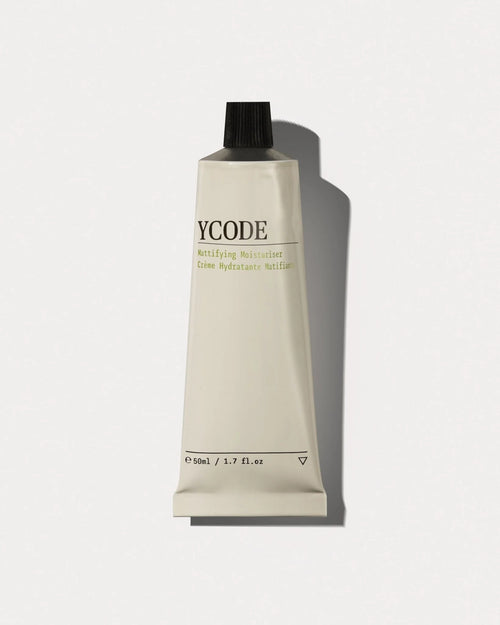
The Mattifying Moisturiser is the step that keeps it there. It is a moisturiser first: deep hydration that holds all day, formulated for every skin type, with oil balanced and the look of pores refined. The matte finish is one feature of it rather than the point of it. In its own trial, 85% said their skin felt instantly hydrated and 87% said it felt soothed and comfortable after application, ADSL 2025-0057, 53 men, after first use.
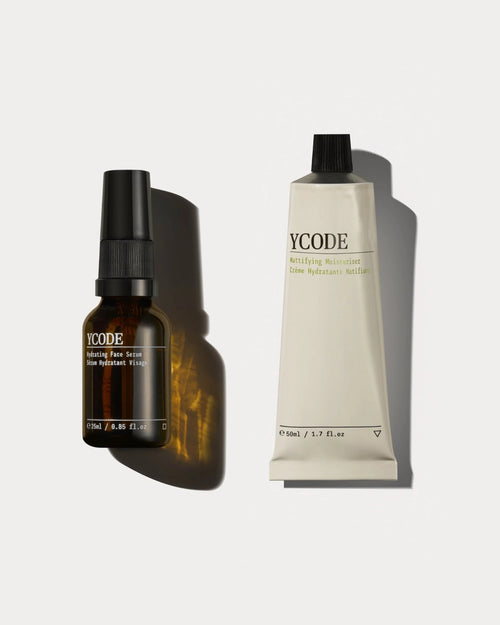
Used in sequence, serum then cream, the pair was trialled together as a regime. After four weeks, 90% said their skin felt deeply hydrated and 90% said it stayed moisturised all day, ADSL 2025-0162, 50 men. That pairing is sold as The Daily Essentials, and it takes under a minute.
When it is not just dehydration
Tightness that arrives with persistent redness, flaking that does not settle, stinging on anything you apply, or skin that is genuinely sore rather than taut, is worth showing to a GP or a dermatologist. That is a barrier that has gone past the point a routine fixes, and it is a small minority of cases. For everyone else this is a twenty-second problem you have been carrying around for years.
And if you have ever had a serum roll into little grey balls under your moisturiser on the way on, that has a mechanical explanation too, covered in why serum pills under moisturiser.
Why does my skin feel tight after washing?
Is my skin dry or dehydrated?
How long does skin take to recover after washing?
Will a heavier moisturiser stop the tightness?
- Bennett-Kennett R, Pace J, Lynch B, Domanov Y, Luengo GS, Potter A, Dauskardt RH. Sensory neuron activation from topical treatments modulates the sensorial perception of human skin. PNAS Nexus. 2023;2(9):pgad292. Source
- Blaak J, Staib P. The Relation of pH and Skin Cleansing. Current Problems in Dermatology. 2018;54:132-142. Source
- Lambers H, Piessens S, Bloem A, Pronk H, Finkel P. Natural skin surface pH is on average below 5, which is beneficial for its resident flora. International Journal of Cosmetic Science. 2006;28(5):359-370. Source
- Rajkumar J, Chandan N, Lio P, Shi V. The Skin Barrier and Moisturization: Function, Disruption, and Mechanisms of Repair. Skin Pharmacology and Physiology. 2023;36(4):174-185. Source
- Camilion JV, Khanna S, Anasseri S, Laney C, Mayrovitz HN. Physiological, Pathological, and Circadian Factors Impacting Skin Hydration. Cureus. 2022;14(8):e27666. Source
- American Academy of Dermatology. Face washing 101. Source

I started YCODE because most skincare was never designed for men’s skin. What I write here is what the formulators taught me, and what the trials actually found.
Continue reading
VIEW ALL →
Your skin can notice the change of season before you reach for a coat....
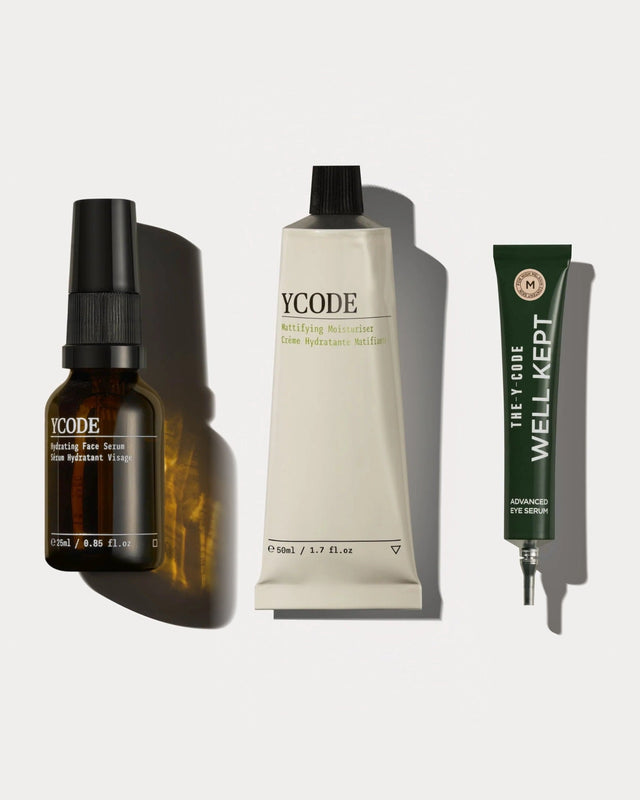
Three formulas focus on the major concerns men tend to see across the face...
The Daily Essentials improves the face and neck. Advanced Eye Serum adds concentrated support...












































































