

Why your face serum pills under your moisturiser
Those little grey rolls are not your skin, and they are not the product failing you. Pilling is a thin film breaking under friction, and there are four causes worth knowing.

You put the serum on, it disappears, you go over the top with the moisturiser and the whole thing gathers into little grey rolls under your fingers. They flick off. You do it again and it happens again. Most men conclude the product is cheap, or that their skin is somehow rejecting it, and quietly stop using one of the two.
Neither is what is going on. Pilling is a mechanical failure of a thin film, not a chemical rejection by your face, and once you know which of four things caused it the fix takes about ten seconds a day.
What the little balls are made of
They are not skin. That is the first thing to settle, because a lot of men assume they are rubbing off dead cells and take that as evidence the routine is working.
Almost every serum, gel and cream contains polymers. They thicken the liquid, hold the oil and water phases together, and leave a very thin film behind on the surface once the water has gone. Cosmetic reviews of polymer use describe exactly this: polymers are the reason products feel substantial, spread evenly and stay put, and they are what forms the water-resistant and long-lasting layers in the category 1. Carbomers, xanthan and guar gums, cellulose derivatives and silicones all do versions of this job.
A pill is that film, dried or half-dried, rolled up by friction into a visible piece. What you are flicking off your jaw is product, plus whatever it had picked up.
Why films fail
Films fail when the second layer cannot merge with the first, and the reason usually comes down to chemistry that does not match.
Work on cosmetic films shows the principle neatly. When film-forming agents and the particles suspended in them share a similar structure, they interact strongly and the film survives handling, staying largely intact under stress. When they do not, the same film cracks and breaks apart 2. The lesson generalises well beyond that one study: like merges with like, and unlike sits on top and shears.
In a bathroom that plays out as a short list.
Silicone over a water-based gel. A silicone-rich cream is designed to form a continuous water-repellent layer. Spread it over a gel film built from water-soluble gums that have not fully set, and the two do not become one layer. They slide, and the top one rolls.
Too much product. A thicker film has more to lose. Two pumps of serum leave far more polymer on the surface than the skin can take up, and the excess has nowhere to go except into a roll under your fingertips.
Not waiting. Films need the water to leave before they are stable. Going in with the moisturiser five seconds after the serum means dragging a wet layer around rather than covering a set one.
Rubbing. Pilling is a friction phenomenon. Vigorous circular application supplies exactly the shear force needed to gather a weak film into pieces.
Pilling is not your skin refusing a product. It is two films that never became one film, rolled up by your own hands.
The order still matters, even when nothing pills
It is worth remembering why anyone layers at all. Moisturising works through three mechanisms that are not interchangeable: humectants draw water into the outer layer, occlusives slow its escape, and emollients settle into the lipid matrix and support the skin's own lipid production 3. Thin and water-phase goes first because it needs direct contact with the skin. Richer goes second because its job is to sit above and hold.
Get that order wrong and you get pilling and a worse result at the same time.
The fix, in the order worth trying
Use less. Half a pump of serum for the whole face is usually plenty. Most pilling stops here.
Press, do not scrub. Warm the product between your palms, then press and smooth it over the face in a few passes. The AAD makes the same point about washing: fingertips rather than flannels, and no scrubbing, because friction irritates skin 4. The same physics applies to what you put on afterwards.
Wait thirty seconds. Not five minutes. Enough for the water to flash off and the film to set. Brush your teeth in the gap.
Apply to slightly damp skin. A light serum spreads much further on damp skin, which means less product doing more work.
Look at what is underneath. If a product further down the routine is heavy in silicones and long-chain film formers, everything above it is going to struggle. That is the layer to change, not the one that visibly rolls.
Change one thing at a time. If it still pills after all of the above, you have an incompatible pair, and the only way to find out which one is the problem is to remove one for a week.
How we approach it
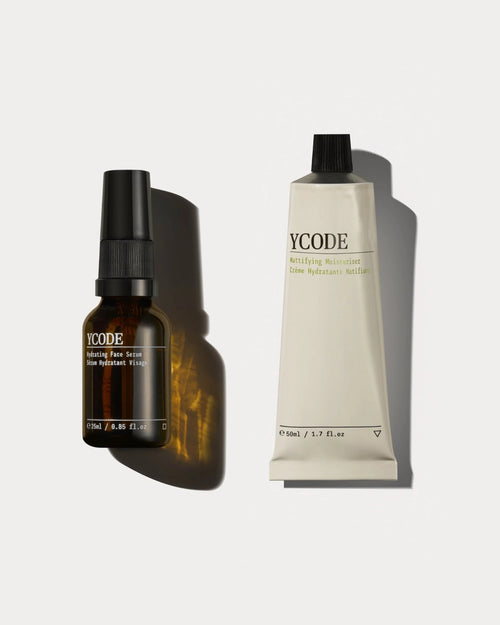
We build the two face products to be used one after the other, which means the serum has to leave nothing behind for the cream to sit on.
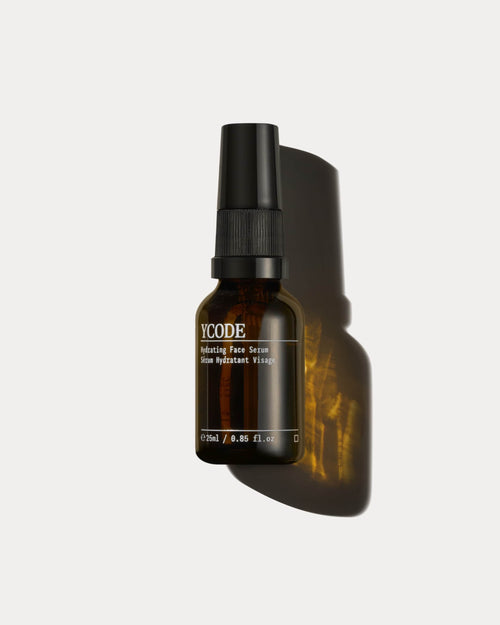
The Hydrating Face Serum is water-light and dries down fast by design.
YCODE Hydrating Face Serum, independent consumer trial, ADSL 2025-0056, 50 men, after first use.
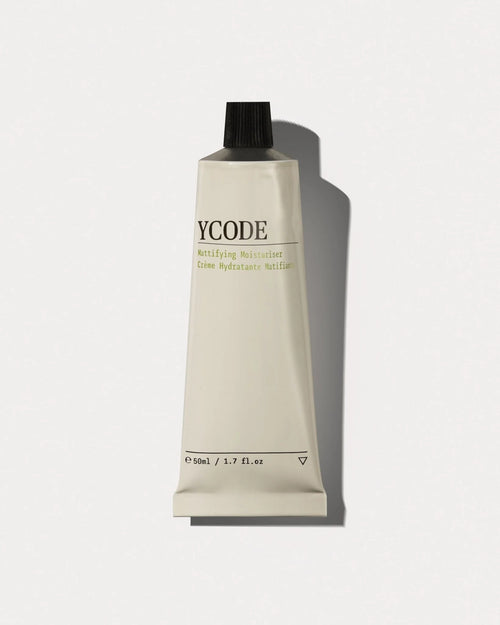
The Mattifying Moisturiser goes over the top. It is a moisturiser first, deep hydration that holds all day, formulated for every skin type, with oil balanced and the look of pores refined, and it was measured absorbing cleanly rather than sitting on the surface: 81% said it absorbs with no greasy film and 87% said their skin appeared rehydrated, ADSL 2025-0057, 53 men, after four weeks.
The two were also trialled as a pair, in that order, which is the only honest way to test a layered routine. After four weeks, 90% said their skin felt deeply hydrated and 90% said it stayed moisturised all day, ADSL 2025-0162, 50 men. They are sold together as The Daily Essentials.
If the layer underneath is the part you are unsure about, why skin feels tight after washing covers what a serum is actually for, and the two-product routine sets out the whole thing in under a minute a side.
Why does my serum pill under my moisturiser?
Are the little balls dead skin?
How long should I wait between serum and moisturiser?
Does pilling mean the product is not absorbing?
- Alves TFR, et al. Applications of Natural, Semi-Synthetic, and Synthetic Polymers in Cosmetic Formulations. Cosmetics. 2020;7(4):75. Source
- Chen Y, Xu H, Liu Y, Fu Q, Zhang P, Zhou J, Dong H, Yan X. Structural Similarity-Induced Inter-Component Interaction in Silicone Polymer-Based Composite Sunscreen Film for Enhanced UV Protection. Polymers. 2024;16(23):3317. Source
- Rajkumar J, Chandan N, Lio P, Shi V. The Skin Barrier and Moisturization: Function, Disruption, and Mechanisms of Repair. Skin Pharmacology and Physiology. 2023;36(4):174-185. Source
- American Academy of Dermatology. Face washing 101. Source

I started YCODE because most skincare was never designed for men’s skin. What I write here is what the formulators taught me, and what the trials actually found.
Continue reading
VIEW ALL →
Your skin can notice the change of season before you reach for a coat....
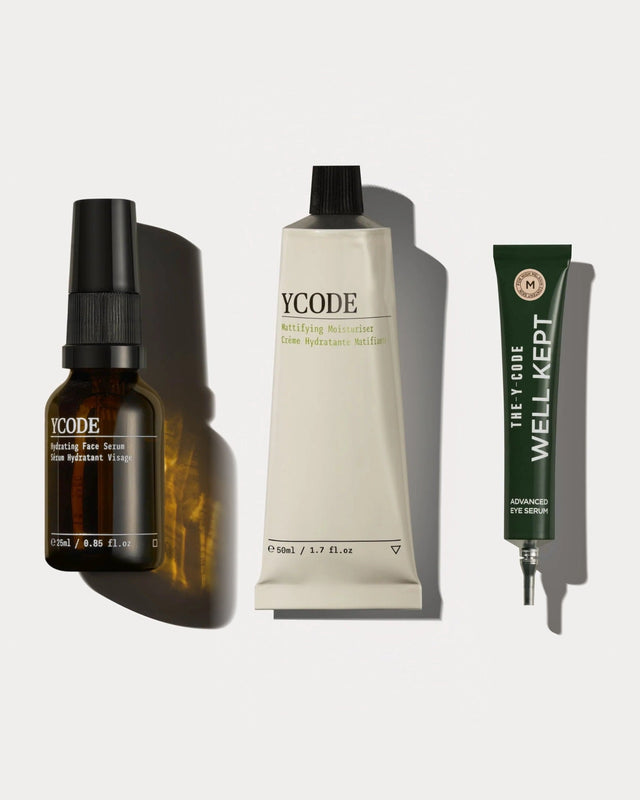
Three formulas focus on the major concerns men tend to see across the face...
The Daily Essentials improves the face and neck. Advanced Eye Serum adds concentrated support...