

Skincare for men who do not do skincare
Written for the man who has never seen the point. No ten-step routine, no transformation promised. The whole argument is two minutes, morning and night.

You are not against skincare. You have just never seen a version of it that looked like it was meant for you. The shelves are crowded, the language is odd, everyone in the photographs is twenty-four, and the whole thing seems to assume you have a spare fifteen minutes and an interest you do not have.
Fair enough. So here is the short version, written for someone who wants the smallest thing that works and then wants to stop thinking about it. The whole argument is two minutes, morning and night.
What you are already doing, and what it costs
Most men have a routine already. It is: wash face in the shower with whatever is in the shower, dry it on a towel, leave.
That is not neutral. Cleansing removes lipids from the outer layer of skin along with the dirt, and when that layer loses lipids and water it contracts. The contraction strains nerve endings below the surface, which is the mechanism behind that tight feeling after washing, now modelled and measured rather than assumed 1. The tightness passes, and the barrier does repair itself. It just repairs itself more slowly than you undo it, twice a day, for years.
The American Academy of Dermatology's basic guidance runs to seven points and finishes with "apply moisturiser" 2. That last step is the one nearly everyone skips, and it is the one that does the most for the least effort.
Nothing here is about looking groomed
If the objection is that skincare is vanity, it is worth separating two things.
One is appearance, which you can take or leave. The other is comfort and function: skin that does not feel tight, does not flake at the jaw after shaving, does not go shiny by two in the afternoon, and does not look more tired than you actually are. Those are practical outcomes. Men typically produce more sebum and run a slightly higher surface pH than women, and the comparative data shows other measurable differences in thickness and barrier behaviour 3. That is an argument for products built for the skin you have, not an argument for more of them.
The question is not whether you care about skincare. It is whether twenty seconds twice a day is worth a face that feels better and looks less tired.
The smallest thing that does anything
Two products. One that puts water and useful actives in, one that keeps them there.
The mechanisms are not complicated. Humectants draw water into the outer layer of skin. Occlusives sit above and slow it leaving. Emollients settle into the lipid matrix and help the skin rebuild its own 4. A light serum does the first job well because there is nothing in the way. A moisturiser does the second because that is what a cream is for. Neither one covers both properly on its own, which is why two is the floor rather than the ambition.
Serum on slightly damp skin, ten seconds. Wait while you brush your teeth. Moisturiser over the top, ten seconds. Repeat at night. The full mechanics of it are in the two-product routine, if you want the longer version.
Why short routines are the ones that survive
This is the part most brands skip, because it argues against selling you more.
A 2024 review of adherence in dermatology found that people prescribed topical treatment for real conditions applied it between 50% and 60% of the expected number of times, with adherence falling from around 85% at the start to roughly half by the eighth week. The reasons given were the time it took, the fuss of applying it, and forgetting. Once-daily regimens were adhered to better than twice-daily ones 5.
If that is what happens with medicine, a ten-step routine bought on a whim was never going to survive a Tuesday. Two products has a chance because there is very little to abandon.
On making it stick, one useful finding. In a study of people building a new daily behaviour, automaticity took a median of 66 days to plateau, with a wide spread between individuals, and missing a single day did no lasting damage 6. Two things follow. It will feel deliberate for longer than you expect, and skipping a night is not a failure. Attaching it to something you already do without thinking, like brushing your teeth, does most of the work for you.
What we would actually give you
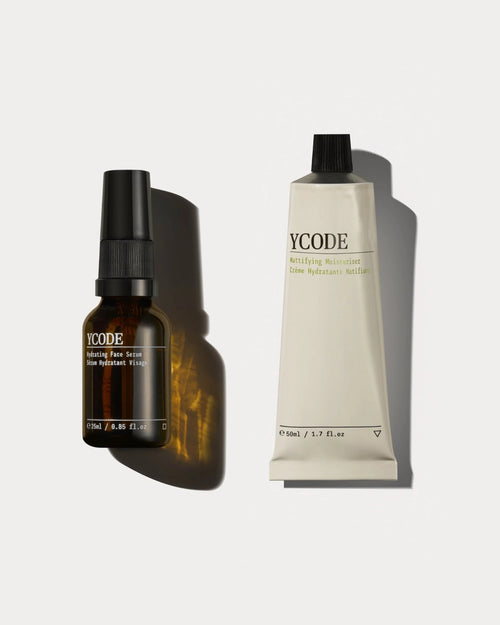
Two products, in one box, and nothing else to decide.
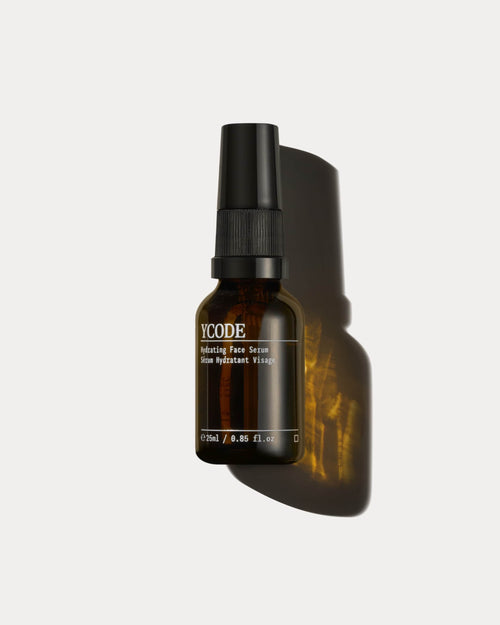
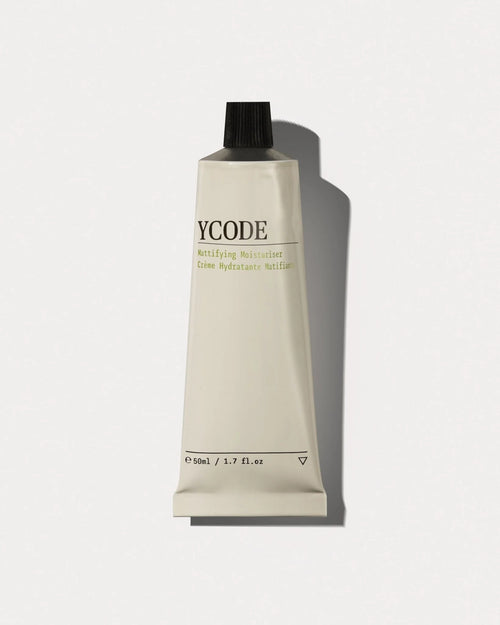
The Daily Essentials is the face serum and the moisturiser. The serum is light and dries down fast. The moisturiser is a moisturiser first: deep hydration that holds all day, formulated for every skin type, with oil balanced and the look of pores refined, and the matte finish is one feature of it rather than the whole idea.
YCODE serum and moisturiser used together, independent consumer trial, ADSL 2025-0162, 50 men, four weeks.
In the same trial, 84% said their skin looked less shiny and more balanced. After the first use, 88% said their skin instantly felt rehydrated using the serum followed by the cream, which is the point at which most sceptics decide whether to continue.
If the thing that actually bothers you is looking tired rather than how your skin feels, the Starter Kit pairs the moisturiser with our eye serum instead. In published ingredient studies run by Eurofins Dermscan on 111 volunteers of mean age 42, measured at 15 minutes and at 15 days, 90% saw dark circles visibly reduced and 89% saw under-eye bags reduced. Those are ingredient studies rather than our own consumer trial, and we label them that way deliberately.
What we are not going to claim
Two products will not undo a decade of not sleeping. They are not a treatment for acne, eczema or rosacea, and if you have any of those, a GP or dermatologist is a better use of your money than we are.
What they will do is stop the tight feeling after washing, keep your skin comfortable through the day, and, over a month or so, make your face look less like it has been awake since five. That is the honest size of it.
Give it a fortnight before you decide, and look in daylight rather than bathroom light. If you would rather be told which one to start with than work it out, the two-minute skin analysis does that in about the same time as one application.
I have never used skincare. Where do I start?
Do men actually need skincare, or is it marketing?
How long does it take each day?
What if I forget for a few days?
- Bennett-Kennett R, Pace J, Lynch B, Domanov Y, Luengo GS, Potter A, Dauskardt RH. Sensory neuron activation from topical treatments modulates the sensorial perception of human skin. PNAS Nexus. 2023;2(9):pgad292. Source
- American Academy of Dermatology. Face washing 101. Source
- Rahrovan S, Fanian F, Mehryan P, Humbert P, Firooz A. Male versus female skin: What dermatologists and cosmeticians should know. International Journal of Women's Dermatology. 2018;4(3):122-130. Source
- Rajkumar J, Chandan N, Lio P, Shi V. The Skin Barrier and Moisturization: Function, Disruption, and Mechanisms of Repair. Skin Pharmacology and Physiology. 2023;36(4):174-185. Source
- Cirstea N, Radu A, Vesa C, et al. Current Insights on Treatment Adherence in Prevalent Dermatological Conditions and Strategies To Optimize Adherence Rates. Cureus. 2024;16(9):e69764. Source
- Lally P, van Jaarsveld CHM, Potts HWW, Wardle J. How are habits formed: Modelling habit formation in the real world. European Journal of Social Psychology. 2010;40(6):998-1009. Source

I started YCODE because most skincare was never designed for men’s skin. What I write here is what the formulators taught me, and what the trials actually found.
Continue reading
VIEW ALL →
Your skin can notice the change of season before you reach for a coat....
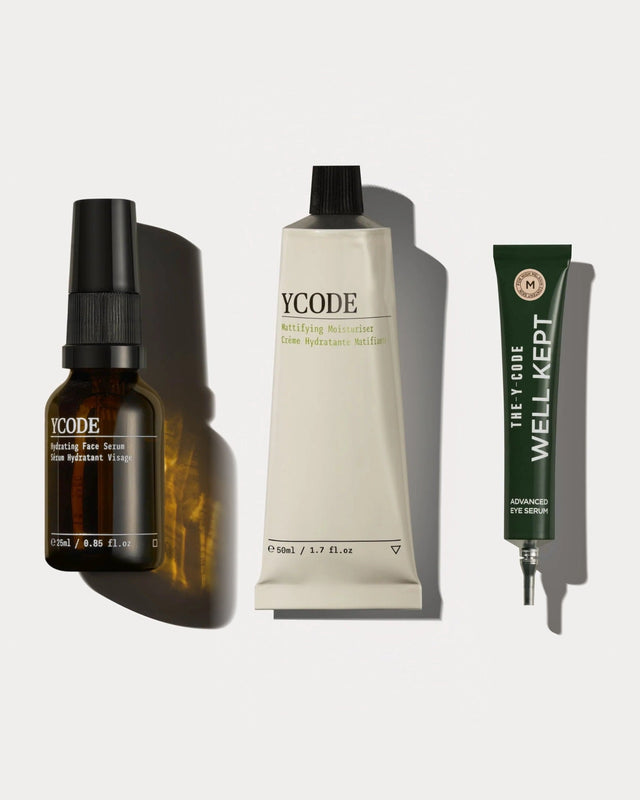
Three formulas focus on the major concerns men tend to see across the face...
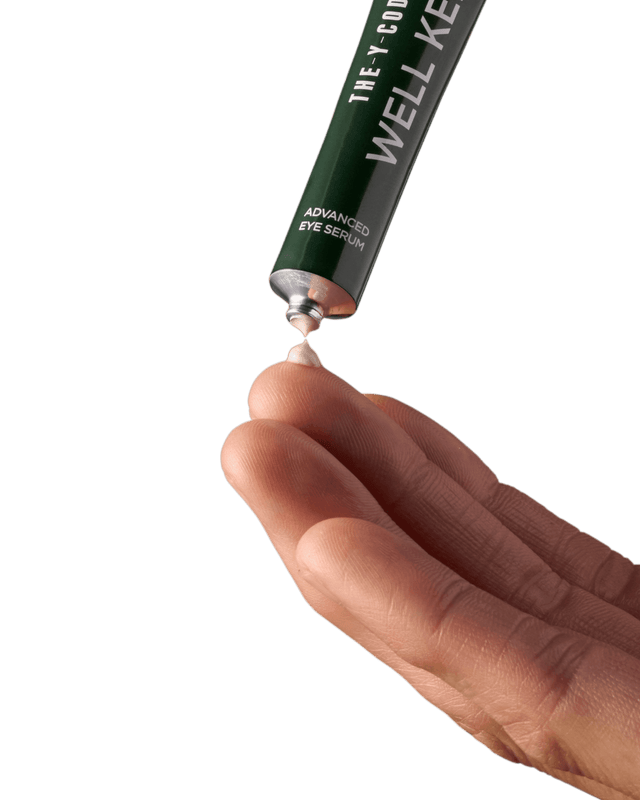
The Daily Essentials improves the face and neck. Advanced Eye Serum adds concentrated support...












































































