

Skincare for Men's Skin Tone, Not Just Skin Type
Every men's brand asks whether your skin is oily or dry. Useful, and incomplete. Skin type tells you how skin handles oil and water. It tells you almost nothing about how it responds to injury, and that is governed by tone.

Every men's skincare brand asks you the same question before it sells you anything. Is your skin oily, dry, combination or sensitive. It is a reasonable question and the answer is genuinely useful. It is also the only question most brands ask, and it leaves out a variable that decides what actually happens when a product meets your face.
Skin type tells you how your skin handles oil and water. It tells you almost nothing about how your skin responds to injury. Those are separate systems, and the second one is governed largely by tone.
The same spot, two different outcomes
Take two men, both thirty-five, both with oily skin, both using an identical routine. Each gets a spot on the jawline in the same week. On one of them it clears in a few days and leaves nothing behind. On the other it clears and leaves a brown mark that is still there in the spring.
Nothing about their skin type predicted that difference. Tone did.
The numbers are not marginal. In a review of the epidemiology, 65.3% of African-American patients with acne developed post-inflammatory hyperpigmentation, and pigmentary disorders other than vitiligo were the third most common skin complaint in that group at 9%, against 1.7% in Caucasian patients. Epidermal marks can take months to years to fade untreated, and pigment that has reached the dermis may not fade at all.1
So for one of those two men, the spot is the whole event. For the other, the spot is the beginning of a longer one. A routine built for oily skin, and only for oily skin, treats them identically.
Why this is a men's question specifically
There is a version of this that men run into daily and rarely connect to anything else, and that is shaving.
Pseudofolliculitis barbae, the ingrown-hair reaction most men know as razor bumps, affects an estimated 45% to 80% of men of African ancestry, and it tracks with curly, coarse hair rather than with skin type. Once the bumps heal, post-inflammatory hyperpigmentation and scarring can follow.2 A related review put the rate of pigmentation after pseudofolliculitis barbae at around 90% of affected patients.1
That is a daily, mechanical, unavoidable source of inflammation on the exact skin where pigment responds most readily. No amount of knowing whether you are oily or dry helps you with it. Knowing that your skin answers inflammation with pigment changes how you shave, what you put on afterwards, and how aggressive a routine you should be running at all.
The biology, briefly
Tone is not a matter of having more or fewer pigment cells. Melanocytes are present in broadly similar numbers across tones. What differs is the size, packaging and distribution of the pigment they produce. Melanosomes are largest in darker skin and dispersed individually through the surrounding skin cells, smaller and grouped into clusters in lighter skin, with a mixture of both patterns in Asian skin.3
Alongside that structural difference sits a functional one. Melanocytes in deeper tones tend to be larger and more active, with higher tyrosinase activity and dendrites that transfer more pigment into surrounding cells.4 Inflammatory mediators, including interleukins, prostaglandins, leukotrienes and TNF-alpha, activate tyrosinase directly.1 Inflammation and pigment are wired together, and how tightly they are wired varies with tone.
None of that makes one skin better or worse than another. It makes them different inputs to the same formula, which is a formulation problem and not a moral one.
Tone has been treated as a question about who appears in the photograph. It is really a question about what happens inside the tube.
How the industry got this wrong
Tone did eventually become a subject in beauty, and the answer arrived in the form of shade ranges and casting. Both matter. Neither is formulation.
Two habits followed and both are worth naming. The first is treating a huge and varied group of people as one category, usually under a phrase like ethnic skin, as though a man from Lagos, a man from Seoul and a man from Mumbai present the same formulation brief. They do not. Tone is a continuum with different pigment behaviour along its length, and it interacts with everything else about a person's skin.
The second habit is treating lighter skin as the default and everything else as a variant of it. That is how a product gets developed, tested and signed off on one set of responses and then described as suitable for all skin types, which is true of the oil and water axis and silent on the one that matters here.
What changes when you formulate for tone
Four things, concretely.
The irritation threshold becomes a hard constraint. On skin that answers inflammation with pigment, a formula that stings slightly is not merely uncomfortable, it is a pigment risk. That rules out a lot of the aggressive men's skincare tradition: high alcohol, menthol, strong fragrance, the tingle that has been sold as evidence of a product working.
Active selection changes. A systematic review of 1,356 people with Fitzpatrick types III to VI found topical retinoids the most effective topical treatment for post-inflammatory pigmentation, and in the same paragraph warned that retinoid dermatitis may worsen the pigmentation being treated, advising lower starting concentrations and slow escalation. Repeated laser treatment induced new pigmentation in 11% to 17% of cases, more often in darker skin.5 Effective and appropriate are not the same word.
The optical finish becomes a variable. Any mineral particle in a formula interacts with light the skin underneath is already scattering. A loading calibrated on one tone reads chalky or flat on another. If a product has a visible finish, one version of it cannot be right for everyone.
Fragrance goes. It is a common cause of low-grade contact irritation, it does nothing for the skin, and low-grade irritation is precisely the thing you are trying to avoid.
What we do about it
The eye is where tone shows first, so that is where our answer is most visible. The Advanced Eye Serum is made in three formulas rather than one. Formula M was developed for the majority of skin tones, M- for very light skin, and M+ for deeper tones, with more hydration and a finish that stays true rather than going ashy. They are formulas, not shades, and nothing is being covered or corrected. We call the approach melanin adaptive because the minerals respond to the tone they are applied to.
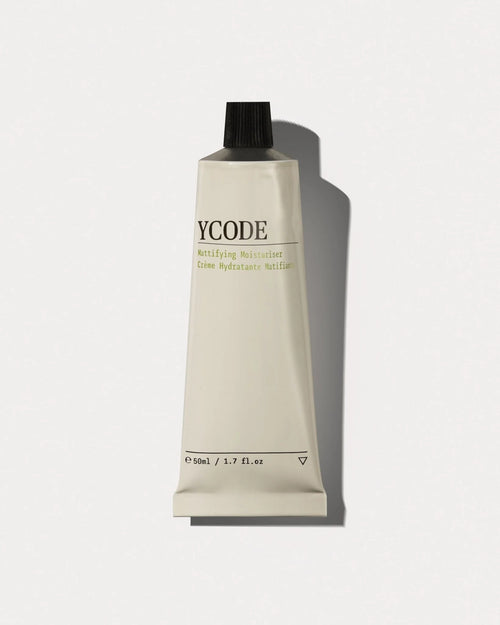
Everywhere else the same thinking shows up as restraint rather than as options. Every formula we make is fragrance-free. The moisturiser rebalances oil rather than stripping it, because stripping provokes. We chose a wild ginger extract over caffeine at the eye partly because it carries published data on the pigmented cause of dark circles and not only the vascular one. None of that is dramatic on a product page, and all of it is the same decision repeated.
The three-formula system exists at the eye today, which is where tone shows first and where the optical result is hardest to get right. The wider point stands well beyond it: daily sun protection does more for pigmentation over a year than any active applied at night, whoever makes it.
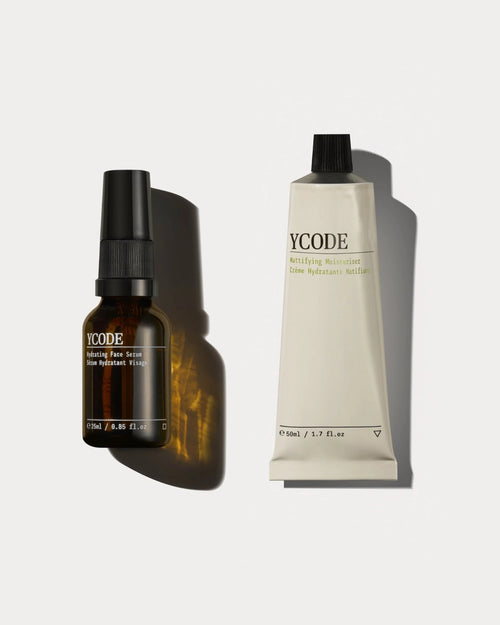
If you want the full definition and the formulation logic, read what melanin adaptive skincare actually means. For the under-eye specifically, we wrote about why depth of tone changes what works there. And if you would rather just start, the Core Trio is the serum, moisturiser and eye serum in one go.
Is skin tone more important than skin type?
Does darker skin need different skincare?
Why do my spots leave dark marks?
What should I change about shaving?
- Davis EC, Callender VD. Postinflammatory Hyperpigmentation: A Review of the Epidemiology, Clinical Features, and Treatment Options in Skin of Color. Journal of Clinical and Aesthetic Dermatology. 2010;3(7):20-31. Source
- Numan H, Gomez J, Oakley A. Pseudofolliculitis barbae. DermNet, 2022. Source
- Thong HY, Jee SH, Sun CC, Boissy RE. The patterns of melanosome distribution in keratinocytes of human skin as one determining factor of skin colour. British Journal of Dermatology. 2003;149(3):498-505. Source
- Markiewicz E, Karaman-Jurukovska N, Mammone T, Idowu OC. Post-Inflammatory Hyperpigmentation in Dark Skin: Molecular Mechanism and Skincare Implications. Clinical, Cosmetic and Investigational Dermatology. 2022;15:2555-2565. Source
- Mar K, Khalid B, Maazi M, Ahmed R, Wang OJE, Khosravi-Hafshejani T. Treatment of Post-Inflammatory Hyperpigmentation in Skin of Colour: A Systematic Review. Journal of Cutaneous Medicine and Surgery. 2024;28(5). Source

I started YCODE because most skincare was never designed for men’s skin. What I write here is what the formulators taught me, and what the trials actually found.
Continue reading
VIEW ALL →
Stress and poor sleep have a way of becoming visible. The eyes look heavier....

Your skin can notice the change of season before you reach for a coat....
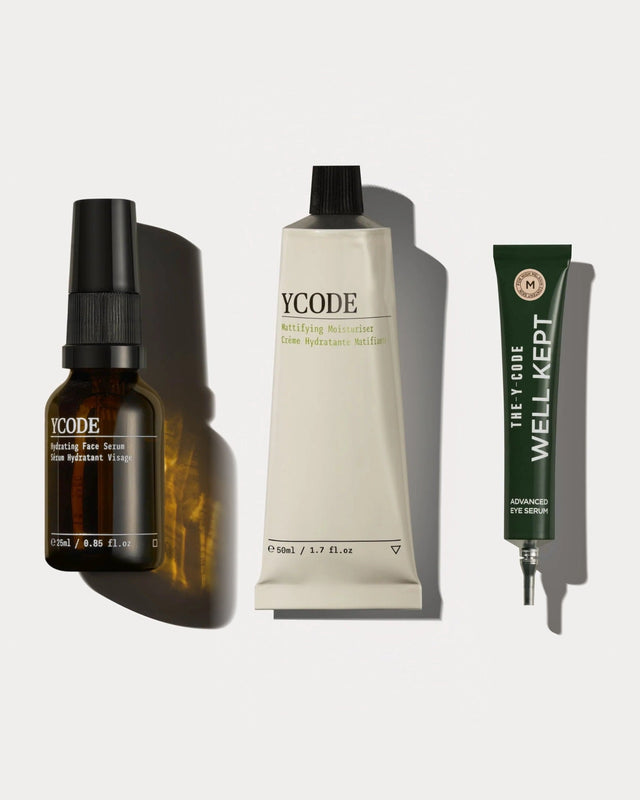
Three formulas focus on the major concerns men tend to see across the face...












































































