

Why does an eye serum sting, and what it means if yours does
A sting under the eye is almost always the formula rather than your eyes. What causes it, how to tell an ordinary sting from something worth showing a pharmacist, and what to do about it.
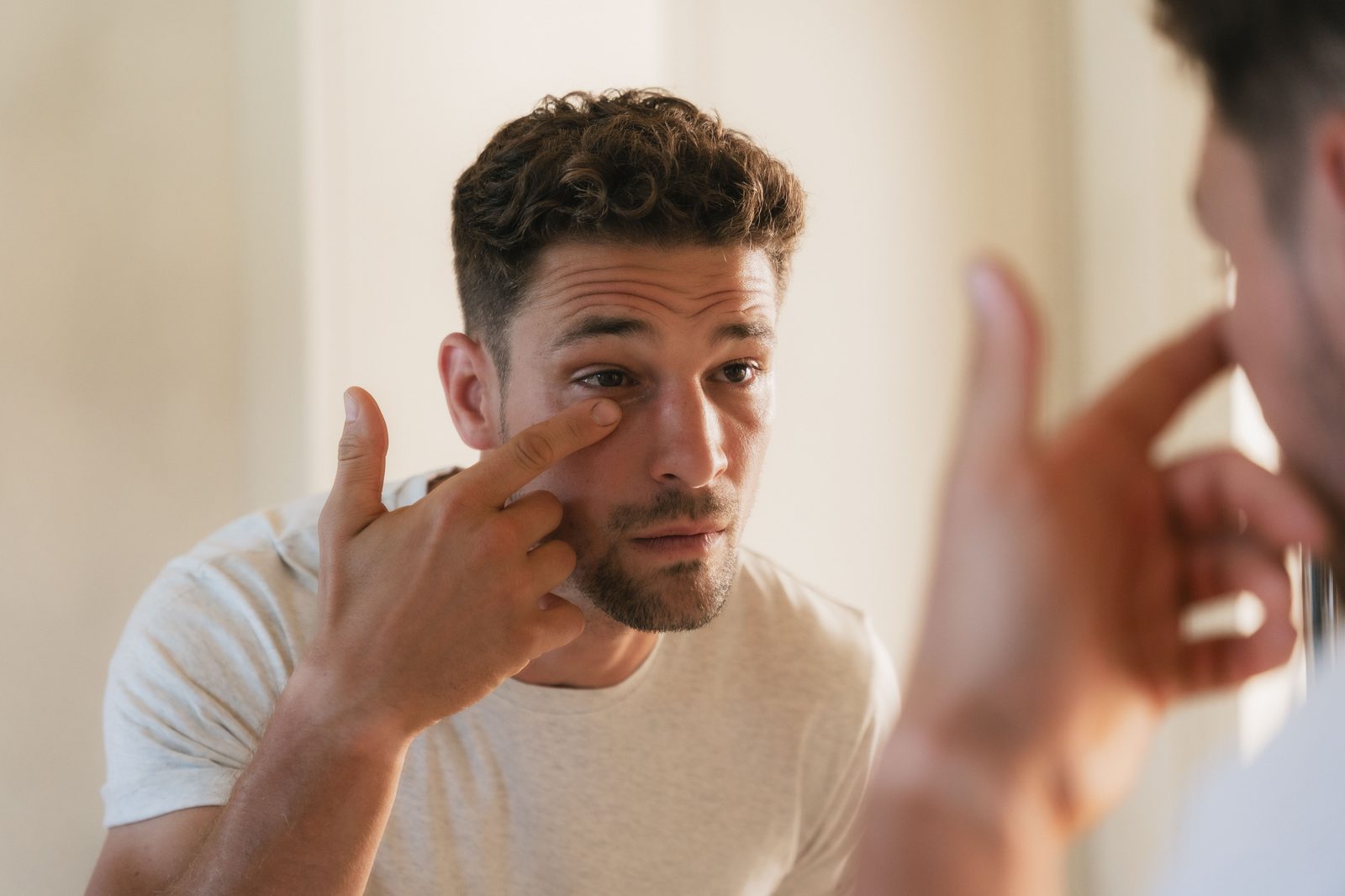
If your eye serum stings, here is the short answer before anything else. In almost every case it is the formula, not your eyes, and it is not doing you lasting harm. A sting that arrives within a minute of applying, settles within about ten, and leaves nothing visible behind is a sensory reaction in very thin skin. It is a reason to change product. It is not a reason to worry.
What is worth taking seriously is different, and easy to tell apart. Burning that keeps going, a lid that swells, skin that weeps or crusts, or any change to your vision. That is a conversation with a pharmacist or your GP rather than another application in the morning.1
Now the explanation, because knowing why it happened is what stops it happening again.
What stinging actually is
Stinging and burning without anything to see is its own category. Dermatology calls it sensory irritation: unpleasant sensations in response to something that should not provoke them, in skin that looks completely normal.2 It is the nerve endings responding, not the immune system. Research on sensitive skin has found altered small nerve fibres in the epidermis of people who react this way, which is why two men can use the identical product and only one of them feels anything.2
An allergy looks and behaves differently. Allergic contact dermatitis around the eye usually turns up hours or days after use, not seconds, and it brings redness, itching, scaling and swelling with it.3 A quick sting that fades is the first thing. A red, itchy, flaking lid two days later is the second, and that one is worth showing to someone.
Why it happens here and nowhere else on your face
Because the skin is not comparable. High-frequency ultrasound work measured the upper eyelid at a median of about 574 micrometres, against roughly 1,907 micrometres at the tip of the nose, so the skin around your eye is more than three times thinner than skin a few centimetres away.4 Reviews of eyelid dermatitis put the eyelid at around half a millimetre and note that this is precisely why substances get through there that never trouble the rest of the face.3
Add the fact that the area has fewer oil glands and a thinner protective layer, and that whatever you apply is warmed, blinked and moved about all day. A product placed too close to the lash line does not stay where you put it. Some of it migrates towards the eye itself, which is a separate kind of sting altogether and usually the reason men think a serum has burned them when in fact a little of it got in.
The usual suspects
Four things account for most of it.
Fragrance. Fragrance sits in the top group of allergens identified in eyelid dermatitis, alongside metals, preservatives and surfactants.3 That includes the natural kind. Essential oils and heavily perfumed botanical extracts are fragrance as far as the skin is concerned. Since a fragrance does nothing for your under-eye, its presence in an eye product is a formulation decision made for the shelf rather than for you.
High-strength vitamin C. Pure L-ascorbic acid only stays stable and gets through the skin at a pH below about 3.5, and above 20% there is no more benefit to be had while irritation becomes more likely.5 Vitamin C has a real place in skincare. An acid at that pH applied to half a millimetre of eyelid skin is not that place for most men.
Retinoids. Irritation is the well-documented cost of retinoids: stinging, burning, redness and peeling are common enough that a good deal of formulation science exists purely to reduce them.6 A retinoid intended for the face applied around the eye is a predictable sting.
Preservatives, solvents and alcohol. Preservative systems appear high in the eyelid allergen lists,3 and formulas that use a lot of alcohol to dry quickly can bite on thin skin for the same reason they feel light.
A sting is information. Usually it says the formula was designed for a face and then sold for an eye.
What to do in the moment
Rinse with cool water and nothing else. No cleanser, no wipes, no toner. Pat dry rather than dragging a towel across the area.
Do not rub. Rubbing is not a neutral act around the eye, because repeated trauma to the area is one of the recognised contributors to under-eye pigmentation over time.7 You would be trading ten seconds of relief for something more permanent.
Leave it bare, or use a plain moisturiser you already know suits you. Then stop using the product that caused it for a few days rather than testing your luck again on day two.
If you want to know whether it was that product, apply a small amount to the skin just outside the outer corner of one eye, once a day for three days. Same area, less of it, and nowhere near the lash line. If it stings there, it will sting everywhere on that skin.
What a formula that does not sting looks like
The short list is genuinely short. Fragrance-free. No high-percentage acids and no retinoid. A preservative system chosen for thin skin. And a texture that absorbs rather than sits, because a product that sits is a product that migrates.
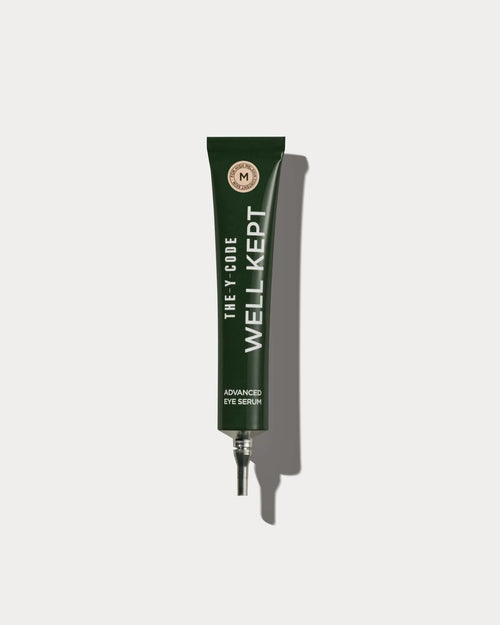
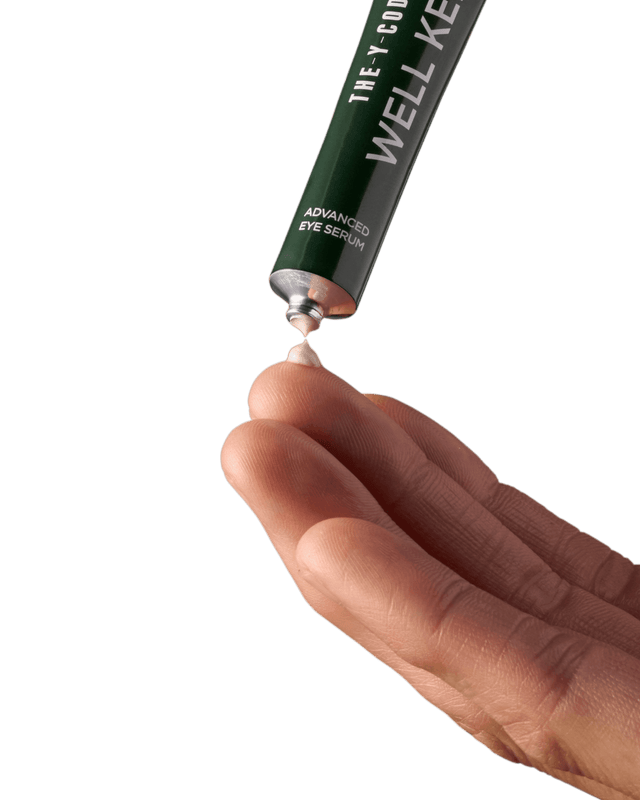
Our Advanced Eye Serum is fragrance-free, which is not a marketing position but a consequence of formulating for this specific area. It does not use vitamin C, and it does not use a retinoid. The active doing the work on dark circles is a supercritical CO2 extract of wild ginger, chosen because the published data covers both the pigment cause and the vascular cause of circles rather than only one.
Figures from published ingredient studies of the supercritical CO2 wild ginger extract the serum is built on. Eurofins Dermscan, 111 volunteers, mean age 42, measured at 15 minutes and 15 days. These are ingredient-study results, not a YCODE consumer trial.
It also comes in three formulas, M, M+ and M-, built around the different requirements of different skin tones under our Melanin Adaptive Technology. And the tube is aluminium throughout with no plastic cap, which has nothing to do with stinging and everything to do with not putting more plastic into the world.
If you are still deciding what your under-eye actually needs, our two-minute skin analysis is the quickest route to an honest answer. If you already know a sting has put you off eye products entirely, read what to look for in an eye serum that does not sting next, or our wider guide to choosing an eye product as a man.
Is it normal for an eye serum to sting?
Does stinging mean it is working?
How long should a sting last before I worry?
My serum only stings sometimes. Why?
- NHS. Eyelid problems. National Health Service, 2024. Source
- Misery L. Sensitive Skins May Be Neuropathic Disorders: Lessons from Studies on Skin and Other Organs. Cosmetics. 2021;8(1):14. Source
- Huang CX, Yiannias JA, Killian JM, Shen JF. Seven Common Allergen Groups Causing Eyelid Dermatitis: Education and Avoidance Strategies. Clinical Ophthalmology. 2021;15:1477-1490. Source
- Korzekwa S, Matusz K, Kukulski M, et al. Quantitative Analysis of the Human Face Skin Thickness: A High-Frequency Ultrasound Study. Journal of Clinical Medicine. 2025;14(23):8401. Source
- Al-Niaimi F, Chiang NYZ. Topical Vitamin C and the Skin: Mechanisms of Action and Clinical Applications. Journal of Clinical and Aesthetic Dermatology. 2017;10(7):14-17. Source
- Narsa AC, Suhandi C, Afidika J, Ghaliya S, Elamin KM, Wathoni N. A Comprehensive Review of the Strategies to Reduce Retinoid-Induced Skin Irritation in Topical Formulation. Dermatology Research and Practice. 2024;2024:5551774. Source
- Sarkar R, Ranjan R, Garg S, Garg VK, Sonthalia S, Bansal S. Periorbital Hyperpigmentation: A Comprehensive Review. Journal of Clinical and Aesthetic Dermatology. 2016;9(1):49-55. Source

I started YCODE because most skincare was never designed for men’s skin. What I write here is what the formulators taught me, and what the trials actually found.

Continue reading
VIEW ALL →
Your skin can notice the change of season before you reach for a coat....
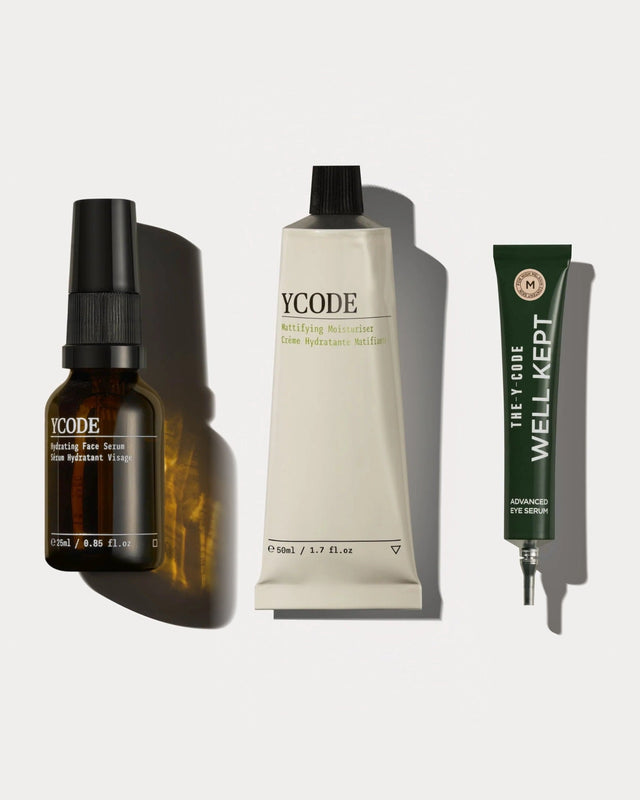
Three formulas focus on the major concerns men tend to see across the face...
The Daily Essentials improves the face and neck. Advanced Eye Serum adds concentrated support...












































































