

An eye serum for men that does not sting: how to find one
Four checks on the back of the box rule out almost every eye product that burns. What to look for, what the front-of-pack language is worth, and how to test a new one safely.
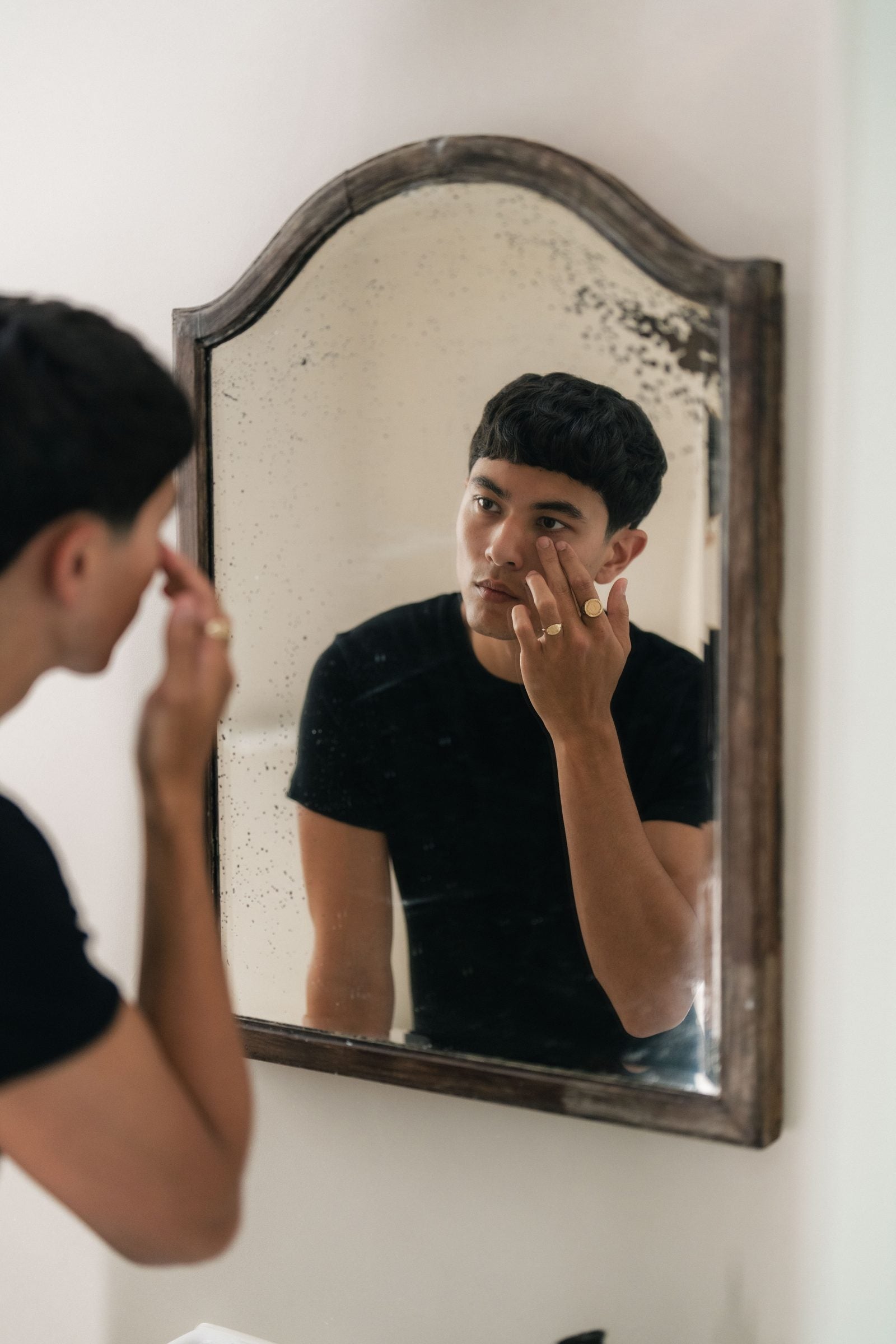
Most men who ask for an eye serum that does not sting are not curious. They are put off. They tried something once, it burned, and the tube went into the back of a drawer. That is a reasonable response to a bad experience, and it is also a shame, because the sting was almost certainly avoidable. It came from a handful of ingredients that have no business being applied to the thinnest skin on your face.
So here is the buying guide. What to check on the back of the box, what the marketing language on the front is worth, and how to test a new product without risking another bad morning.
Why the eye area is a different problem
Skin thickness is not uniform across a face, and the difference is larger than most people assume. Ultrasound measurement puts the upper eyelid at a median of roughly 574 micrometres against about 1,907 micrometres at the tip of the nose, so the skin around your eye is more than three times thinner than skin a few centimetres from it.1 Reviews of eyelid dermatitis describe eyelid skin at around half a millimetre and point to that thinness as the reason substances penetrate there that the rest of the face shrugs off.2
Some of it is also about you rather than the product. Sensitive skin, in the dermatological sense, means unpleasant sensations such as stinging and burning in response to things that should not cause them, in skin that looks entirely normal, and it has been linked to altered nerve fibres in the epidermis.3 If you are one of the men who feels things others do not, you are not imagining it, and the answer is a shorter ingredient list rather than a tougher attitude.
The four things to check on the label
One: fragrance. Look for parfum, fragrance, or a list of essential oils near the end of the ingredients. Fragrances sit among the leading allergen groups in eyelid dermatitis,2 and no fragrance has ever improved an under-eye. Natural does not exempt it. Lavender and citrus oils are fragrance in every way that matters to skin.
Two: acids at low pH. Pure L-ascorbic acid needs a pH below about 3.5 to remain stable and penetrate, and going above 20% adds irritation rather than benefit.4 Vitamin C has a real place in skincare. An acidic vitamin C serum applied to half a millimetre of eyelid skin is not that place for most men.
Three: retinoids. Stinging, burning, redness and flaking are the known cost of retinoid use, to the point that a whole area of formulation research exists to reduce it.5 A face retinoid borrowed upwards to the eye is the single most common cause of the sting men describe.
Four: the preservative system and alcohol. Preservatives rank high in eyelid allergen surveys,2 and a formula leaning on alcohol for a fast, dry finish can bite for the same reason it feels light. Alcohol denat high on an ingredient list is worth noticing.
An eye serum that does not sting is not a gentler version of a face product. It is a product formulated for the eye area from the start.
What the words on the front are worth
"For sensitive eyes" and "ophthalmologist tested" are not meaningless, but neither carries a single fixed protocol behind it, so they tell you less than the ingredient list on the back. "Dermatologically tested" tells you a test happened, not what the result was.
The claims worth more are the specific ones. Fragrance-free is a formulation fact you can verify by reading the ingredients. So is the absence of a retinoid. So is a stated pH. Anything a brand will state precisely is generally worth more than anything it states warmly.
How to test a new eye product properly
Do not start at the eye. Apply a small amount to the skin just outside the outer corner of one eye, once a day for three days. That is the same skin, in a place where nothing can migrate towards the eye itself.
If nothing happens, move to the normal placement, which is on the orbital bone rather than the soft skin right under the lash line. Most stinging blamed on formulas is really placement: product applied too close to the lash line warms up, moves with blinking and finds its way in. Our guide to how much eye serum to use and where to put it covers this properly.
And judge it over a month rather than a morning. Comfort is immediate. Results are not.
How the Advanced Eye Serum is built
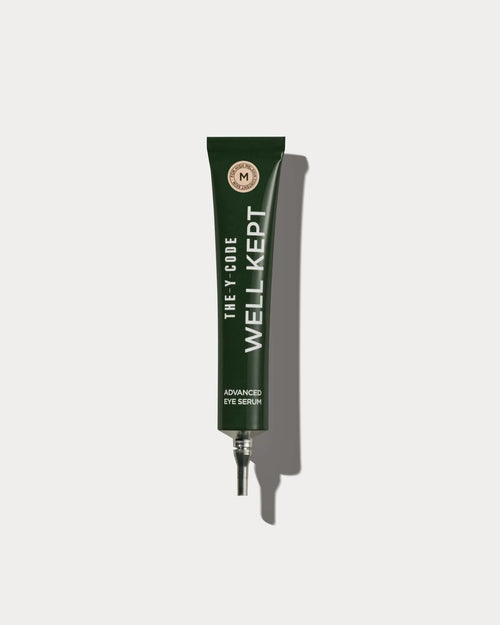
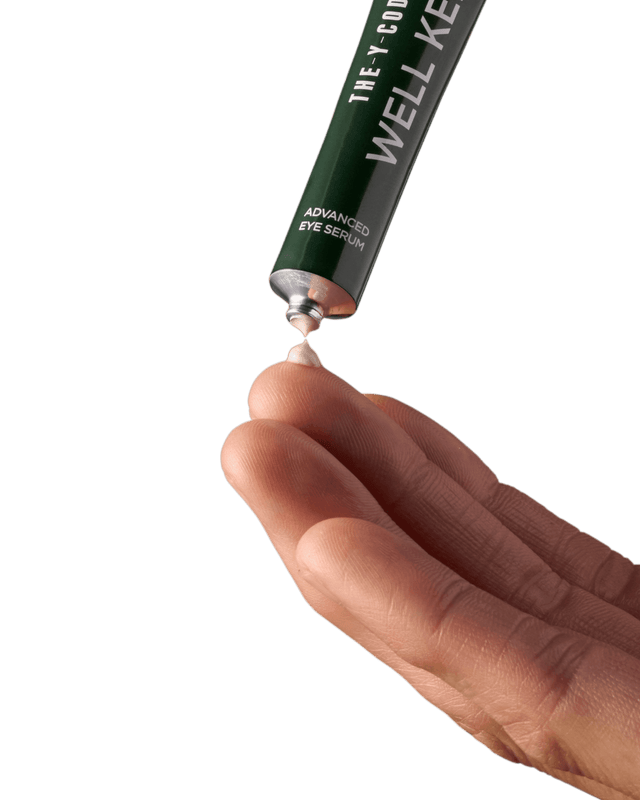
Every decision above is already made in our Advanced Eye Serum. It is fragrance-free, so there is nothing perfumed sitting on skin half a millimetre thick. It contains no vitamin C and no retinoid, which removes the two most common causes of an eye sting outright.
The active doing the work on dark circles is a supercritical CO2 extract of wild ginger. We chose it over the obvious pick, caffeine, because its published data covers both causes of under-eye darkness, the pigment and the vascular, rather than only the second.
Figures from published ingredient studies of the supercritical CO2 wild ginger extract the serum is built on. Eurofins Dermscan, 111 volunteers, mean age 42, measured at 15 minutes and 15 days. These are ingredient-study results, not a YCODE consumer trial.
It comes in three formulas, M, M+ and M-, developed around the different requirements of different skin tones under our Melanin Adaptive Technology. It is not a tint and it is not make-up. The minerals work with your own tone so the under-eye reads as more rested rather than covered.
The dose is a rice-grain amount around each eye, which matters more than it sounds: over-application is its own cause of discomfort. The tube is aluminium throughout, with no plastic cap.
If you want the eye serum alongside a moisturiser rather than on its own, The Starter Kit puts the two together. And if your last serum did sting and you want to know what that meant, we wrote about why eye serums sting in detail.
What is the best eye serum for men that does not sting?
Can I use my face serum around my eyes instead?
Is fragrance-free the same as unscented?
I wear contact lenses. Does that change anything?
- Korzekwa S, Matusz K, Kukulski M, et al. Quantitative Analysis of the Human Face Skin Thickness: A High-Frequency Ultrasound Study. Journal of Clinical Medicine. 2025;14(23):8401. Source
- Huang CX, Yiannias JA, Killian JM, Shen JF. Seven Common Allergen Groups Causing Eyelid Dermatitis: Education and Avoidance Strategies. Clinical Ophthalmology. 2021;15:1477-1490. Source
- Misery L. Sensitive Skins May Be Neuropathic Disorders: Lessons from Studies on Skin and Other Organs. Cosmetics. 2021;8(1):14. Source
- Al-Niaimi F, Chiang NYZ. Topical Vitamin C and the Skin: Mechanisms of Action and Clinical Applications. Journal of Clinical and Aesthetic Dermatology. 2017;10(7):14-17. Source
- Narsa AC, Suhandi C, Afidika J, Ghaliya S, Elamin KM, Wathoni N. A Comprehensive Review of the Strategies to Reduce Retinoid-Induced Skin Irritation in Topical Formulation. Dermatology Research and Practice. 2024;2024:5551774. Source

I started YCODE because most skincare was never designed for men’s skin. What I write here is what the formulators taught me, and what the trials actually found.

Continue reading
VIEW ALL →
Your skin can notice the change of season before you reach for a coat....
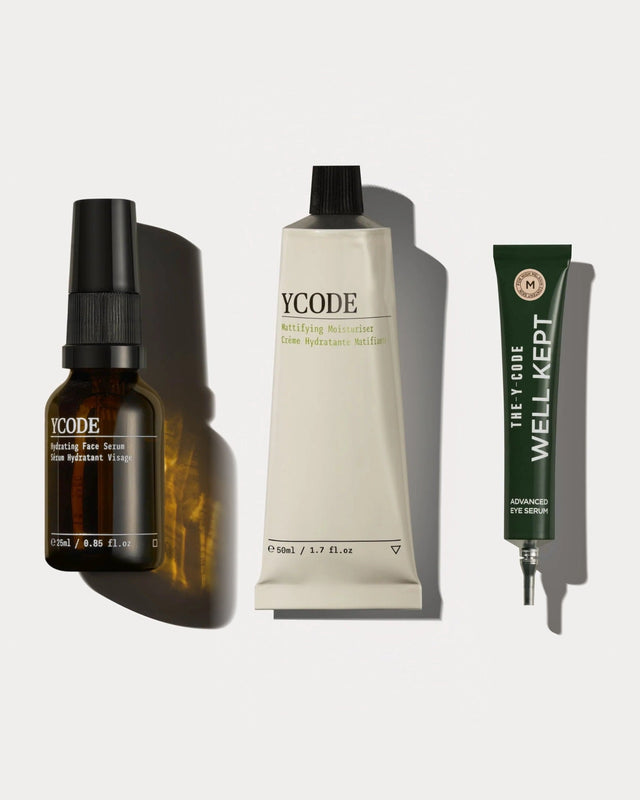
Three formulas focus on the major concerns men tend to see across the face...
The Daily Essentials improves the face and neck. Advanced Eye Serum adds concentrated support...












































































