

Does niacinamide help dark circles? An honest answer for men
Niacinamide helps one of the four causes of dark circles directly, a second one slowly and indirectly, and the other two not at all. Here is which is which, and how to tell what you are actually dealing with.

Niacinamide helps one of the four causes of dark circles directly, a second one slowly and indirectly, and the remaining two not at all. That is the honest answer. It is also more useful than the one you will find on most pages that answer this question, because most of them are selling a bottle and stop the explanation just before the part where the ingredient runs out of road.
The confusion is not really about niacinamide. It is about dark circles. Under-eye darkness is not one condition with one fix. Dermatology sorts it into pigmented, vascular and structural types, and notes that a great many people carry a mixed picture of more than one at the same time.1 An ingredient that acts on melanin will do nothing to a hollow. An ingredient that thickens skin will not neutralise brown pigment. Match the mechanism to the cause and you get somewhere. Guess, and you get a product you abandon in week three.
What niacinamide actually does
Niacinamide is vitamin B3 in its amide form. It is small, water-soluble and unusually stable, which is why it appears in so many formulas, and it has three well-documented actions on skin.
It builds the barrier. Applied topically, nicotinamide increases the biosynthesis of ceramides and the other lipids that make up the stratum corneum, and that translates into a measurable improvement in the epidermal permeability barrier.2 A barrier with more lipid in it holds water better and reads as less papery.
It interrupts pigment transfer. Melanin is made inside melanocytes, then handed over to surrounding skin cells in parcels called melanosomes. Niacinamide does not block melanin from being made. It reduces that handover step, and in controlled human testing it significantly reduced facial hyperpigmentation.3
It moderates oil. Testing of 2% niacinamide recorded measurable reductions in facial sebum production over several weeks of use.4 Useful across a man's face. Almost entirely beside the point under the eye, where there are barely any sebaceous glands to moderate.
A review of its mechanisms adds anti-inflammatory activity and a role in cellular energy, since niacinamide is a precursor of NAD.5 It is a good ingredient with a genuine evidence base. None of those actions, though, is a vasoconstrictor, and none of them is a filler.
The four reasons your under-eyes look dark
Pigmentary. Excess melanin sitting in the skin beneath the eye. It reads brown rather than blue. It is more common in deeper skin tones, and it is often made worse by rubbing, by sun on the upper cheek, and by any inflammation in the area that leaves pigment behind as it settles.
Vascular. The blue or purple cast. Under-eye skin is among the thinnest on the body, and it sits over a dense network of small vessels. When blood pools or those vessels dilate, the colour shows through. Sleep loss, dehydration, alcohol, allergy and congestion all push this the wrong way.
Structural. Anatomy rather than colour. The tear trough deepens with age as the fat pad under the eye loses volume and the cheek descends, leaving a hollow along the orbital rim.1
The shadowing that hollow creates. A depression catches light differently from the flat skin around it, so it looks dark regardless of what colour the skin actually is. Clinicians separate this from true pigment with a simple test: stretch the skin gently, and real pigmentation keeps its appearance while a shadowed contour lightens or disappears entirely.1 Try it at the mirror. It takes five seconds and it tells you more than any ingredient list.
Where niacinamide plausibly helps
Pigmentary circles are the clear case. The melanosome-transfer mechanism is exactly the right one for brown under-eye pigment, and it is supported by human data rather than cell studies alone.3 It works slowly, because you are waiting for pigmented cells already in the skin to turn over. Weeks, not days.
Vascular circles are the partial case, and this is where honesty matters. Niacinamide does nothing to blood vessels. What it does is build barrier lipids, and over time a better-built, better-hydrated barrier is a slightly less transparent one.2 Less transparent skin shows what is underneath it less clearly. That is a real but modest and indirect effect, and anyone promising you it will clear a blue-purple cast is overselling a barrier ingredient.
Where it does not help at all
Structural circles, and the darkness cast by them, are outside what any topical can reach. A systematic review of treatments for periorbital hyperpigmentation put it plainly: soft-tissue fillers and fat grafting are the most effective option where the cause is volume loss, surgery where the cause is excess skin, and topical creams and peels are for the pigment-based type.6 No cream rebuilds a fat pad. Anything that claims otherwise is describing a lighting effect.
Nor does niacinamide address the reason many men's circles come and go. In a controlled study, faces photographed after sleep deprivation were rated by observers as having darker circles under the eyes, more swollen eyes and a more fatigued appearance than the same faces after normal sleep.7 If your under-eyes look worse on Thursday than they did on Monday, that is not your serum failing. That is the week.
Niacinamide is a pigment and barrier ingredient. If your circles are brown, it has a mechanism. If they are cast by a hollow, nothing in a bottle reaches them.
Where we put niacinamide, and where we deliberately did not
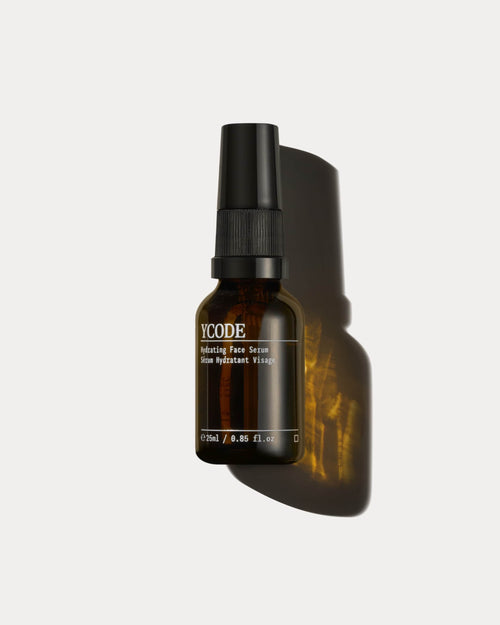
Niacinamide sits second on the ingredient list of our Hydrating Face Serum, which is a meaningful level rather than a token one. It is there for tone, barrier and oil balance across the whole face, which is what the evidence actually supports.
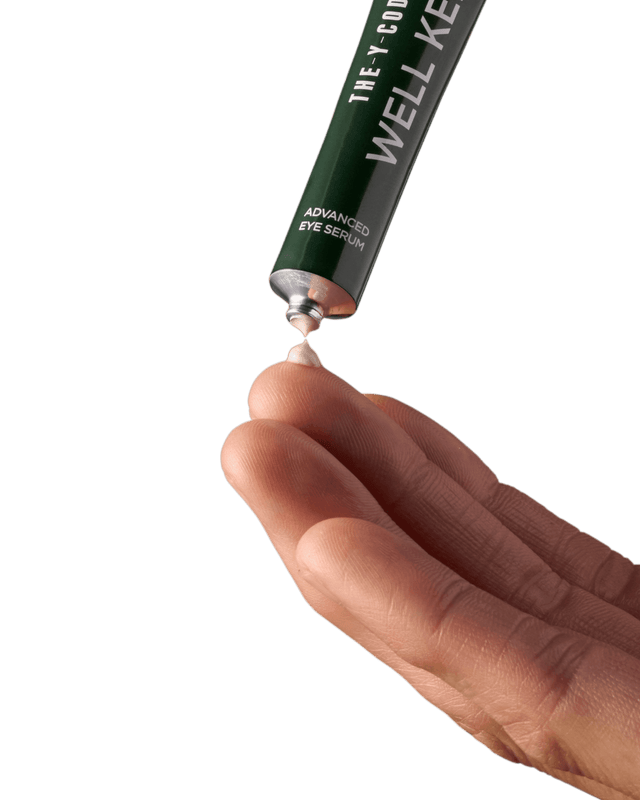
It is not in our Advanced Eye Serum, and that was a decision rather than an oversight. Under-eye skin is thin, mobile and the least forgiving on the face, so the active there needs to earn its place on the specific problem. We chose a supercritical CO2 extract of wild ginger, because its published data covers both the pigment side and the microcirculation side of dark circles rather than one of them, and we built the rest of that formula on marine actives.
Those published ingredient studies, run by Eurofins Dermscan on 111 volunteers with a mean age of 42 and measured at 15 minutes and 15 days, recorded 90% seeing dark circles visibly reduced, 89% seeing under-eye bags reduced and 86% seeing fine lines and wrinkles smoothed. Those are studies of the extract, not a consumer trial of our finished serum, and we label them that way every time.
For the face serum we do have our own consumer trial. In an independent trial of 50 men, ADSL 2025-0056, 90% said their skin looked more awake straight after use, and at four weeks 88% said their complexion appeared renewed and well rested. Those are self-assessment figures from men using the product, presented as exactly that.
The short version
Work out which type you have before you buy anything. Stretch the skin at the mirror. If the darkness stays, pigment is in play and niacinamide has a genuine, slow mechanism for it. If it lightens, you are looking at anatomy, and the useful moves are sleep, sun sense and realistic expectations rather than a stronger active.
Most men are somewhere in between, which is why a routine beats a single hero product. If you want the fuller picture of which actives suit which cause, our guide to the best ingredients for dark circles covers caffeine, vitamin C and peptides alongside this. And if you are wondering where a niacinamide serum sits relative to everything else at the basin, we set out the reasoning in whether serum goes before or after moisturiser.
Does niacinamide help dark circles?
How long does niacinamide take to work on pigmentation?
Can I use a niacinamide face serum under my eyes?
Is a higher percentage of niacinamide better for dark circles?
- Sarkar R, Ranjan R, Garg S, et al. Periorbital hyperpigmentation: a comprehensive review. J Clin Aesthet Dermatol. 2016;9(1):49-55. Source
- Tanno O, Ota Y, Oikawa N, Kitamura N, Inoue S. Nicotinamide increases biosynthesis of ceramides as well as other stratum corneum lipids to improve the epidermal permeability barrier. Br J Dermatol. 2000;143(3):524-531. PubMed
- Hakozaki T, Minwalla L, Zhuang J, et al. The effect of niacinamide on reducing cutaneous pigmentation and suppression of melanosome transfer. Br J Dermatol. 2002;147(1):20-31. PubMed
- Draelos ZD, Matsubara A, Smiles K. The effect of 2% niacinamide on facial sebum production. J Cosmet Laser Ther. 2006;8(2):96-101. Source
- Wohlrab J, Kreft D. Niacinamide: mechanisms of action and its topical use in dermatology. Skin Pharmacol Physiol. 2014;27(6):311-315. Source
- Michelle L, Pouldar Foulad D, Ekelem C, Saedi N, Mesinkovska NA. Treatments of periorbital hyperpigmentation: a systematic review. Dermatol Surg. 2021;47(1):70-74. PubMed
- Sundelin T, Lekander M, Kecklund G, Van Someren EJW, Olsson A, Axelsson J. Cues of fatigue: effects of sleep deprivation on facial appearance. Sleep. 2013;36(9):1355-1360. Source

I started YCODE because most skincare was never designed for men’s skin. What I write here is what the formulators taught me, and what the trials actually found.
Continue reading
VIEW ALL →
Your skin can notice the change of season before you reach for a coat....
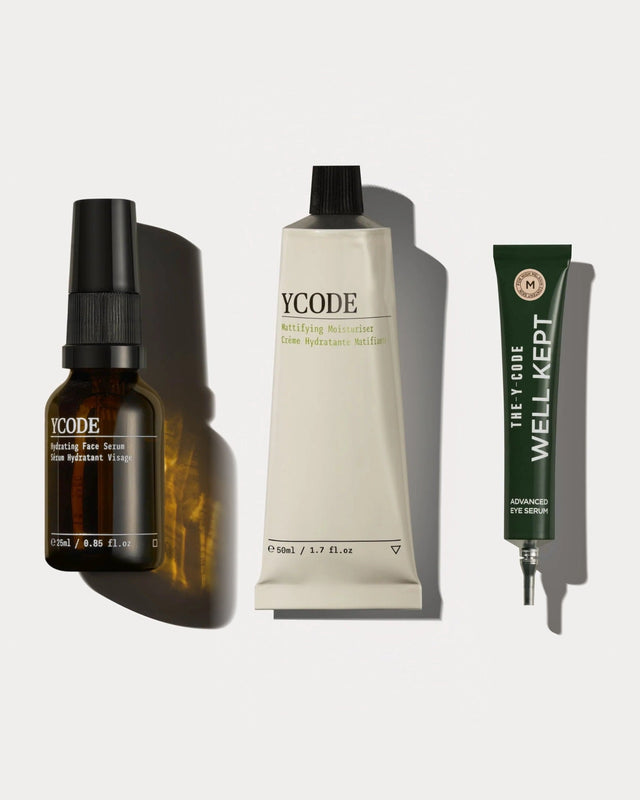
Three formulas focus on the major concerns men tend to see across the face...
The Daily Essentials improves the face and neck. Advanced Eye Serum adds concentrated support...












































































