

Why your eyes look puffy in the morning, and what actually helps
Morning puffiness is a fluid event, not a skin event. What happens overnight, why some mornings are worse, how it differs from permanent bags, and when it is worth getting checked.

You look worse at seven in the morning than you did at midnight, and it is mostly plumbing. Spend eight hours lying flat and fluid that gravity held in your legs all day moves upwards. The tissue around your eye is thin, loose and has nothing much to push back with, so that is where it shows first. Stand up, and most of it drains away again within an hour or two.
That is the honest core of it. Morning puffiness is usually a fluid event, not a skin event, which is why no product on earth removes it entirely and why the things that help most are unglamorous.
What is actually happening while you sleep
During the day, standing and sitting mean fluid accumulates in the blood vessels and tissues of your legs. Lie down and that reverses. Sleep researchers studying the effect call it a rostral fluid shift: fluid redistributing from the legs towards the upper body once gravity stops holding it down.1 It is a normal, nightly, entirely healthy thing that happens to everyone.
The eye area then acts as the display. The skin there is the thinnest on the face, measured at a median of roughly 574 micrometres at the upper eyelid against about 1,907 at the tip of the nose,2 and the tissue beneath it is loose. A small volume of fluid that would be invisible in your cheek is obvious under your eye.
You are also not blinking much while asleep, and the movement of blinking is part of what keeps things circulating around the eye. Several hours of stillness, horizontal, is close to the ideal set-up for a puffy morning.
Why some mornings are worse
Four variables move the dial more than the rest.
Sleep itself. This is measurable rather than folklore. When researchers photographed people after normal sleep and again after 31 hours awake, independent observers rated the sleep-deprived faces as having more swollen eyes, more hanging eyelids, more pronounced dark circles and a generally more fatigued appearance.3 Other people can see it, which is usually the part men care about.
Salt. A salty dinner or a late takeaway holds more water in the tissues overnight, and that water goes where the fluid shift takes it. This is the single easiest variable to test on yourself over a week.
Alcohol. It fragments sleep and dehydrates you, which is a combination that produces both puffiness and the tired look that comes with it. The night is fine. The morning presents the invoice.
How flat you sleep. The lower your head, the more fluid moves upwards. An extra pillow is not a cure, but it is a genuine lever and it costs nothing to try.
Morning puffiness is a fluid problem wearing a skincare problem's clothes. Treat the fluid, and the skin looks after itself.
Puffiness is not the same as bags
Worth separating, because the two get sold as one thing.
Puffiness comes and goes. It is worst on waking, improves through the morning, and varies with sleep, salt and alcohol.
Under-eye bags that are there at nine in the morning and still there at nine at night are usually structural: the way fat sits under the eye, the depression of the tear trough, and skin that has lost firmness with age. Reviews of the under-eye area describe exactly this loss of volume and the hollowing that follows, which casts a darkness of its own.4 Structural change is not something a serum reverses, and any brand claiming otherwise is selling you a story.
What does respond is hydration, firmness and the look of dark circles. That is a real and visible difference, and it is worth being precise about which one you are buying.
What actually helps in the morning
Get upright and stay upright. Gravity did this and gravity undoes it, usually within an hour.
Apply something cool. A cold flannel or the back of a cold spoon for a minute is as effective as most gadgets, and works by the same mechanism.
Do not rub. It feels like relief and it is not one, because repeated rubbing of the eye area is one of the recognised contributors to under-eye pigmentation over time.4 You would be swapping a temporary puffiness for a lasting darkness.
Drink water, go easy on salt in the evening, and protect the sleep you can control. Most men know all of this. Almost none of them treat it as skincare, which is precisely what it is.
When it is worth getting looked at
Puffiness that is symmetrical, worst on waking and better by mid-morning is ordinary. Swelling that is one-sided, hot, painful, red or blistered, that comes with a drooping lid, or that affects your vision is not, and that is a same-day conversation with a pharmacist or GP rather than something to manage with a serum.5 Persistent, unexplained swelling that will not settle is also worth mentioning to your GP, since a number of ordinary medical causes sit behind it.
Where a product fits
An eye product is not a drainage device. What it can do is hydrate thin skin, support firmness, and work on the look of dark circles, which is most of what you are reacting to in the mirror anyway.
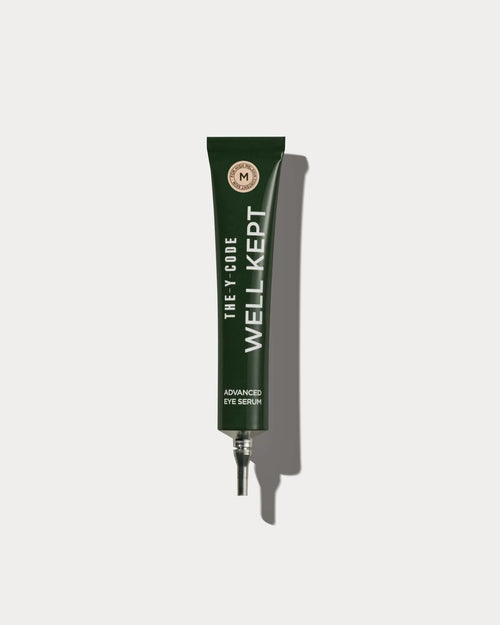
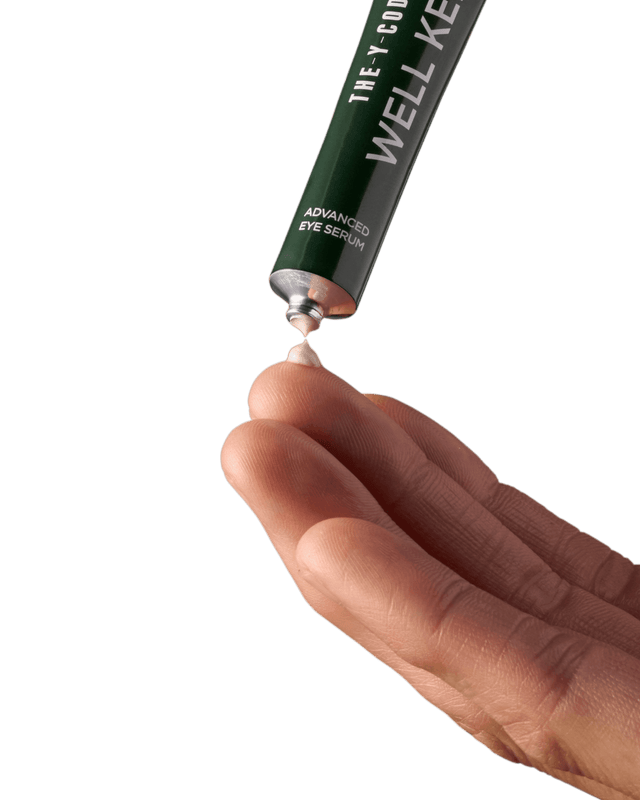
Our Advanced Eye Serum is built around a supercritical CO2 extract of wild ginger, chosen because its published data addresses both the pigment and the vascular causes of under-eye darkness. It is fragrance-free, and it comes in three formulas, M, M+ and M-, developed around the different requirements of different skin tones under our Melanin Adaptive Technology.
Figures from published ingredient studies of the supercritical CO2 wild ginger extract the serum is built on. Eurofins Dermscan, 111 volunteers, mean age 42, measured at 15 minutes and 15 days. These are ingredient-study results, not a YCODE consumer trial.
Used in the morning at a rice-grain dose, applied cool, on the orbital bone, it is a two-minute habit rather than a project. The technique matters here more than the quantity, and we set it out in how much eye serum to use and where to apply it. If the under-eye is your main concern, our guide to the ingredients that work on dark circles is the next thing to read, and if a previous eye product stung, an eye serum that does not sting covers what to look for instead.
Why are my eyes puffy in the morning but fine by lunchtime?
Does drinking more water help or make it worse?
Will an eye serum get rid of puffiness?
Is sleeping on my front making it worse?
- White LH, Bradley TD. Role of nocturnal rostral fluid shift in the pathogenesis of obstructive and central sleep apnoea. The Journal of Physiology. 2013;591(5):1179-1193. Source
- Korzekwa S, Matusz K, Kukulski M, et al. Quantitative Analysis of the Human Face Skin Thickness: A High-Frequency Ultrasound Study. Journal of Clinical Medicine. 2025;14(23):8401. Source
- Sundelin T, Lekander M, Kecklund G, Van Someren EJW, Olsson A, Axelsson J. Cues of Fatigue: Effects of Sleep Deprivation on Facial Appearance. Sleep. 2013;36(9):1355-1360. Source
- Sarkar R, Ranjan R, Garg S, Garg VK, Sonthalia S, Bansal S. Periorbital Hyperpigmentation: A Comprehensive Review. Journal of Clinical and Aesthetic Dermatology. 2016;9(1):49-55. Source
- NHS. Eyelid problems. National Health Service, 2024. Source

I started YCODE because most skincare was never designed for men’s skin. What I write here is what the formulators taught me, and what the trials actually found.

Continue reading
VIEW ALL →
Your skin can notice the change of season before you reach for a coat....
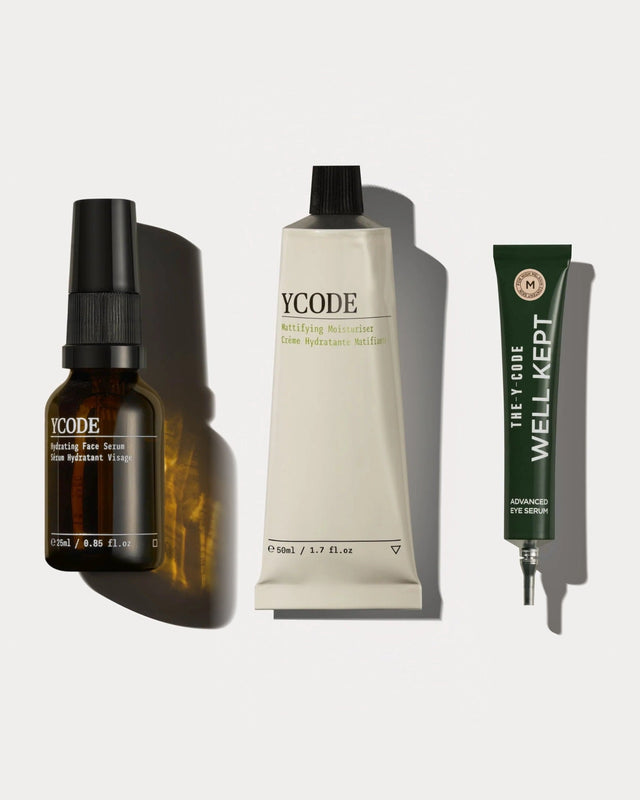
Three formulas focus on the major concerns men tend to see across the face...
The Daily Essentials improves the face and neck. Advanced Eye Serum adds concentrated support...