

What four weeks of Mattifying Moisturiser changed
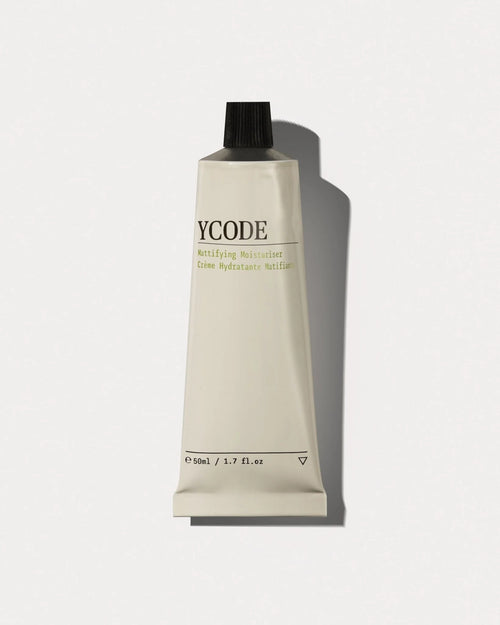
Fifty-three men, two applications a day and a complete month. The finished moisturiser was assessed for hydration, comfort, shine, facial hair and confidence, and four weeks is a little over one renewal cycle.

Four weeks is the first complete product-level checkpoint for Mattifying Moisturiser.
The immediate finish had already been assessed after a single application. The month tells us whether the product stayed useful once the novelty wore off, and whether the result reached past shine control.
It did.
How the trial was run
An independent consumer trial followed 53 men aged 18 to 50 using the finished Mattifying Moisturiser morning and evening for four weeks. The panel included normal, sensitive and blemish-prone skin, with representation across Fitzpatrick skin-tone classifications. Results were collected after the first application and again at four weeks. No adverse reactions were recorded.1
Every figure below is participant self-assessment: each man's own reading of his own face, recorded under a controlled protocol. That is a complementary measure, not instrumental efficacy data, and it is worth being blunt about why. A systematic review of self-report instruments in facial aesthetics identified 47 measures, of which only nine met the review's inclusion criteria and none satisfied every methodological guideline.2 Properly validated patient-reported instruments do exist, and they take years of psychometric work to build.3 A four-week consumer panel is not one of them, and we are not going to dress it up as one.
Hydration and barrier comfort
A further 79% said their overall skin quality had improved.1
These are the results that stop the product being understood only through the word mattifying. A finish is visible for a few hours. Barrier comfort and overall skin quality describe how the face feels and behaves after repeated use.
Matte, without looking dry
Seventy-four percent said their skin looked more balanced and less shiny, and 72% said it looked mattified but not dry.1
The second figure is the more demanding one. Removing shine is straightforward. Removing excess shine while keeping a comfortable, natural-looking surface asks the oil-control and hydration systems to stay in balance with each other.
Rice starch contributes the immediate physical mattification, as a formulation function rather than a measured claim; there is no published human study of rice starch absorbing oil on facial skin. The Chlorella material brings the seven and 14-day moisture, sebum and redness findings from its own double-blind split-face study.4 Humectants, emollients and the occlusive phase complete the formula around them, covering the three established jobs of a moisturiser: binding water, softening the surface and slowing its escape.5
The facial-hair result
Eighty-one percent said the facial-hair area felt soothed and that follicles felt less irritated.1
This is a specifically male result, and one of the reasons the product was tested on men. Stubble and beard growth change the way a moisturiser spreads. Shaving repeatedly disturbs the skin around follicles. A formula can be perfectly acceptable on the forehead and fail along the jaw.
It also reinforces the application method. The moisturiser has to be worked through the hair to the skin beneath it, not polished across the top of it.
What four weeks is, in skin time
It is tempting to say skin renews itself every 28 days, because the month would then line up neatly with a complete cycle. That figure does not survive contact with the literature.
Stratum corneum transit time, measured by fluorescent labelling, is around 20 days in young adults and roughly ten days longer in older ones.6 Desquamation rates themselves vary by body region and by age.7 And total epidermal turnover, once the proliferative compartment is included, has been recalculated at 47 to 48 days.8
So four weeks is a little over one stratum corneum renewal cycle, and rather less than a full epidermal turnover. That is enough time for most of the surface a man is looking at to have been replaced while he was using the product. It is not enough time to have rebuilt the epidermis beneath it, and we would rather say so than borrow a rounder number.
What changed beyond the skin
The trial also asked what the routine meant to the men using it. Eighty-five percent said looking better made them feel more confident. Eighty-three percent said taking care of their skin felt as essential as looking after fitness or nutrition. Seventy-seven percent said the daily act had become an important ritual.1
This is not separate from product performance. A routine becomes permanent when the result is visible enough to matter and the act is simple enough to repeat. The moisturiser is not there only to remove a tight feeling after washing. It should change how a man feels about how he presents himself.
What to look for at one month
Compare your first photograph with one taken today in the same natural light. Studies of home-use cosmetic treatments commonly assess at day zero, 15, 30 and 60 for the same reason: change at this pace is easy to normalise and hard to remember accurately.9
Look for skin that appears smoother and more evenly hydrated, less contrast between oily and dry areas, a controlled surface that still looks natural, greater comfort around the jaw, neck and facial hair, and fewer moments in the day when the face feels tight or looks excessively shiny.
Then consider the less visible result. Has the product become automatic? Do you notice its absence when you skip it? Has it earned its ten seconds?
What happens after one month
One month is not the end of the formula's timeline.
The prebiotic system has longer microbiome work behind it.10 Palmitoyl tripeptide-5 sits on an 84-day research clock.11 The barrier also responds to the conditions it is given each day rather than permanently banking a completed result.
At the next stage the question changes from whether the moisturiser works to whether the rest of the face routine makes it more useful.
Where the moisturiser fits
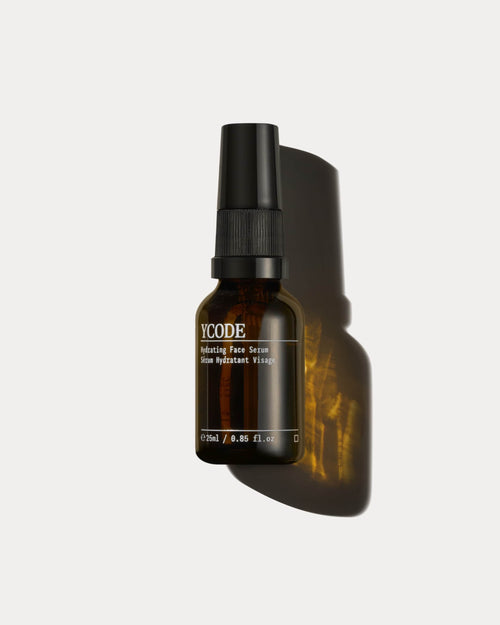
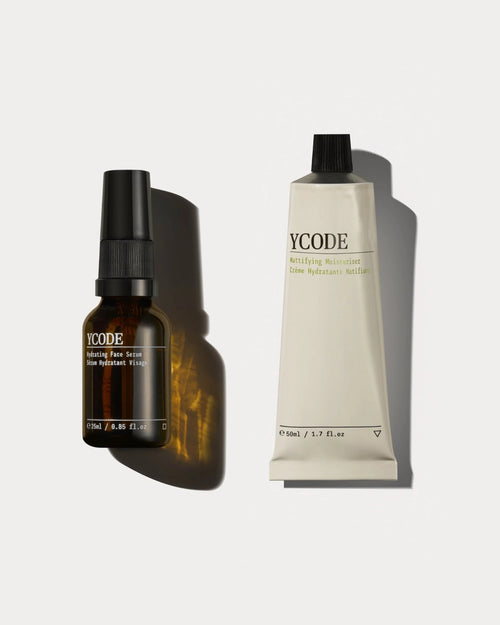
Mattifying Moisturiser is the second step of a routine that takes under two minutes, after Hydrating Face Serum and before Advanced Eye Serum.
For the measured ingredient stage before this one, read what has changed after 15 days. For the formula itself, read inside Mattifying Moisturiser. For the next stage, continue to why face serum and moisturiser do different jobs.
We made a moisturiser for the face a man wants to leave the house with, not just the skin he wants to stop feeling tight. Four weeks later that distinction shows up in the numbers, and I would rather report them honestly than inflate them.
Freddie Sheridan
Founder
Was the finished Mattifying Moisturiser tested, or only its ingredients?
Were sensitive and blemish-prone skin included?
Does skin really renew itself every 28 days?
Why are the percentages different for hydration and mattification?
How much weight should a consumer self-assessment carry?
Does one month mean the result is complete?
Why does routine formation matter to a skincare result?
- YCODE Mattifying Moisturiser independent consumer self-assessment, ADSL 2025-0057. Finished product, 53 men aged 18 to 50, morning and evening, assessed after first use and at four weeks. Participant self-assessment, reported as a complementary measure rather than instrumental efficacy data.
- Kosowski TR, McCarthy C, Reavey PL, et al. A systematic review of patient-reported outcome measures after facial cosmetic surgery and/or nonsurgical facial rejuvenation. Plastic and Reconstructive Surgery. 2009;123(6):1819-1827. Of 47 measures identified, nine met inclusion criteria and none satisfied all guidelines. Source
- Klassen AF, Cano SJ, Schwitzer JA, et al. Development and Psychometric Validation of the FACE-Q Skin, Lips, and Facial Rhytids Appearance Scales and Adverse Effects Checklists for Cosmetic Procedures. JAMA Dermatology. 2016;152(4):443-451. 783 patients, Rasch measurement theory analysis. Source
- Supplier dossier and efficacy portfolio for the Chlorella vulgaris material used in the formula. Double-blind split-face study, ten volunteers aged 40 to 55, twice daily against placebo, with corneometer measurement at day seven and Sebumeter and colorimeter measurements at day 14.
- Rajkumar J, Chandan N, Lio P, Shi V. The Skin Barrier and Moisturization: Function, Disruption, and Mechanisms of Repair. Skin Pharmacology and Physiology. 2023;36(4):174-185. Source
- Grove GL, Kligman AM. Age-associated changes in human epidermal cell renewal. Journal of Gerontology. 1983;38(2):137-142. Stratum corneum transit approximately 20 days in young adults, roughly ten days longer in older adults. Source
- Roberts D, Marks R. The determination of regional and age variations in the rate of desquamation: a comparison of four techniques. Journal of Investigative Dermatology. 1980;74(1):13-16. Source
- Iizuka H. Epidermal turnover time. Journal of Dermatological Science. 1994;8(3):215-217. Recalculates total epidermal turnover as 47 to 48 days. Source
- Ferrillo M, Vastarella M, Cantelli M, Mazzella C, Fabbrocini G. Instrumental, clinical and subjective evaluation of the efficacy of a cosmetic treatment for home use. Journal of Cosmetic and Laser Therapy. 2019;21(4):190-195. Assessments at day 0, 15, 30 and 60. Source
- Supplier technical dossier and microbiome research for the chicory-derived inulin and fructo-oligosaccharide material, including early microbial interaction modelling and a 28-day metagenomic assessment.
- Supplier technical and clinical documentation for palmitoyl tripeptide-5, including a controlled 84-day study of a cream containing the peptide with skin-surface relief assessed by PRIMOS.

I started YCODE because most skincare was never designed for men’s skin. What I write here is what the formulators taught me, and what the trials actually found.
Continue reading
VIEW ALL →
Stress and poor sleep have a way of becoming visible. The eyes look heavier....

Your skin can notice the change of season before you reach for a coat....
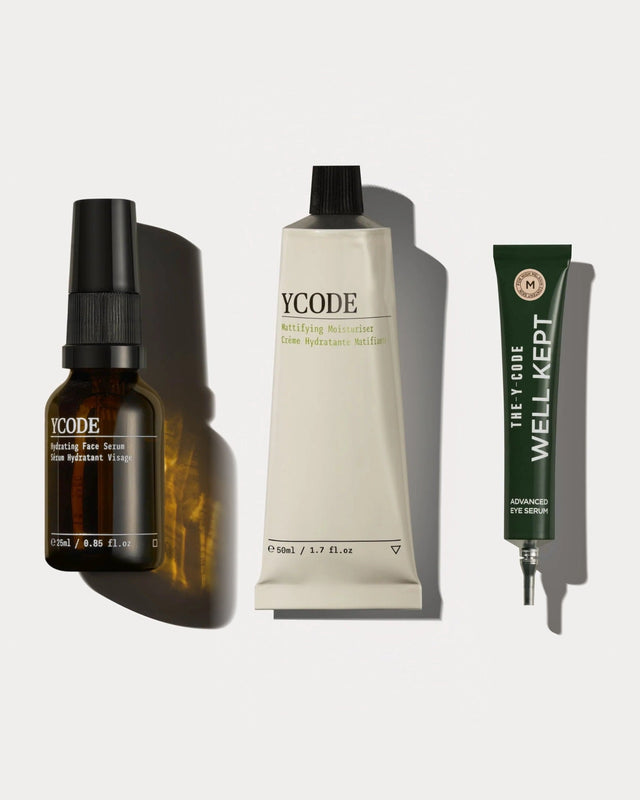
Three formulas focus on the major concerns men tend to see across the face...












































































