

What has changed after 15 days of Mattifying Moisturiser
The first application changed the finish. At 15 days the more useful question is whether the skin beneath it is finding a better balance, and what the instruments behind that claim actually measure.

At 15 days, the interesting part is no longer the few minutes immediately after applying Mattifying Moisturiser.
The matte finish should already be familiar. The deeper checkpoint is how the face behaves across a whole day: whether shine returns as quickly, whether dry areas stay comfortable, and whether the surface looks more even without looking flat.
This is also the point at which the Chlorella material in the formula has more than one human measurement to report.
What the ingredient study measured
The Chlorella material was assessed in a double-blind split-face study. Ten volunteers aged 40 to 55 applied the active to one side of the face and a placebo to the other, twice daily, so each volunteer acted as his or her own comparison.1
Two things are worth saying plainly before those numbers travel any further. They belong to the raw material at its studied level, in that study, against that placebo, in ten people. They are not a measurement of this moisturiser, and they are not a forecast for any individual face.1
What the seven-day reading actually is
Moisture was measured with a corneometer, which does not ask anyone whether their skin feels hydrated. It reads the electrical capacitance of the outer skin, a property that changes with the amount of water held there.
The method has been formalised twice by the EEMCO group: first as guidance for the assessment of stratum corneum hydration by electrical methods,2 and later in a revised guidance covering the in vivo measurement of water in the skin.3 Capacitance and impedance instruments have been compared directly in vivo and track each other closely.4
That is what gives the week-one stage an instrumental marker rather than an impression.
At 14 days, oil and redness move together
Sebum was measured with a sebumeter, which lifts oil from a defined area of skin onto a tape and reads the change in the tape's transparency. The EEMCO group has published guidance for the in vivo assessment of skin greasiness, including the distinction between the casual sebum level sitting on the surface and the rate at which it is replaced.5
Redness was assessed with a colorimeter, an instrument that quantifies colour rather than asking an observer to judge it.6 Colorimeters have been compared against clinical scoring and laser-Doppler flowmetry for irritant-induced erythema,7 and remain the standard objective route to skin colour measurement.8 Standardised guidance for erythema measurement has existed since the 1990s.9
The combined movement matters more than either figure alone.
The active did not lower oil by leaving the skin drier, because moisture had already moved in the other direction at week one. Nor did it produce a harsher-looking surface, because measured redness fell as well. That is the biological version of the product promise: matte, never dry.
What the rest of the formula is doing
Rice starch continues to control surface shine from each application. That is a formulation function of the material. There is no published human study of rice starch absorbing oil on facial skin, so we attach no figure and no citation to it.
Glycerin, sodium hyaluronate and the supporting humectants bind water. Shea butter and the emollient phase soften the surface and help slow moisture escape. Binding water, softening the surface and slowing its loss are the three established jobs of a moisturiser.10
The prebiotic system is on its way towards longer microbiome measurements,11 and palmitoyl tripeptide-5 remains on the slowest clock of all.12
Five jobs are therefore running at five different speeds: immediate surface oil control, immediate water binding and softening, the seven-day Chlorella moisture reading, the 14-day sebum and redness readings, and the longer microbiome and peptide work. The formula does not wait for one hero ingredient to do everything.
What to look for now
Look at your face in natural daylight, not only under a bathroom downlight.
Notice whether shine returns as quickly across the forehead, nose and cheeks. Notice whether the skin feels comfortable after washing, whether dry patches are less obvious, whether the surface feels smoother under the fingertips, and whether the skin around stubble or a beard feels calmer. The finish should still look like skin, simply better controlled.
Take a photograph in the same light as the one you took before the first application. Gradual change becomes normal very quickly, and a photograph gives memory something objective to work against. Studies of home-use cosmetic treatments commonly assess at day zero, 15, 30 and 60 for the same reason.13
Why this is not the final checkpoint
Everything above belongs to the Chlorella material inside the formula rather than to the finished moisturiser.
The product-level assessment arrives at four weeks, when 53 men reported on the finished Mattifying Moisturiser after using it morning and evening.14 Those are participant self-assessments, which is a complementary measure rather than instrumental efficacy data. The systematic review of self-report instruments in this field found that none of the existing measures satisfied every methodological guideline.15 We report ours as what it is.
That next chapter covers hydration, irritation, facial-hair comfort, barrier perception, balance, shine and the routine itself.
Where the moisturiser fits
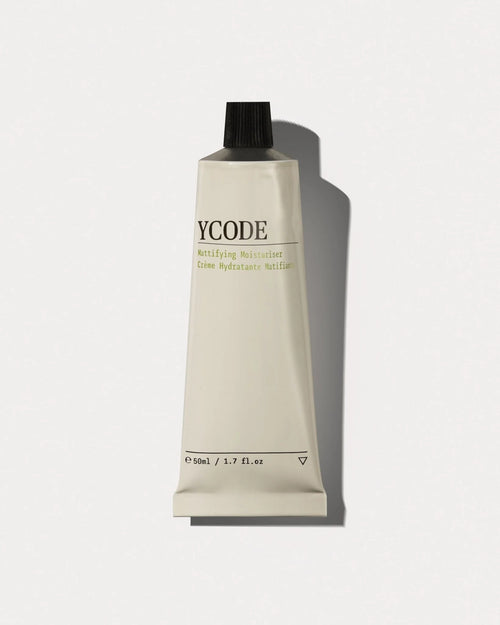
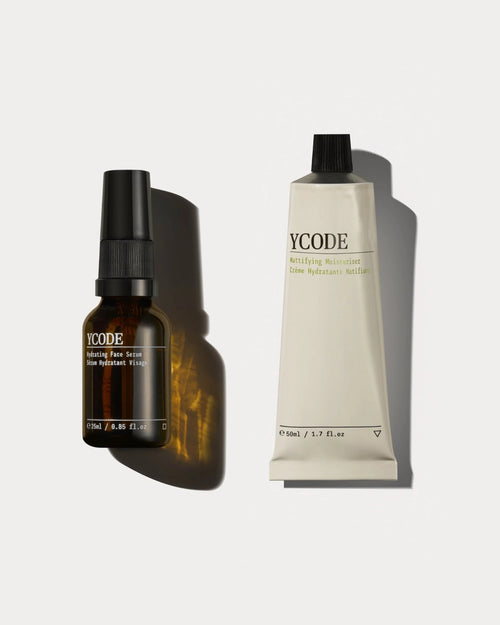
Mattifying Moisturiser is the second step of a routine that takes under two minutes, after Hydrating Face Serum and before Advanced Eye Serum.
For the formula itself, read inside Mattifying Moisturiser. For the method, read how to apply Mattifying Moisturiser. For the finished-product findings, continue to what four weeks changed.
Fifteen days is the point where I ask people to stop looking at the finish and start watching the behaviour. The first use tells you whether you like the cream. A fortnight begins to tell you whether the skin underneath is changing with it.
Freddie Sheridan
Founder
Why is the checkpoint at 15 days when the measurement was taken at day 14?
What does 37% lower sebum actually mean?
Can less sebum make skin feel dry?
Was the Chlorella study run on the finished moisturiser?
How reliable are these instruments?
What if I do not see a large difference yet?
- Supplier dossier and efficacy portfolio for the Chlorella vulgaris material used in the formula. Double-blind split-face study, ten volunteers aged 40 to 55, twice daily against placebo, with corneometer measurement at day seven and Sebumeter and colorimeter measurements at day 14.
- Berardesca E; EEMCO Group. EEMCO guidance for the assessment of stratum corneum hydration: electrical methods. Skin Research and Technology. 1997;3(2):126-132. Source
- Berardesca E, Loden M, Serup J, Masson P, Monteiro Rodrigues L. The revised EEMCO guidance for the in vivo measurement of water in the skin. Skin Research and Technology. 2018;24(3):351-358. Source
- Clarys P, Clijsen R, Taeymans J, Barel AO. Hydration measurements of the stratum corneum: comparison between the capacitance method (digital version of the Corneometer CM 825) and the impedance method (Skicon-200EX). Skin Research and Technology. 2012;18(3):316-323. Source
- Pierard GE, Pierard-Franchimont C, Marks R, Paye M, Rogiers V; EEMCO Group. EEMCO guidance for the in vivo assessment of skin greasiness. Skin Pharmacology and Applied Skin Physiology. 2000;13(6):372-389. Source
- Pierard GE. EEMCO guidance for the assessment of skin colour. Journal of the European Academy of Dermatology and Venereology. 1998;10(1):1-11. Source
- Serup J, Agner T. Colorimetric quantification of erythema: a comparison of two colorimeters (Lange Micro Color and Minolta Chroma Meter CR-200) with a clinical scoring scheme and laser-Doppler flowmetry. Clinical and Experimental Dermatology. 1990;15(4):267-272. Source
- Ly BCK, Dyer EB, Feig JL, Chien AL, Del Bino S. Research Techniques Made Simple: Cutaneous Colorimetry: A Reliable Technique for Objective Skin Color Measurement. Journal of Investigative Dermatology. 2020;140(1):3-12.e1. Source
- Fullerton A, Fischer T, Lahti A, Wilhelm KP, Takiwaki H, Serup J. Guidelines for measurement of skin colour and erythema. A report from the Standardization Group of the European Society of Contact Dermatitis. Contact Dermatitis. 1996;35(1):1-10. Source
- Rajkumar J, Chandan N, Lio P, Shi V. The Skin Barrier and Moisturization: Function, Disruption, and Mechanisms of Repair. Skin Pharmacology and Physiology. 2023;36(4):174-185. Source
- Supplier technical dossier and microbiome research for the chicory-derived inulin and fructo-oligosaccharide material, including early microbial interaction modelling and a 28-day metagenomic assessment.
- Supplier technical and clinical documentation for palmitoyl tripeptide-5, including a controlled 84-day study of a cream containing the peptide.
- Ferrillo M, Vastarella M, Cantelli M, Mazzella C, Fabbrocini G. Instrumental, clinical and subjective evaluation of the efficacy of a cosmetic treatment for home use. Journal of Cosmetic and Laser Therapy. 2019;21(4):190-195. Assessments at day 0, 15, 30 and 60. Source
- YCODE Mattifying Moisturiser independent consumer self-assessment, ADSL 2025-0057. Finished product, 53 men aged 18 to 50, morning and evening, assessed after first use and at four weeks. Participant self-assessment, reported as a complementary measure rather than instrumental efficacy data.
- Kosowski TR, McCarthy C, Reavey PL, et al. A systematic review of patient-reported outcome measures after facial cosmetic surgery and/or nonsurgical facial rejuvenation. Plastic and Reconstructive Surgery. 2009;123(6):1819-1827. Of 47 measures identified, nine met inclusion criteria and none satisfied all guidelines. Source

I started YCODE because most skincare was never designed for men’s skin. What I write here is what the formulators taught me, and what the trials actually found.
Continue reading
VIEW ALL →
Stress and poor sleep have a way of becoming visible. The eyes look heavier....

Your skin can notice the change of season before you reach for a coat....
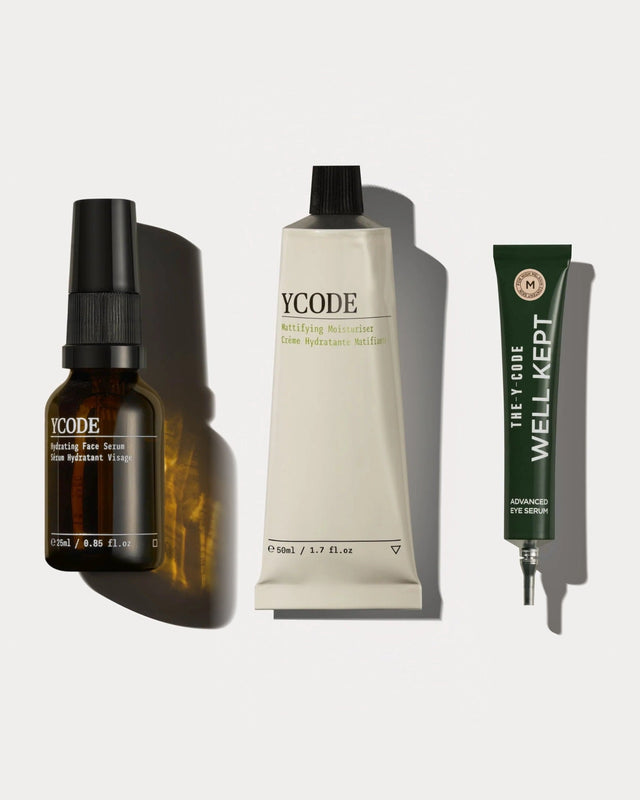
Three formulas focus on the major concerns men tend to see across the face...












































































