

What a mattifying moisturiser does from the first use
Matte on the surface and hydrated beneath it. Here is what happens in the first few seconds on the skin, what 53 men reported after a single application, and why oil control does not have to come from dryness.
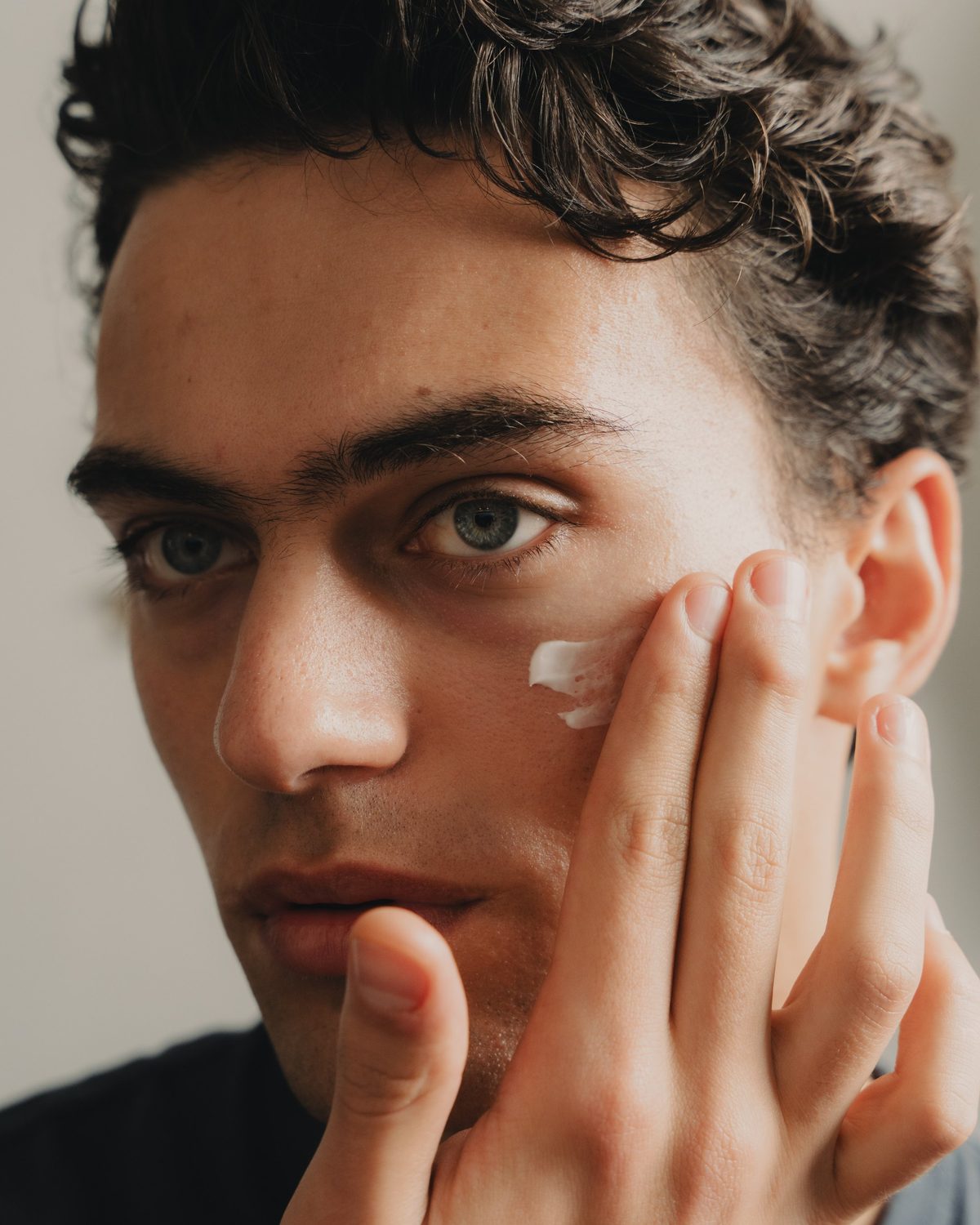
Most mattifying products make a trade. They remove shine quickly by leaving the skin feeling stripped. Most rich moisturisers make the opposite one. They relieve tightness, then leave a film that becomes visible before the morning is over.
Mattifying Moisturiser was designed to resolve both conditions at once: hydrated underneath, matte on the surface.
That is not only a description of the formula. It is what men reported when the finished product was assessed after its first use.
What 53 men reported
In an independent consumer trial, 53 men aged 18 to 50 used the finished Mattifying Moisturiser morning and evening. After the very first application:1
A further 85% said their skin looked smooth, and 75% said the cream was non-greasy and left the skin looking matte.1
These findings matter together. Hydration did not arrive at the expense of the finish, and the matte finish did not depend on discomfort.
They are also self-assessments: each man's own reading of his own face. That is a useful complementary measure and not a substitute for instrumental work, which is why the published research below sits alongside it rather than underneath it.
What happens in the first ten seconds
As the formula is spread, three systems begin working at once.
Humectants bind water. Glycerin, propanediol, pentylene glycol and sodium hyaluronate make up the water-binding system. The measured evidence for combinations of this kind starts at 15 minutes: a study of 1,3-propanediol with butylene glycol and glycerol, conducted in 30 healthy women, recorded hydration and barrier changes at 15 minutes, two hours and eight hours.2 Glycerol on its own has been shown to accelerate barrier recovery,3 and applied topically it raises hydration quickly while barrier readings take several days to move.4 Other work has followed a single application out to 24 hours.56
Those numbers belong to the studies that produced them. One of them was conducted in 30 women, none of them tested this formula, and none of them measured anything in the first few seconds. What they establish is the timescale on which a humectant system becomes measurable at all.
Emollients soften the surface. Shea butter, coconut oil and caprylic/capric triglyceride settle into the spaces between surface cells, improving flexibility and reducing the rough feeling associated with dry skin. Softening the surface is one of the three classical jobs of a moisturiser, alongside binding water and slowing its escape.7
Rice starch controls excess surface oil. This is a physical effect of the material rather than a biological one. The starch takes up excess oil at the surface as soon as it arrives there, which is why the finish can change immediately rather than waiting for a biological process to develop. We attach no measured figure to it. There is no published human study of rice starch absorbing oil on facial skin, and we are not going to borrow one from somewhere else.
Mattifying describes the finish, not the whole job
The word mattifying is often mistaken for drying. They are not the same thing.
Drying removes or disrupts the material that helps the barrier hold water. Mattifying controls how much oil remains visible at the surface. A well-made moisturiser can support water retention beneath while reducing shine above.7
That distinction is particularly important for men. Sebum and the water held in the outer skin are two different variables, read by two different instruments, and a cross-sectional study of 500 volunteers found they vary independently by body site, age and sex.8 A face can look shiny and still feel tight after washing.
What to notice on the first day
Immediately after application, the skin should feel comfortable rather than coated. The finish should look natural rather than powdered or flat.
By lunchtime, notice whether shine has returned across the forehead and nose. At the end of the day, notice whether the cheeks and jaw still feel comfortable.
The first use is not the final result. It is proof that the formula can do something useful now while the longer work begins.
The second clock
Chlorella vulgaris, the prebiotic system and palmitoyl tripeptide-5 do not belong to the first ten seconds at all.
The Chlorella material has human measurements at seven, 14 and 28 days, taken in a double-blind split-face study in which each volunteer's own untreated side was the comparison.9 The prebiotic system has research running from early microbial interaction modelling into 28-day microbiome work.10 The peptide sits on the longest clock, with controlled human research running to 84 days.11
All three of those are studies of the raw materials held by their suppliers, not studies of this moisturiser. They are the reason each ingredient earned its place in the formula, and they belong on a different shelf from the trial of the finished product.
This is how a product becomes worth repeating. The first application earns the second. Consistency allows the formula to show what it does beyond the finish.
Where the moisturiser fits
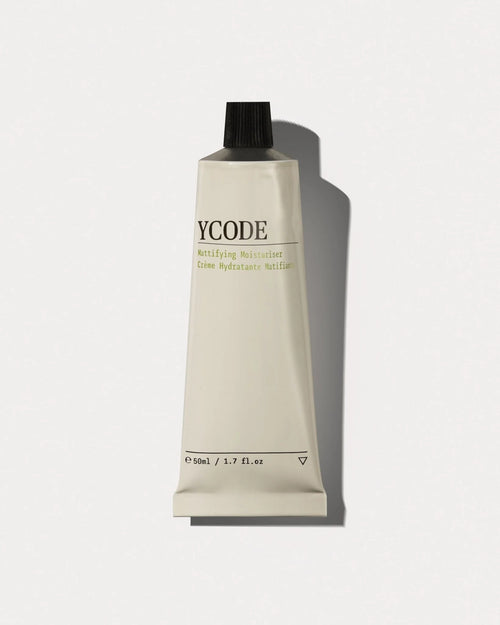
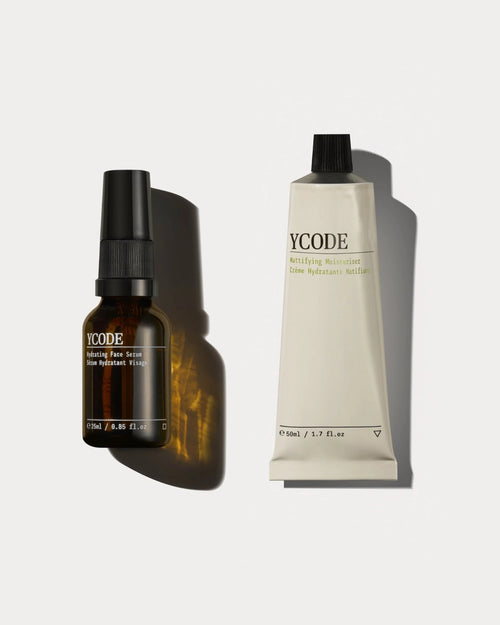
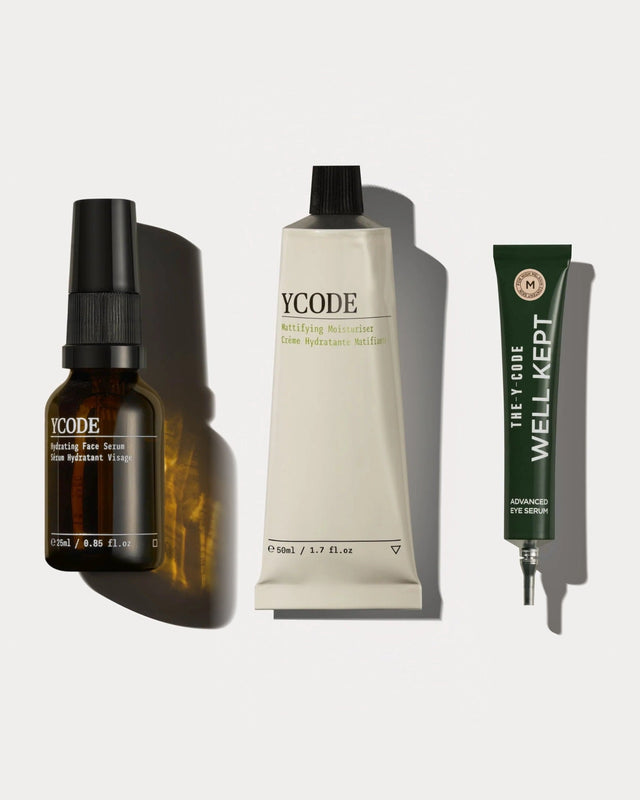
Mattifying Moisturiser is the second step of a routine that takes under two minutes, after Hydrating Face Serum and before Advanced Eye Serum.
For the method itself, read how to apply Mattifying Moisturiser. For the design logic behind the formula, read why men's skin needs a moisturiser built differently. For the next measured stage, continue to inside Mattifying Moisturiser.
The first use is the only part of this a man can judge on the day he opens the tube. I would rather it earned the second application honestly than dazzled you once.
Freddie Sheridan
Founder
Can skin be matte and hydrated at the same time?
Does mattifying mean drying?
How quickly should Mattifying Moisturiser absorb?
Is it too rich for oily skin?
When should I judge the complete result?
Do the ingredient studies apply to the finished moisturiser?
- YCODE Mattifying Moisturiser independent consumer self-assessment, ADSL 2025-0057. Finished product, 53 men aged 18 to 50, morning and evening, assessed after first use and at four weeks. Participant self-assessment, reported as a complementary measure rather than instrumental efficacy data.
- Pinto JR, Monteiro e Silva SA, Leonardi GR. Effects of 1,3-propanediol associated, or not, with butylene glycol and/or glycerol on skin hydration and skin barrier function. International Journal of Cosmetic Science. 2024;46(1):85-95. Conducted in 30 healthy female subjects. Source
- Fluhr JW, Gloor M, Lehmann L, Lazzerini S, Distante F, Berardesca E. Glycerol Accelerates Recovery of Barrier Function In Vivo. Acta Dermato-Venereologica. 1999;79(6):418-421. Source
- Korponyai C, Szel E, Behany Z, et al. Effects of Locally Applied Glycerol and Xylitol on the Hydration, Barrier Function and Morphological Parameters of the Skin. Acta Dermato-Venereologica. 2017;97(2):182-187. Source
- Spada F, Barnes TM, Greive KA. Skin hydration is significantly increased by a cream formulated to mimic the skin's own natural moisturizing systems. Clinical, Cosmetic and Investigational Dermatology. 2018;11:491-497. Source
- Wickett RR, Damjanovic B. Quantitation of 24-Hour Moisturization by Electrical Measurements of Skin Hydration. Journal of Wound, Ostomy and Continence Nursing. 2017;44(5):487-491. Two of the five products tested held hydration at 24 hours; three did not. Source
- Rajkumar J, Chandan N, Lio P, Shi V. The Skin Barrier and Moisturization: Function, Disruption, and Mechanisms of Repair. Skin Pharmacology and Physiology. 2023;36(4):174-185. Source
- Mehta HH, Nikam VV, Jaiswal CR, Mehta HB. A cross-sectional study of variations in the biophysical parameters of skin among healthy volunteers. Indian Journal of Dermatology, Venereology and Leprology. 2018;84(5):521. n=500. Source
- Supplier dossier and efficacy portfolio for the Chlorella vulgaris material used in the formula. Double-blind split-face assessments at seven, 14 and 28 days.
- Supplier technical dossier and microbiome research for the chicory-derived inulin and fructo-oligosaccharide material, including early microbial interaction modelling and a 28-day metagenomic assessment.
- Supplier technical and clinical documentation for palmitoyl tripeptide-5, including a controlled 84-day study of a cream containing the peptide.

I started YCODE because most skincare was never designed for men’s skin. What I write here is what the formulators taught me, and what the trials actually found.
Continue reading
VIEW ALL →
Stress and poor sleep have a way of becoming visible. The eyes look heavier....
Your skin can notice the change of season before you reach for a coat....
Three formulas focus on the major concerns men tend to see across the face...












































































