

What continued use protects, and what can still improve
One month establishes the finished-product result rather than ending it. The barrier still depends on daily conditions, and the longest-clock ingredient in the formula runs on an 84-day research timeline.
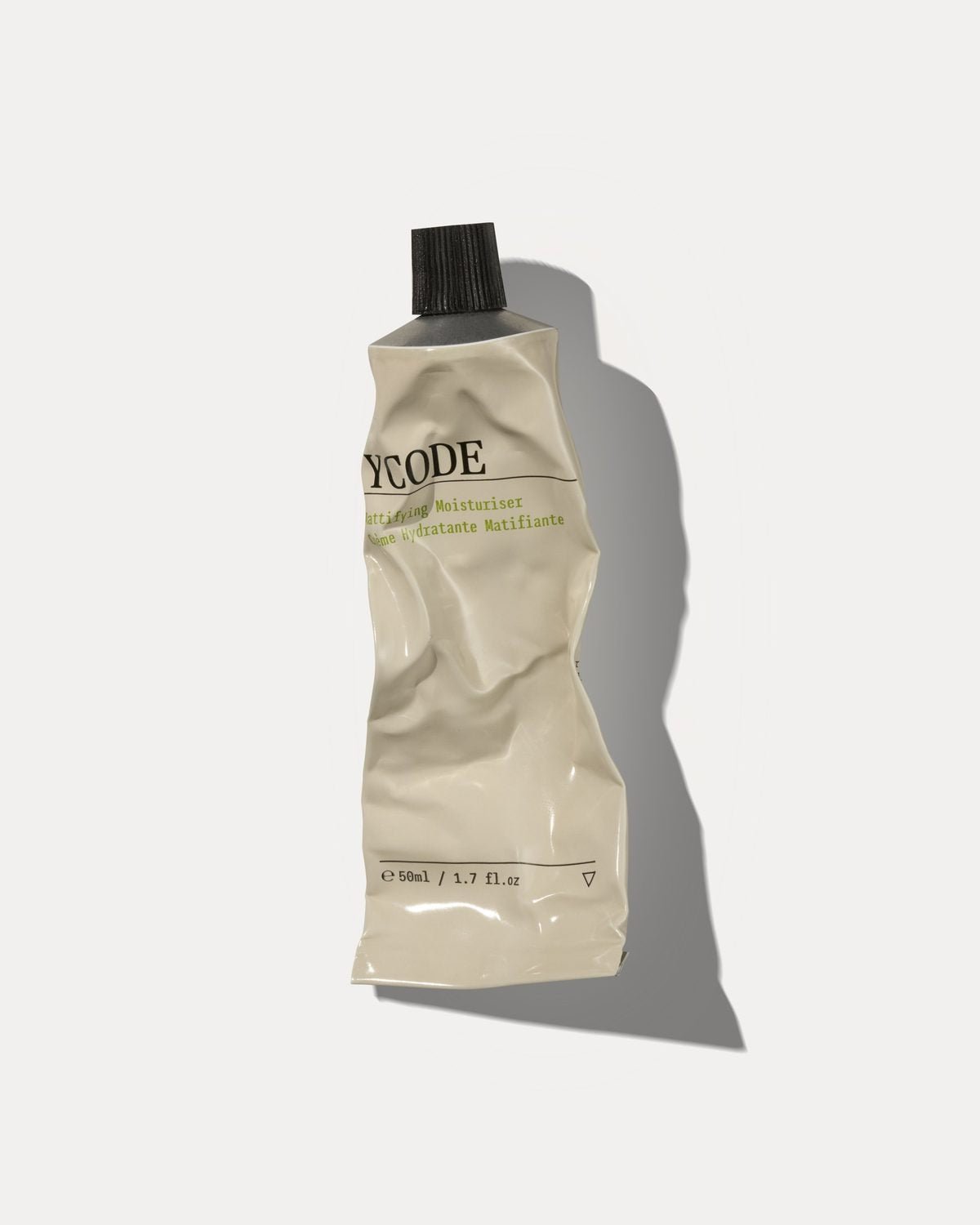
Skincare is not a course that becomes complete.
The skin barrier responds continually to washing, shaving, weather, sleep, travel, heat and age. It holds what it is given and adapts to the conditions around it. Remove regular support and the conditions begin to change again.
One month therefore marks an established result, not an ending.
What consistency is maintaining
After four weeks of Mattifying Moisturiser, the principal finished-product findings covered rehydration, reduced irritation, facial-hair comfort, a stronger-feeling barrier, improved overall skin quality and a more balanced, less shiny appearance.1
Continued use keeps recreating the conditions behind those findings. Humectants bind water at every application, emollients soften the surface, and the richer phase slows moisture escape: the three established jobs of a moisturiser, performed again each time.2 Rice starch controls newly produced surface oil, as a formulation function rather than a measured one. The Chlorella material continues on its own measured clock,3 and the prebiotic system continues supporting a surface repeatedly exposed to washing and shaving.4
Skin produces new oil and loses new water every day. Maintenance is active work rather than the absence of change.
What the recovery literature shows
The barrier is not a static wall. When the stratum corneum is disrupted experimentally, water loss rises and then falls back as the barrier rebuilds.5 In human skin, the rate of that recovery varies with the time of day at which it is measured.6 Tape stripping the stratum corneum produces measurable physical and physiological change,7 and a large study of epidermal recovery after stratum corneum removal in 29 male volunteers found the genomic response unfolding over hours and days rather than instantly.8
None of that work tested this moisturiser, and one of the foundational studies used disrupted animal skin rather than human skin.5 What it establishes is the principle. Barrier condition is a moving state that responds to what is done to it, which is why daily support is not a formality.
The long clock, and what it does not show
Palmitoyl tripeptide-5 is the longest-clock active in the formula.
Peptides are used in cosmetic formulation as signalling fragments.9 This one is associated with signalling involved in collagen production and with limiting pathways that degrade collagen; the published mechanism work behind that concept used a closely related thrombospondin-like tripeptide rather than the palmitoyl version.10 In controlled human research held by the supplier, a cream containing the peptide was used twice daily for 84 days, with changes in skin-surface relief assessed instrumentally rather than by asking anyone whether the skin looked smoother.11
Now the part that usually gets left out.
No human study shows topical peptides of this family raising collagen in living skin. The best-known human trial measured the appearance of photoaged facial skin in 93 women over 12 weeks; it did not measure collagen.12 The collagen measurements come from cultured fibroblasts in a dish.13 And there is no primary peer-reviewed clinical trial of palmitoyl tripeptide-5 itself. The 84-day work is supplier data.11
We include the peptide because a daily moisturiser is the right vehicle for an ingredient whose value would compound slowly, and because the evidence that does exist points somewhere useful. We are not going to tell you it rebuilds collagen.
How the surface is actually measured
PRIMOS projects structured light onto the skin and builds a three-dimensional map of the surface from the distortion. It measures relief rather than asking someone whether the skin seems smoother.
The underlying technique, active image triangulation using a digital micromirror device, was described in the late 1990s.14 Its reliability and validity for skin-surface topography in aged adults have since been assessed directly.15
The significance for a daily product is the timescale. Structural work of this kind is slower than taking up surface oil or binding water, which is why an 84-day assessment exists at all. Its place in a daily moisturiser lets that work continue without adding another product or another decision to the morning.
What can still improve
The first month gives the most important evidence for the finished moisturiser.1 Beyond it, continued use can still support a more consistently comfortable barrier, a more stable oil and water balance across changing conditions, a smoother-looking surface as the peptide stays on its longer clock, greater comfort around shaving and facial hair, and a routine automatic enough to survive busy mornings and travel.
The language matters here. Longer ingredient research explains why continued use remains biologically relevant. It does not convert an ingredient study into a numerical promise for the finished product.
Why interruption matters
Skin does not bank hydration or oil control permanently.
When the tube runs out, rice starch is no longer controlling newly produced oil, the humectant system is no longer being replenished, and the barrier keeps meeting washing, shaving and weather without the same daily support.
Nothing collapses overnight. The conditions simply begin drifting back towards the ones the routine had been correcting. Which is why the best time to replace a tube is before the previous one ends.
Replenishment or subscription
A one-time replacement keeps the routine going. A subscription removes the need to remember, and saves up to 15% on each delivery depending on the frequency you choose.
Pick the frequency that matches how quickly you get through a tube. The value of a subscription is not commitment for its own sake. It is continuity without another task to manage.
Where the moisturiser fits
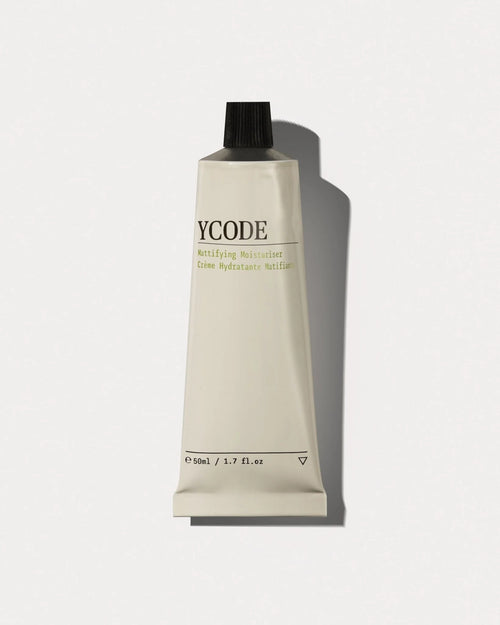
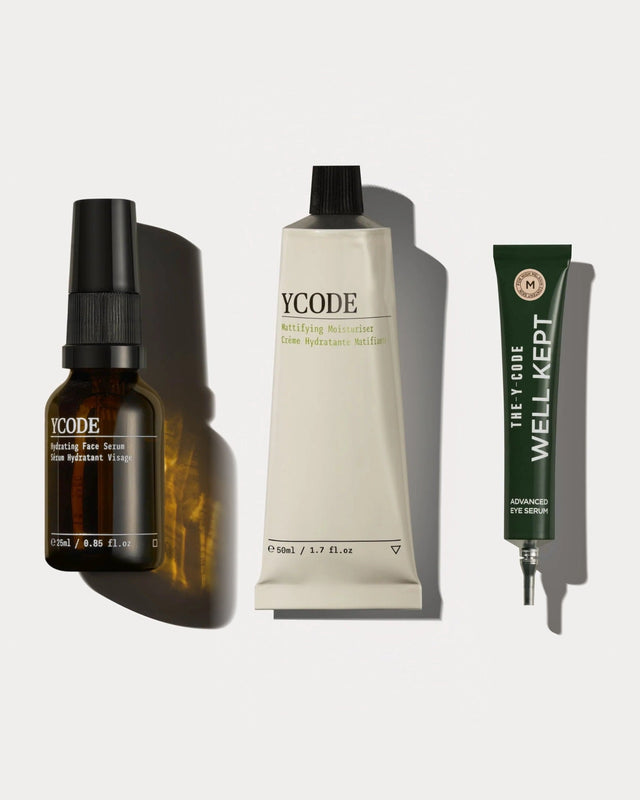
Mattifying Moisturiser is the second step of a routine that takes under two minutes, after Hydrating Face Serum and before Advanced Eye Serum. The Daily Essentials places the first two together.
To revisit the complete method, read how to apply Mattifying Moisturiser. For the finished-product findings, read what four weeks changed. For why the two-step routine is built the way it is, read why face serum and moisturiser do different jobs.
The progress line continues past this article because the skin does the same. The first application proves a moisturiser can make a difference now. Ongoing use is how that difference becomes the way your skin normally behaves.
Freddie Sheridan
Founder
Do the results disappear if I stop using the moisturiser?
What is still happening after four weeks?
Does the peptide build collagen in my skin?
Why does the peptide research run for 84 days?
Does the 84-day study prove the finished moisturiser will do the same?
How often should I subscribe?
- YCODE Mattifying Moisturiser independent consumer self-assessment, ADSL 2025-0057. Finished product, 53 men aged 18 to 50, morning and evening, assessed after first use and at four weeks. Participant self-assessment, reported as a complementary measure rather than instrumental efficacy data.
- Rajkumar J, Chandan N, Lio P, Shi V. The Skin Barrier and Moisturization: Function, Disruption, and Mechanisms of Repair. Skin Pharmacology and Physiology. 2023;36(4):174-185. Source
- Supplier dossier and efficacy portfolio for the Chlorella vulgaris material used in the formula. Double-blind split-face study against placebo, with measurements at seven, 14 and 28 days.
- Supplier technical dossier and microbiome research for the chicory-derived inulin and fructo-oligosaccharide material, including early microbial interaction modelling and a 28-day metagenomic assessment.
- Grubauer G, Elias PM, Feingold KR. Transepidermal water loss: the signal for recovery of barrier structure and function. Journal of Lipid Research. 1989;30(3):323-333. Acetone-disrupted hairless mouse skin, not human. Source
- Denda M, Tsuchiya T. Barrier recovery rate varies time-dependently in human skin. British Journal of Dermatology. 2000;142(5):881-884. Human volar forearm, tape stripping, 24-hour cycle. Source
- Bashir SJ, Chew AL, Anigbogu A, Dreher F, Maibach HI. Physical and physiological effects of stratum corneum tape stripping. Skin Research and Technology. 2001;7(1):40-48. Source
- Sextius P, Marionnet C, Bon FX, et al. Large scale study of epidermal recovery after stratum corneum removal: dynamics of genomic response. Experimental Dermatology. 2010;19:259-268. 29 male volunteers, sampled at 2, 6, 19, 30 and 72 hours. Source
- Schagen SK. Topical Peptide Treatments with Effective Anti-Aging Results. Cosmetics. 2017;4(2):16. Source
- Cauchard JH, Berton A, Godeau G, Hornebeck W, Bellon G. Activation of latent transforming growth factor beta 1 and inhibition of matrix metalloprotease activity by a thrombospondin-like tripeptide linked to elaidic acid. Biochemical Pharmacology. 2004;67(11):2013-2022. Mechanism work on an elaidic, not palmitoyl, tripeptide. Source
- Supplier technical and clinical documentation for palmitoyl tripeptide-5, including a controlled 84-day study of a cream containing the peptide with skin-surface relief assessed by PRIMOS. Supplier data; no primary peer-reviewed clinical trial of this ingredient exists.
- Robinson LR, Fitzgerald NC, Doughty DG, Dawes NC, Berge CA, Bissett DL. Topical palmitoyl pentapeptide provides improvement in photoaged human facial skin. International Journal of Cosmetic Science. 2005;27(3):155-160. 93 women, 12 weeks, split-face, placebo-controlled; wrinkle appearance, not collagen. Source
- Jones RR, Castelletto V, Connon CJ, Hamley IW. Collagen Stimulating Effect of Peptide Amphiphile C16-KTTKS on Human Fibroblasts. Molecular Pharmaceutics. 2013;10(3):1063-1069. Cultured fibroblasts; in vitro only. Source
- Jaspers S, Hopermann H, Sauermann G, Hoppe U, Lunderstadt R, Ennen J. Rapid in vivo measurement of the topography of human skin by active image triangulation using a digital micromirror device. Skin Research and Technology. 1999;volume 5. Source
- Trojahn C, Schario M, Dobos G, Blume-Peytavi U, Kottner J. Reliability and validity of two in vivo measurements for skin surface topography in aged adults. Skin Research and Technology. 2015;21(1):54-60. Validation of PRIMOS and SELS. Source

I started YCODE because most skincare was never designed for men’s skin. What I write here is what the formulators taught me, and what the trials actually found.
Continue reading
VIEW ALL →
Stress and poor sleep have a way of becoming visible. The eyes look heavier....

Your skin can notice the change of season before you reach for a coat....
Three formulas focus on the major concerns men tend to see across the face...












































































