

How to apply Mattifying Moisturiser, and why coverage changes the result
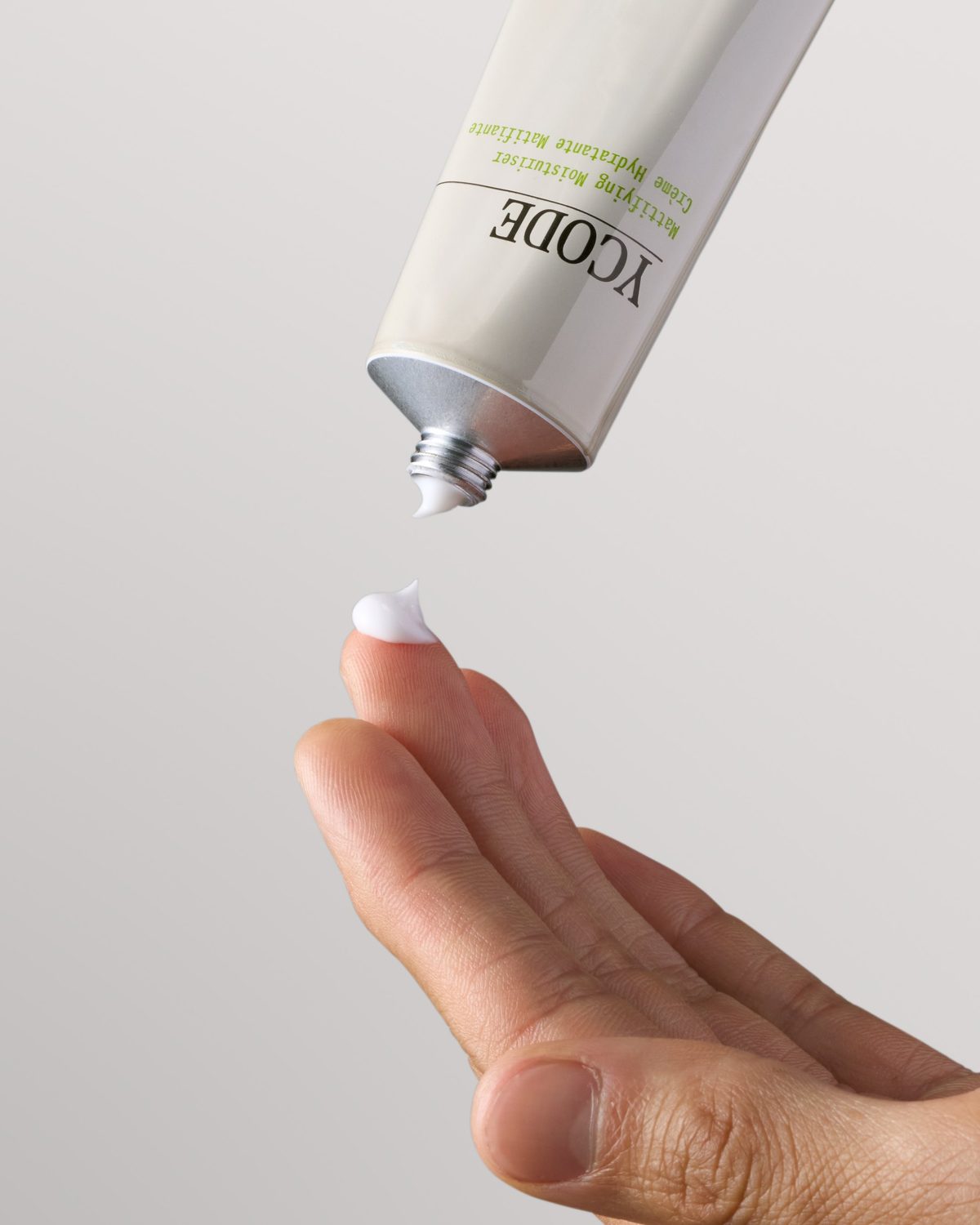
Start with a pea-sized amount, then cover the whole face and neck. The dose, the order and the last few centimetres at the hairline decide whether the formula can do the job it was built to do.
Most men under-apply moisturiser. They cover the centre of the face, stop short of the hairline, miss the neck and leave the skin beneath facial hair largely untouched.
The result is uneven coverage. The forehead may be controlled while the temples become shiny. The cheeks feel comfortable while the jaw remains tight. A good formula cannot support skin it never reaches.
The complete method takes around ten seconds.
Start with a pea-sized amount
Put a pea-sized amount onto your fingertips. This is a starting point, not a ration.
Warm it lightly between the fingertips, then spread it across the forehead, cheeks, nose, jaw and neck. If the layer becomes too thin before every area is covered, add a little more. Complete, even coverage matters more than forcing one amount to stretch.
A moisturiser acts on the surface it is spread across. It adds water to the outer skin, slows the rate at which water escapes and supports the repair processes of the barrier itself.1 None of that happens on skin the product never touched.
Using too much at once creates an unnecessarily heavy film. Using too little leaves gaps. Beginning with a small amount and adding only what is needed gives you control over both.
Take it all the way to the hairline
The face does not end two centimetres before the hair begins.
Work the moisturiser right up to the hairline and slightly into it. Cover the temples and the skin in front of the ears. Bring it beneath the jaw and down the neck.
The same applies to facial hair. Work the fingertips through stubble and into the skin beneath a beard rather than polishing cream across the hair above it.
In the independent four-week trial of the finished product, 53 men used Mattifying Moisturiser morning and evening. Asked about the facial-hair area afterwards, 81% said it felt soothed and that follicles felt less irritated.2 That area has to receive the formula before it can benefit from it.
Those are the men's own assessments rather than instrument readings, which is why they sit beside the published evidence below rather than in place of it.2
Use the products in the right order
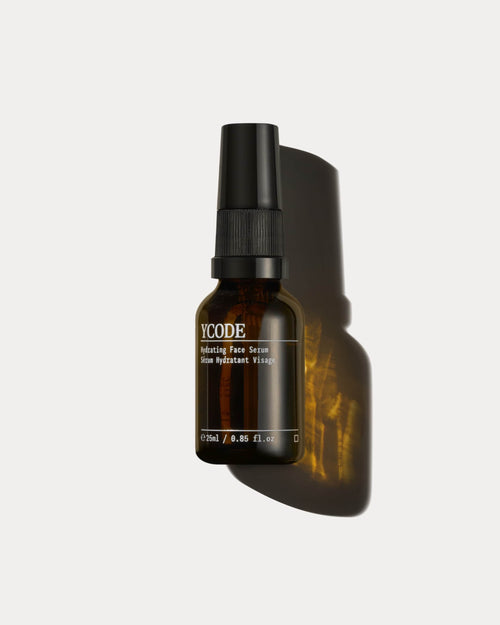
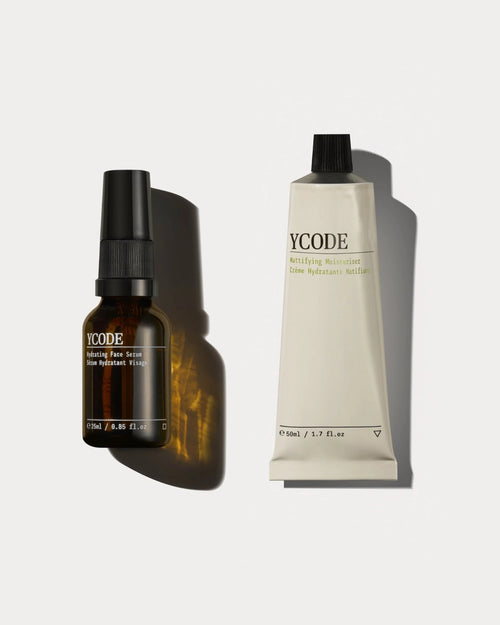
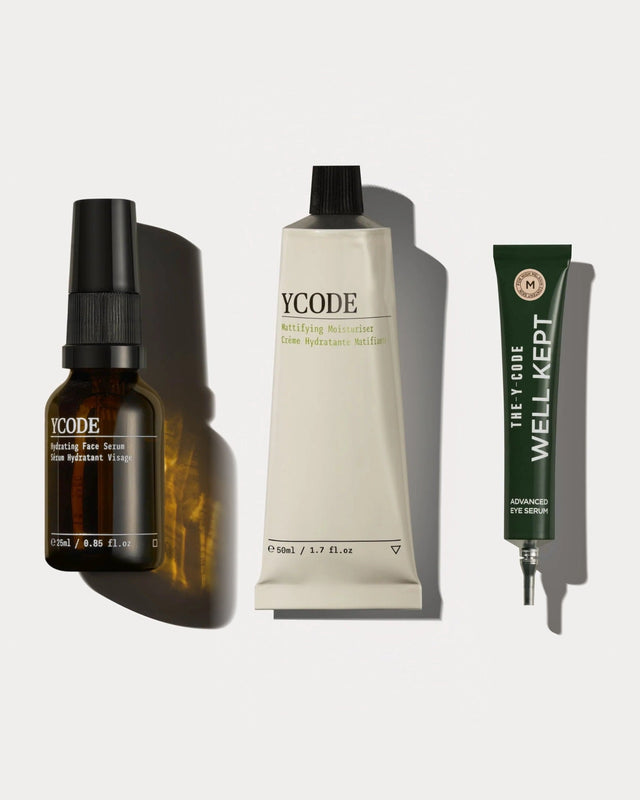
The YCODE order is Hydrating Face Serum on clean skin, Mattifying Moisturiser once the serum has absorbed, then Advanced Eye Serum around the entire eye area.
The face serum is the lighter delivery step. Moisturising products are conventionally grouped by how much of the oil and wax phase they carry, and by whether their job is to bind water, soften the surface or slow water escaping through it.3 The richer of two products is the one built to remain at the surface, so it goes second. The eye serum then targets the specialised skin around the eyes.
There is no controlled trial comparing one application order against another. This is a structural argument rather than a clinical one, and we would rather say so than dress it up.
Why a thin, even layer works
A moisturiser is an emulsion: water and oil held together with ingredients that allow the formula to spread and form a stable layer.
Within that layer the work divides into three established jobs. Humectants bind water in the outer skin. Emollients settle into the spaces between surface cells and improve softness and flexibility. Occlusive components slow the escape of water through the barrier.4 A randomised, double-blind crossover study in healthy volunteers with dry skin measured a humectant and an occlusive working together in a single emollient cream.5
Rice starch sits at the surface and takes up excess oil. That is a formulation function of the material rather than a biological process, which is why the finish changes as soon as the layer is in place.
None of those jobs requires aggressive rubbing. Friction is itself a recognised cause of skin problems and can aggravate ones already present.67 Standard dermatological advice is to massage a moisturiser in gently rather than scrub it in.8
Use the fingertips to smooth the product in a few light passes. Once the layer is even, stop. The formula was designed to absorb quickly and leave the skin matte, comfortable and free from a greasy film.
Morning and night
Morning use gives the surface the control and comfort it needs through the day. Evening use supports skin after washing, shaving, weather and everything else it has encountered.
The barrier is not a tank that fills once. It responds continually to the conditions it is given and to the material it is given to work with,1 which is why a moisturiser used twice a day behaves differently from one used whenever the face happens to feel tight.
The useful routine is not the most elaborate one. It is the one applied completely and repeated without thought.
A note on the tube
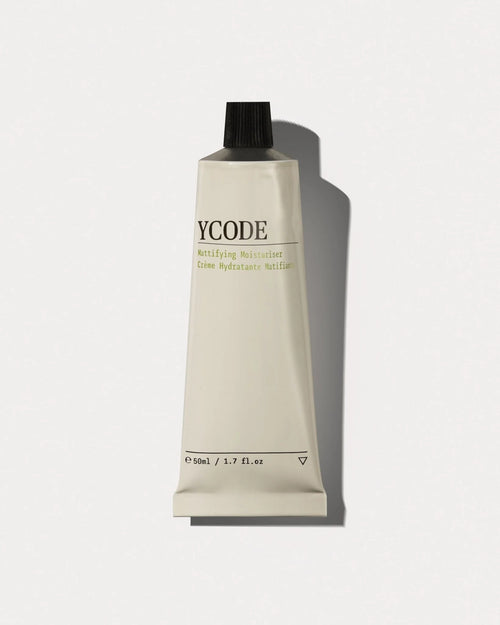
The moisturiser comes in an aluminium tube with a lid made from post-consumer recycled plastic. Aluminium protects the formula and gives the pack its substantial feel. The lid gives already-used plastic another useful life.
Both materials were also chosen for what they do not add. Neither the tube nor the lid carries much bulk beyond the formula itself, so the pack takes up very little room. That is a responsible choice and a practical one: it travels in a washbag without claiming the space a rigid jar or a pump bottle would.
The packaging is considered, but deliberately uncomplicated. Unscrew the lid, use the amount the skin needs and close it again.
What happens next
The first application should leave the face hydrated, smooth and matte. At one week, the Chlorella material in the formula reaches its first human measurement. At 15 days, oil and redness have their first deeper checkpoint. At four weeks, the finished moisturiser has a full set of results from the 53 men who used it.2
The best formula still depends on the hand applying it. Ten seconds, complete coverage, morning and night. That is the entire method.
Where the moisturiser fits
Mattifying Moisturiser is the second step of a routine that takes under two minutes. Hydrating Face Serum goes before it and Advanced Eye Serum after it.
For the next stage, read what a mattifying moisturiser does from the first use. For the design logic behind the formula, read why men's skin needs a moisturiser built differently, then inside Mattifying Moisturiser for the ingredient story.
I have watched men apply this well and apply it badly, and the difference is never the formula. Ten seconds, right to the hairline, and the tube will do the rest.
Freddie Sheridan
Founder
How much Mattifying Moisturiser should I use?
Should moisturiser go into the hairline?
Can I apply it over stubble or a beard?
Should I rub it in until it disappears?
Which YCODE product goes first?
How often should I use it?
- Rajkumar J, Chandan N, Lio P, Shi V. The Skin Barrier and Moisturization: Function, Disruption, and Mechanisms of Repair. Skin Pharmacology and Physiology. 2023;36(4):174-185. Source
- YCODE Mattifying Moisturiser independent consumer self-assessment, ADSL 2025-0057. Finished product, 53 men aged 18 to 50, morning and evening for four weeks. Participant self-assessment, reported here as a complementary measure rather than instrumental efficacy data.
- Sethi A, Kaur T, Malhotra SK, Gambhir ML. Moisturizers: The Slippery Road. Indian Journal of Dermatology. 2016;61(3):279-287. Source
- Purnamawati S, Indrastuti N, Danarti R, Saefudin T. The Role of Moisturizers in Addressing Various Kinds of Dermatitis: A Review. Clinical Medicine & Research. 2017;15(3-4):75-87. Source
- Vaillant L, Georgescou G, Rivollier C, Delarue A. Combined effects of glycerol and petrolatum in an emollient cream: A randomized, double-blind, crossover study in healthy volunteers with dry skin. Journal of Cosmetic Dermatology. 2020;19(6):1399-1403. Source
- Arora G, Khandpur S, Bansal A, et al. Current understanding of frictional dermatoses: A review. Indian Journal of Dermatology, Venereology and Leprology. 2023;89(2):170-188. Source
- Hsieh CY, Tsai TF. Friction-Induced Skin Disorders: A Review. Dermatitis. 2023;34(4):278-286. Source
- American Academy of Dermatology Association. Dermatologists' top tips for relieving dry skin. Source

I started YCODE because most skincare was never designed for men’s skin. What I write here is what the formulators taught me, and what the trials actually found.
Continue reading
VIEW ALL →
Stress and poor sleep have a way of becoming visible. The eyes look heavier....

Your skin can notice the change of season before you reach for a coat....
Three formulas focus on the major concerns men tend to see across the face...












































































