

Why men's skin needs a moisturiser built differently
Male skin is thicker, oilier, more densely structured and repeatedly disrupted by shaving. Each of those differences creates a formulation requirement, not a reason to change the colour of the packaging.

Men and women share the same basic skin anatomy. They do not begin from exactly the same condition.
Male facial skin is measurably thicker, produces more sebum, carries a denser collagen structure and sits at a lower surface pH. Facial hair changes how a product spreads. Shaving repeatedly removes hair and surface material from the same area of the face.
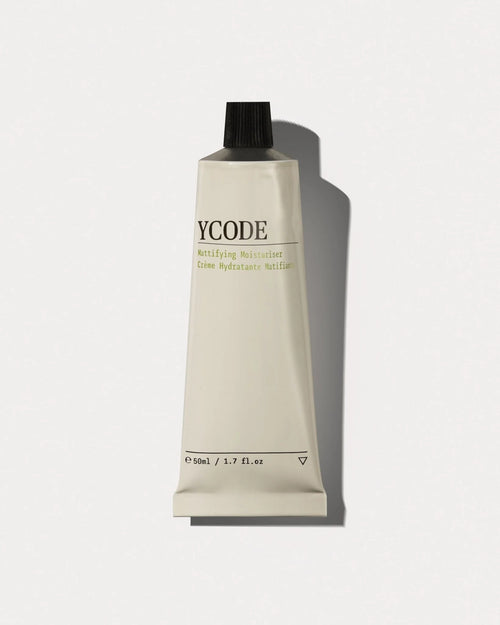
Those differences do not require a separate scientific universe. They do require different priorities. Mattifying Moisturiser was built around those priorities from the beginning.
More oil does not mean more water
Sebum is oil produced by the sebaceous glands. Hydration is water held in the outer skin. They are related, but they are not interchangeable.
They are also read by different instruments and vary independently by body site, age and sex.1 Sebum content, stratum corneum hydration, water loss and surface pH have been compared directly between the sexes in an in vivo study of 300 people2 and in a population study of 713,3 and the review literature summarises male skin as the oilier and more acidic of the two.4
So a man can produce visible shine across the forehead and nose while the cheeks feel tight and the barrier loses water. Treating every sign of oil with aggressive cleansing or drying alcohol can make that imbalance worse.
This is why the moisturiser does two jobs. Rice starch controls excess surface oil, which is a formulation function of the material with no biological claim attached to it. Humectants and emollients support water, comfort and barrier function beneath it.
The intended result is balance rather than subtraction.
Thicker skin changes the design brief
High-frequency ultrasound of healthy adults found the male dermis significantly thicker at nearly every facial site measured.5 Review literature places the average difference at roughly 20 to 25%,4 and broader biophysical surveys record further variation by age, gender and body region.6 Skin thickness, skin collagen and density in relation to age and sex have been a subject of study since the 1970s.7
Greater average thickness and density affect how male skin feels and how it ages. Men often tolerate substantial textures poorly, not because the skin needs less support, but because a heavy surface film sits visibly on top of skin that is already producing more oil.
The formula therefore needs enough substance to support the barrier and enough elegance to disappear quickly.
That is why the texture of Mattifying Moisturiser is dense in the hand but fast once spread. It should feel like a meaningful formula going on and leave very little evidence that anything was applied.
Shaving is repeated barrier stress
A razor does not remove only hair. It also creates friction and disturbs the outermost surface.
That has been modelled directly. A laboratory study of shaving found that a single pass with a dry razor raised transepidermal water loss, and that the effect was attenuated when a shaving preparation or a post-shave moisturiser was used.8 Review work on shaving and skin reaches the same practical conclusion.9 Repeated over the jaw, neck and upper lip, that disruption can leave the facial-hair area tight, reactive or uncomfortable.
The moisturiser combines emollients, humectants, prebiotics and Chlorella vulgaris to support that environment without adding a greasy film around the follicles.
After four weeks of twice-daily use, the 53 men in the independent finished-product trial reported:10
Those are the men's own assessments of their own faces, and we present them as exactly that: a complementary measure that sits beside the published work rather than replacing it.
Collagen density is not permanent protection
Men begin with a denser collagen structure, but collagen still changes with age and environmental exposure.4
The formula includes palmitoyl tripeptide-5 as its longest-clock active. The peptide is associated with signalling involved in collagen production and with limiting collagen-degrading pathways. The published mechanism work behind that idea was done on a closely related thrombospondin-like tripeptide rather than on this one.11 The controlled human research on the material itself ran twice daily for 84 days and measured skin-surface relief.12
It is worth being exact about what that does and does not show. The best-known human trial in this peptide family, 93 women over 12 weeks against placebo, measured the appearance of photoaged facial skin.13 No human study we are aware of measures collagen rising in living skin after topical application.
The peptide is therefore not there to create an overnight tightening story. It is there because a daily product is the right place for slow, cumulative structural support on the evidence that actually exists.
A lower pH and a living surface
The skin surface is a chemical and microbial environment, not an inert sheet.
Its pH influences barrier enzymes and the balance of microorganisms living there, and men begin from a different average surface pH.23 They then expose that surface to shaving, sweat, washing and environmental change.
Inulin and fructose provide prebiotic support. The published field is younger than the marketing around it: a recent review of prebiotic oligosaccharides in skin found the evidence base still largely laboratory-based,14 and the microbiome research on this particular material is held by its supplier.15 Chlorella vulgaris contributes hydration, oil-balance and redness data on its own measured timeline, from a double-blind split-face study.16
Together they reflect a larger principle: work with the biology already present rather than forcing the surface into temporary submission.
What formulated for men should mean
It should mean more than fragrance, colour or the word men on the tube.
It should mean the oil-control system was chosen for higher sebum. The hydration system was built to avoid visible weight. The facial-hair area was considered from the start. The finish suits a man who does not want to look as though he is wearing skincare. The routine is short enough to survive an ordinary morning.
That is the standard the formula was designed to meet. Men's skin was the beginning of the formulation brief, not the final line added to it. That distinction is the product.
Where the moisturiser fits
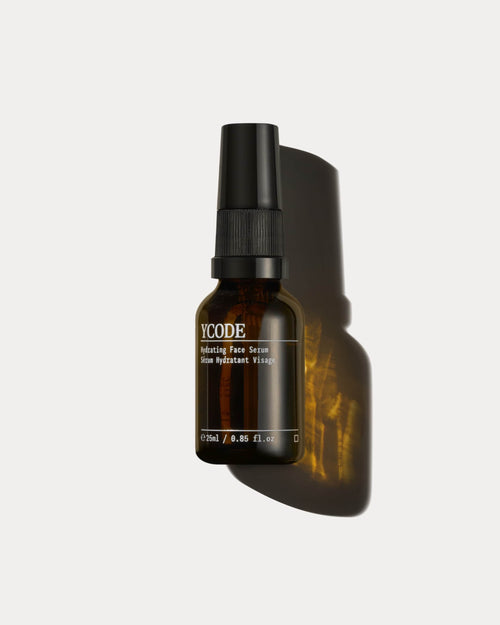
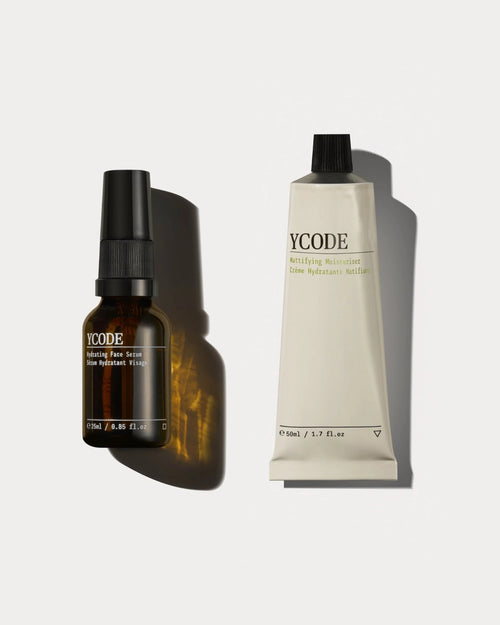
Mattifying Moisturiser is the second step of a routine that takes under two minutes, after Hydrating Face Serum and before Advanced Eye Serum.
For the method, read how to apply Mattifying Moisturiser. For what happens on day one, read what a mattifying moisturiser does from the first use. For the ingredient and provenance story, continue to inside Mattifying Moisturiser.
I did not want to make a women's moisturiser with a grey tube on it. Everything here started from a face that shaves, produces more oil and has about ninety seconds to spare.
Freddie Sheridan
Founder
Is men's skin really thicker than women's skin?
Does oily male skin still need moisturiser?
Why include a mattifying ingredient instead of removing oil?
Is the moisturiser suitable around facial hair?
Does the peptide raise collagen in the skin?
Was all the research behind this done on men?
Does shaving actually damage the skin barrier?
- Mehta HH, Nikam VV, Jaiswal CR, Mehta HB. A cross-sectional study of variations in the biophysical parameters of skin among healthy volunteers. Indian Journal of Dermatology, Venereology and Leprology. 2018;84(5):521. n=500. Source
- Luebberding S, Krueger N, Kerscher M. Skin physiology in men and women: in vivo evaluation of 300 people including TEWL, SC hydration, sebum content and skin surface pH. International Journal of Cosmetic Science. 2013;35(5):477-483. Source
- Man MQ, Xin SJ, Song SP, et al. Variation of skin surface pH, sebum content and stratum corneum hydration with age and gender in a large Chinese population. Skin Pharmacology and Physiology. 2009;22(4):190-199. Source
- Rahrovan S, Fanian F, Mehryan P, Humbert P, Firooz A. Male versus female skin: What dermatologists and cosmeticians should know. International Journal of Women's Dermatology. 2018;4(3):122-130. Source
- Meng Y, Feng L, Shan J, Yuan Z, Jin L. Application of high-frequency ultrasound to assess facial skin thickness in association with gender, age, and BMI in healthy adults. BMC Medical Imaging. 2022;22:113. Source
- Firooz A, Sadr B, Babakoohi S, et al. Variation of biophysical parameters of the skin with age, gender, and body region. The Scientific World Journal. 2012;2012:386936. Source
- Shuster S, Black MM, McVitie E. The influence of age and sex on skin thickness, skin collagen and density. British Journal of Dermatology. 1975;93(6):639-643. Cited here for the existence of the enquiry; we have not been able to read the full text, so no figure is attributed to it. Source
- Costello L, Goncalves K, Maltman V, et al. Development of a novel in vitro strategy to understand the impact of shaving on skin health. Frontiers in Medicine. 2023;10:1236790. Source
- Cowley K, Vanoosthuyze K. Insights into shaving and its impact on skin. British Journal of Dermatology. 2012;166(Suppl 1):6-12. Review; authors affiliated with a razor manufacturer. Source
- YCODE Mattifying Moisturiser independent consumer self-assessment, ADSL 2025-0057. Finished product, 53 men aged 18 to 50, morning and evening, assessed after first use and at four weeks. Participant self-assessment, reported as a complementary measure rather than instrumental efficacy data.
- Cauchard JH, Berton A, Godeau G, Hornebeck W, Bellon G. Activation of latent transforming growth factor beta 1 and inhibition of matrix metalloprotease activity by a thrombospondin-like tripeptide linked to elaidic acid. Biochemical Pharmacology. 2004;67(11):2013-2022. Mechanism work on an elaidic, not palmitoyl, tripeptide. Source
- Supplier technical and clinical documentation for palmitoyl tripeptide-5, including a controlled 84-day study of a cream containing the peptide with skin-surface relief assessed by PRIMOS.
- Robinson LR, Fitzgerald NC, Doughty DG, Dawes NC, Berge CA, Bissett DL. Topical palmitoyl pentapeptide provides improvement in photoaged human facial skin. International Journal of Cosmetic Science. 2005;27(3):155-160. 93 women, 12 weeks, split-face, placebo-controlled; wrinkle appearance, not collagen. Source
- Zeng M, Li Y, Cheng J, Wang J, Liu Q. Prebiotic Oligosaccharides in Skin Health: Benefits, Mechanisms, and Cosmetic Applications. Antioxidants. 2025;14(6):754. Evidence base largely in vitro. Source
- Supplier technical dossier and microbiome research for the chicory-derived inulin and fructo-oligosaccharide material.
- Supplier dossier and efficacy portfolio for the Chlorella vulgaris material used in the formula. Double-blind split-face assessments at seven, 14 and 28 days.

I started YCODE because most skincare was never designed for men’s skin. What I write here is what the formulators taught me, and what the trials actually found.
Continue reading
VIEW ALL →
Stress and poor sleep have a way of becoming visible. The eyes look heavier....
Your skin can notice the change of season before you reach for a coat....
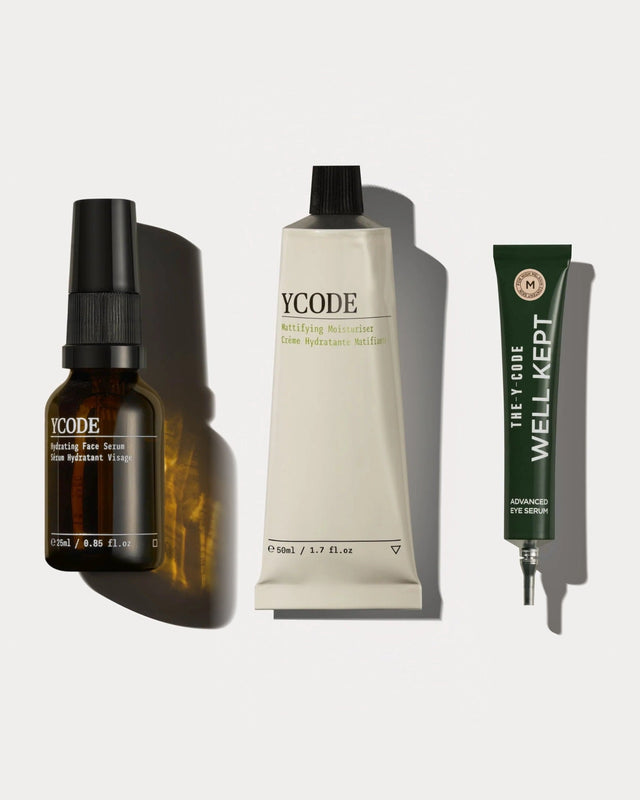
Three formulas focus on the major concerns men tend to see across the face...












































































